
We read your photo as:
Hersiening: Wat ken jy nou? A Kies die korrekte voornaamwoord tussen hakies. B Skryf die sinne in die direkte rede. C Verbeter die taalfoute (redigering). D Sê of die woord in vet druk letterlik of figuurlik gebruik word.
ScanSolve AI Answer
The image shows a set of Afrikaans grammar exercises. I will help you with section D, which asks whether the bolded word is used literally or figuratively.
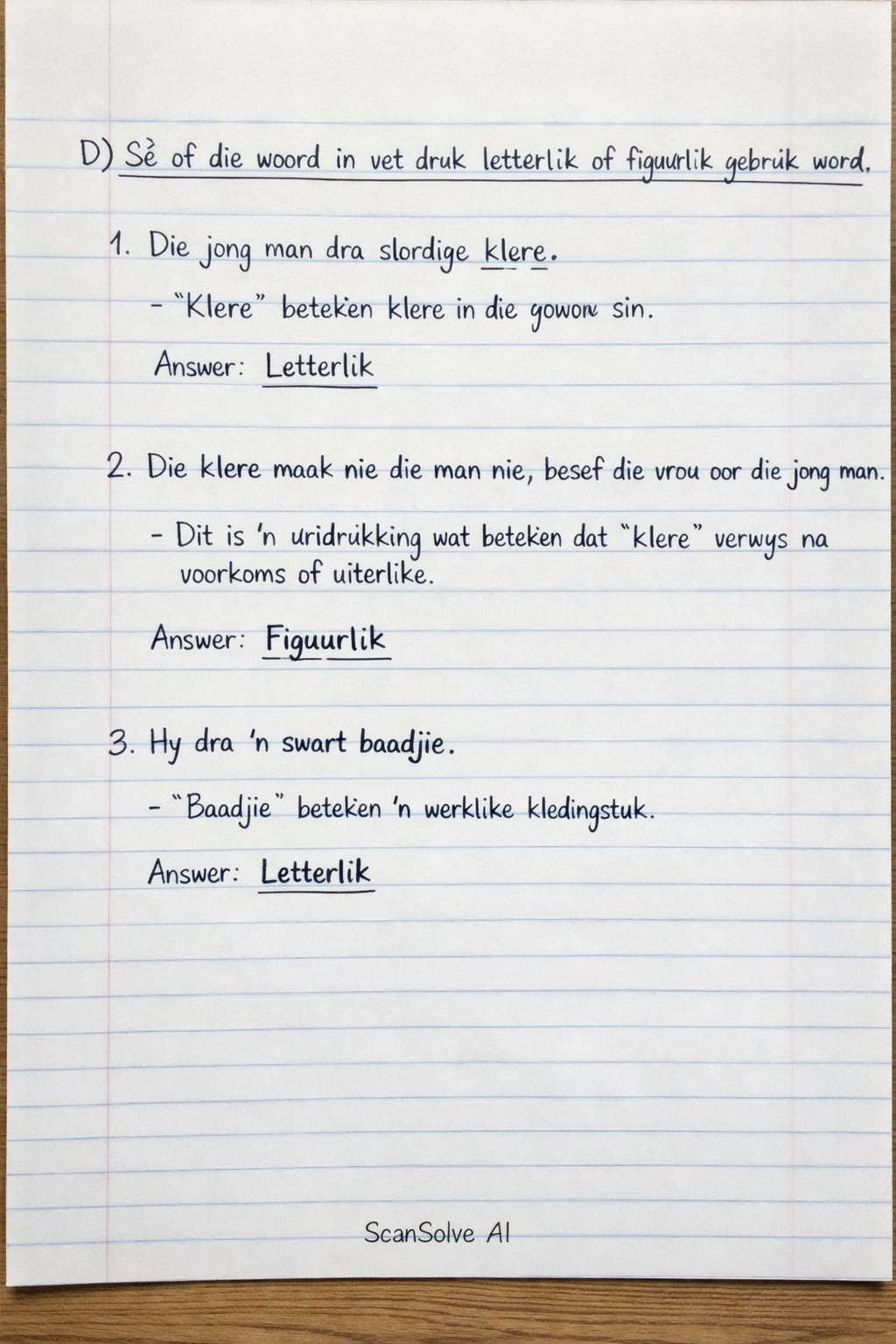
D) Sê of die woord in vet druk letterlik of figuurlik gebruik word.
(Say whether the bolded word is used literally or figuratively.)
-
Die jong man dra slordige klere. (The young man wears untidy clothes.) The word "klere" (clothes) is used in its direct, everyday sense.
Answer: Letterlik (Literally)
-
Die klere maak nie die man nie, besef die vrou oor die jong man. (The clothes don't make the man, the woman realizes about the young man.) This is an idiom, meaning that a person's character or worth is not determined by their outward appearance or attire. The word "klere" here represents appearance in a broader, symbolic sense.
Answer: Figuurlik (Figuratively)
-
Hy dra 'n swart baadjie. (He wears a black jacket.) The word "baadjie" (jacket) refers to an actual piece of clothing.
Answer: Letterlik (Literally)
-
Jy moet hom nie op sy baadjie takseer nie. (Jy moenie iemand oordeel volgens die klere wat hy dra nie.) (You shouldn't judge him by his jacket. (You shouldn't judge someone by the clothes they wear.)) This is an idiom, similar to "don't judge a book by its cover." The "baadjie" here represents outward appearance or superficial qualities, not literally a jacket.
Answer: Figuurlik (Figuratively)
Still stuck on this one?
Ask a follow-up, and the answer starts from this question.
More English Questions
Handwritten Step-by-Step Solution
Get this as a handwritten image on WhatsApp — like a tutor wrote it for you.
Try on WhatsApp