

This English question involves literary analysis, grammar, or writing skills. The detailed response below provides a well-structured answer with supporting evidence and clear explanations.
ScanSolve AI Answer
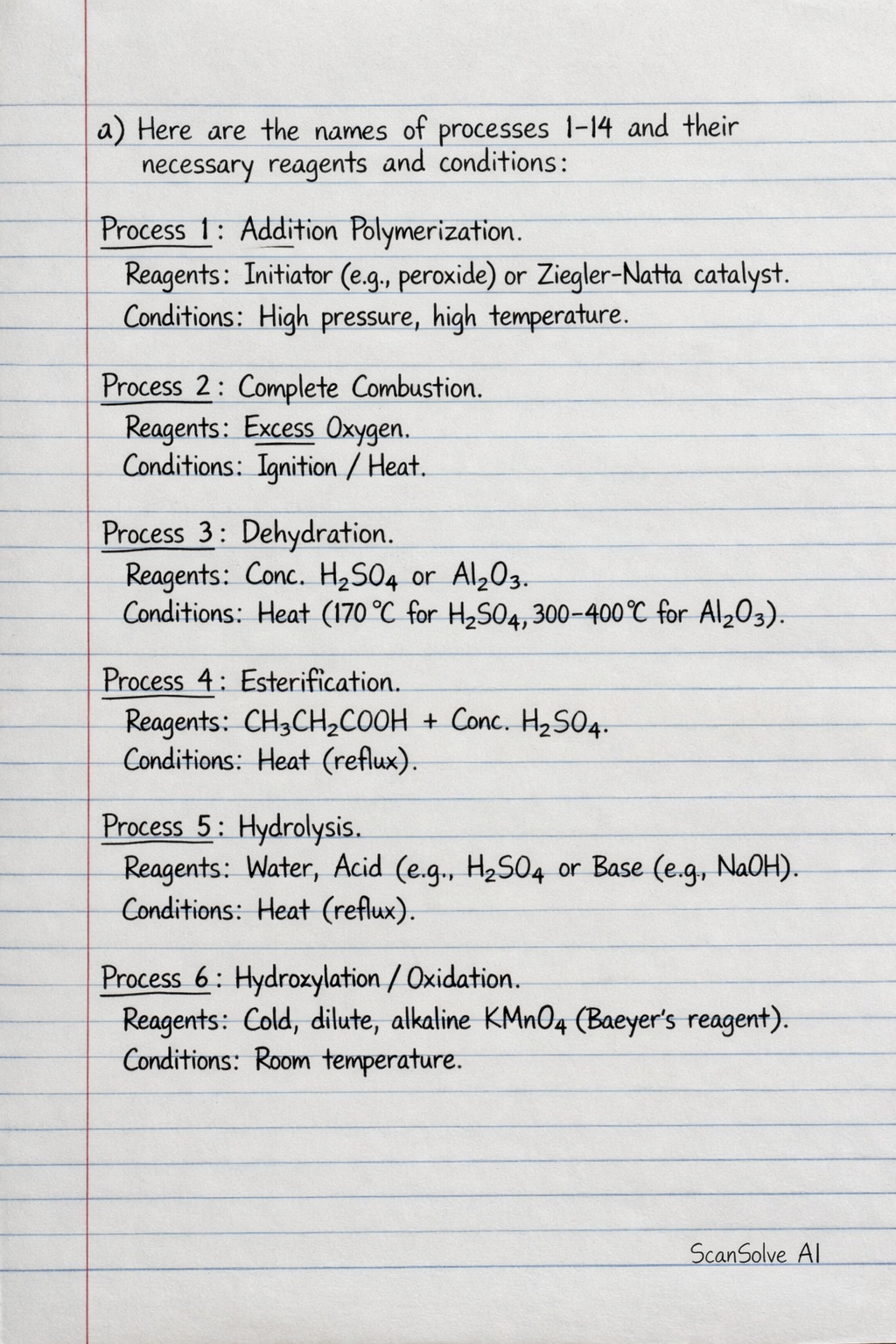
here are the chemistry answers in English: a) Here are the names of processes 1-14 and their necessary reagents and conditions: • Process 1: Addition Polymerization. Reagents: Initiator (e.g., peroxide) or Ziegler-Natta catalyst. Conditions: High pressure, high temperature. • Process 2: Complete Combustion. Reagents: Excess Oxygen. Conditions: Ignition/Heat. • Process 3: Dehydration. Reagents: Concentrated sulfuric acid (H_2SO_4) or aluminum oxide (Al_2O_3). Conditions: Heat (e.g., 170^ C for H_2SO_4, 300-400^ C for Al_2O_3). • Process 4: Esterification. Reagents: Propanoic acid (CH_3CH_2COOH), concentrated sulfuric acid (H_2SO_4) as catalyst. Conditions: Heat (reflux). • Process 5: Hydrolysis. Reagents: Water, acid (e.g., H_2SO_4) or base (e.g., NaOH). Conditions: Heat (reflux). • Process 6: Hydroxylation/Oxidation. Reagents: Cold, dilute, alkaline potassium permanganate(VII) (KMnO_4) (Baeyer's reagent). Conditions: Room temperature. • Process 7: Condensation Polymerization. Reagents: Terephthalic acid (benzene-1,4-dicarboxylic acid). Conditions: Heat, catalyst. (Assuming it refers to Terylene formation from Ethan-1,2-diol). • Process 8: Fractional Distillation. Reagents: None. Conditions: Heating. • Process 9: Hydrogenation. Reagents: Hydrogen gas (H_2). Conditions: Nickel or Platinum catalyst, heat. • Process 10: Fermentation. Reagents: Yeast. Conditions: Anaerobic, 37^ C. (Assuming Glucose to Ethanol, despite arrow direction). • Process 11: Condensation. Reagents: Fructose. Conditions: Enzyme. (Assuming Glucose to Sucrose). • Process 12: Condensation Polymerization. Reagents: Terephthalic acid (benzene-1,4-dicarboxylic acid). Conditions: Heat, catalyst. • Process 13: Biochemical Conversion/Reduction. Reagents: Microorganisms, reducing agents. Conditions: Specific fermentation conditions. • Process 14: Condensation Polymerization. Reagents: Hexamethylenediamine (hexane-1,6-diamine). Conditions: Heat, high pressure. b) Here are the formulae of the specified substances: • E: C_2H_4 (Ethene) • F: C_2H_2 (Ethyne) • G: CO_2 (Carbon dioxide) • H: H_2O (Water) • M: CH_3CH_2ONa (Sodium ethoxide) • N: CH_3COONa (Sodium ethanoate) • P: CH_4 (Methane) • R: H_2 (Hydrogen) • S: CO (Carbon monoxide) • Q: CH_3CH_2COOH (Propanoic acid) • X: CH_3CH_2OH (Ethanol) c) Here are the types of reactions I-VIII and their necessary reagents and conditions: • Reaction I: Addition Polymerization. Reagents: Initiator (e.g., peroxide) or Ziegler-Natta catalyst. Conditions: High pressure, high temperature. • Reaction II: Hydration. Reagents: Steam (H_2O(g)), concentrated phosphoric acid (H_3PO_4) as catalyst. Conditions: High temperature (e.g., 300^ C), high pressure (e.g., 60-70 atm). • Reaction III: Oxidation. Reagents: Acidified potassium dichromate(VI) (K_2Cr_2O_7/H^+) or acidified potassium permanganate(VII) (KMnO_4/H^+). Conditions: Heat (reflux). • Reaction IV: Free Radical Substitution (Halogenation). Reagents: Bromine (Br_2). Conditions: UV light (excess Br_2 for hexabromoethane). • Reaction V: Addition (Halogenation). Reagents: Bromine (Br_2). Conditions: Room temperature, in an inert solvent (e.g., CCl_4) or aqueous. • Reaction VI: Addition (Hydrohalogenation). Reagents: Hydrogen bromide (HBr). Conditions: Room temperature. • Reaction VII: Decarboxylation. Reagents: Soda lime (NaOH + CaO). Conditions: Heat. • Reaction VIII: Neutralization. Reagents: Sodium hydroxide (NaOH). Conditions: Room temperature. d) Here are the differences: i) Reaction IV (Ethane to C_2Br_6) and Reaction V (Ethene to C_2H_4Br_2) • Reaction IV: This is a free radical substitution reaction involving an alkane (ethane). It requires UV light and replaces hydrogen atoms with bromine atoms. • Reaction V: This is an electrophilic addition reaction involving an alkene (ethene). It occurs at room temperature and adds bromine atoms across the double bond. ii) Reaction VIII (Ethanoic acid + NaOH) and Process 4 (Ethanol + Propanoic acid) • Reaction VIII: This is a neutralization reaction between a carboxylic acid and a base, producing a salt and water. • Process 4: This is an esterification reaction between an alcohol and a carboxylic acid, producing an ester and water. e) Here are the equations for the specified reactions and processes: • Reaction I: nCH_2=CH_2 High P, T, initiator -(CH_2-CH_2)_n- • Reaction II: CH_2=CH_2(g) + H_2O(g) Conc. H_3PO_4, High T, P CH_3CH_2OH(g) • Reaction III: CH_3CH_2OH(aq) + 2[O] K_2Cr_2O_7/H^+, Heat CH_3COOH(aq) + H_2O(l) • Reaction IV: CH_3CH_3(g) + 6Br_2(g) UV light C_2Br_6(s) + 6HBr(g) • Reaction V: CH_2=CH_2(g) + Br_2(aq) Room temp CH_2Br-CH_2Br(aq) • Reaction VI: CH_2=CH_2(g) + HBr(g) Room temp CH_3CH_2Br(g) • Reaction VII: CH_3COOH(s) + NaOH(s) CaO, Heat CH_4(g) + Na_2CO_3(s) • Reaction VIII: CH_3COOH(aq) + NaOH(aq) Room temp CH_3COONa(aq) + H_2O(l) • Process 4: CH_3CH_2OH(l) + CH_3CH_2COOH(l) Conc. H_2SO_4, Heat CH_3CH_2COOCH_2CH_3(l) + H_2O(l) • Process 5: CH_3CH_2COOCH_2CH_3(l) + H_2O(l) H^+ or OH^-, Heat CH_3CH_2COOH(l) + CH_3CH_2OH(l) • Process 6: CH_2=CH_2(g) + H_2O(l) + [O] Cold, dil. alk. KMnO_4 HOCH_2-CH_2OH(aq) • Process 10: C_6H_12O_6(aq) Yeast, 37^ C 2CH_3CH_2OH(aq) + 2CO_2(g) f) Here's how to differentiate the compounds: i) Methanol and pentan-1-ol • Physical Test: Boiling point. Methanol has a boiling point of 65^ C, while pentan-1-ol has a boiling point of 138^ C. • Chemical Test: Esterification with ethanoic acid. Methanol forms methyl ethanoate (fruity smell), while pentan-1-ol forms pentyl ethanoate (banana-like smell). ii) Pentane and pentan-1-ol • Physical Test: Solubility in water. Pentane is insoluble in water, whereas pentan-1-ol is sparingly soluble due to hydrogen bonding. • Chemical Test: Reaction with sodium metal. Pentan-1-ol will react with sodium to produce hydrogen gas, while pentane will not react. iii) Methanol and methanoic acid • Physical Test: Boiling point. Methanol has a boiling point of 65^ C, while methanoic acid has a boiling point of 101^ C. • Chemical Test: Reaction with sodium carbonate/bicarbonate. Methanoic acid will react with sodium carbonate to produce carbon dioxide gas (effervescence), while methanol will not. iv) Propane and hexane • Physical Test: State at room temperature. Propane is a gas at room temperature, while hexane is a liquid. • Chemical Test: Both are alkanes and are generally unreactive with common laboratory reagents. There is no simple qualitative chemical test to differentiate them. v) Ethane and ethene • Physical Test: Boiling point. Ethane has a boiling point of -89^ C, while ethene has a boiling point of -104^ C. • Chemical Test: Reaction with bromine water. Ethene (an alkene) will decolorize orange/brown bromine water, while ethane (an alkane) will not react in the dark. vi) Ethanol and ethene • Physical Test: State at room temperature. Ethanol is a liquid, while ethene is a gas. • Chemical Test: Reaction with sodium metal. Ethanol will react with sodium to produce hydrogen gas, while ethene will not react. g) Substance F (Ethyne) belongs to the Alkyne homologous series. h) The type of reaction leading to the formation of gas P (Methane) from Ethanoic acid is Decarboxylation. The equation is: CH_3COOH(s) + NaOH(s) CaO, Heat CH_4(g) + Na_2CO_3(s) i) The fourth member of the homologous series to which F (Ethyne) belongs is Pentyne. j) The molecular formula of compound -(CH_2CH_2)_n- is 3556. Step 1: Calculate the molecular weight of the repeating unit CH_2CH_2. Atomic weights: C = 12, H = 1. Molecular weight of CH_2CH_2 = (2 × 12) + (4 × 1) = 24 + 4 = 28. Step 2: Use the total molecular weight to find n. n × 28 = 3556 Step 3: Solve for n. n = (3556)/(28) n = 127 The value of n is 127. Drop the next question!