

This English question involves literary analysis, grammar, or writing skills. The detailed response below provides a well-structured answer with supporting evidence and clear explanations.
ScanSolve AI Answer
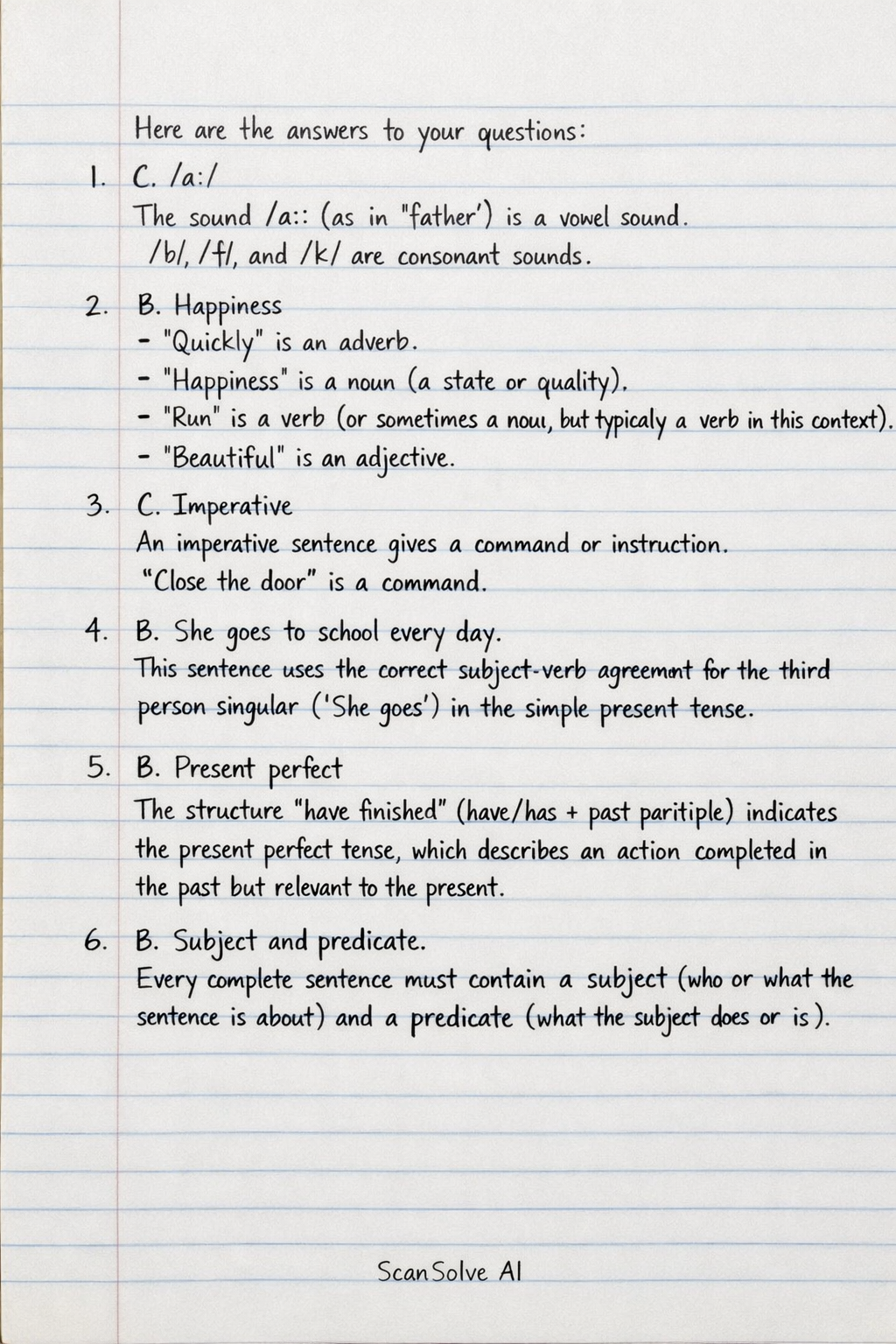
Here are the answers to your questions: 1. C. /a:/ The sound /a:/ (as in 'father') is a vowel sound. /b/, /f/, and /k/ are consonant sounds. 2. B. Happiness "Quickly" is an adverb. "Happiness" is a noun (a state or quality). "Run" is a verb (or sometimes a noun, but typically a verb in this context). "Beautiful" is an adjective. 3. C. Imperative An imperative sentence gives a command or instruction. "Close the door" is a command. 4. B. She goes to school every day. This sentence uses the correct subject-verb agreement for the third person singular ("She goes") in the simple present tense. 5. B. Present perfect The structure "have finished" (have/has + past participle) indicates the present perfect tense, which describes an action completed in the past but relevant to the present. 6. B. Subject and predicate Every complete sentence must contain a subject (who or what the sentence is about) and a predicate (what the subject does or is). 7. A. She is happy. This is a simple sentence because it contains only one independent clause. A compound sentence consists of two or more independent clauses joined by a coordinating conjunction (like 'and', 'but', 'or') or a semicolon. Therefore, option A is not an example of a compound sentence. The other options are not visible in the image. Send me the next one 📸