
We read your photo as:
Identify the type of noun, circle the correct modal verb, and complete the sentences with appropriate pronouns.
ScanSolve AI Answer
here are the solutions to your questions.
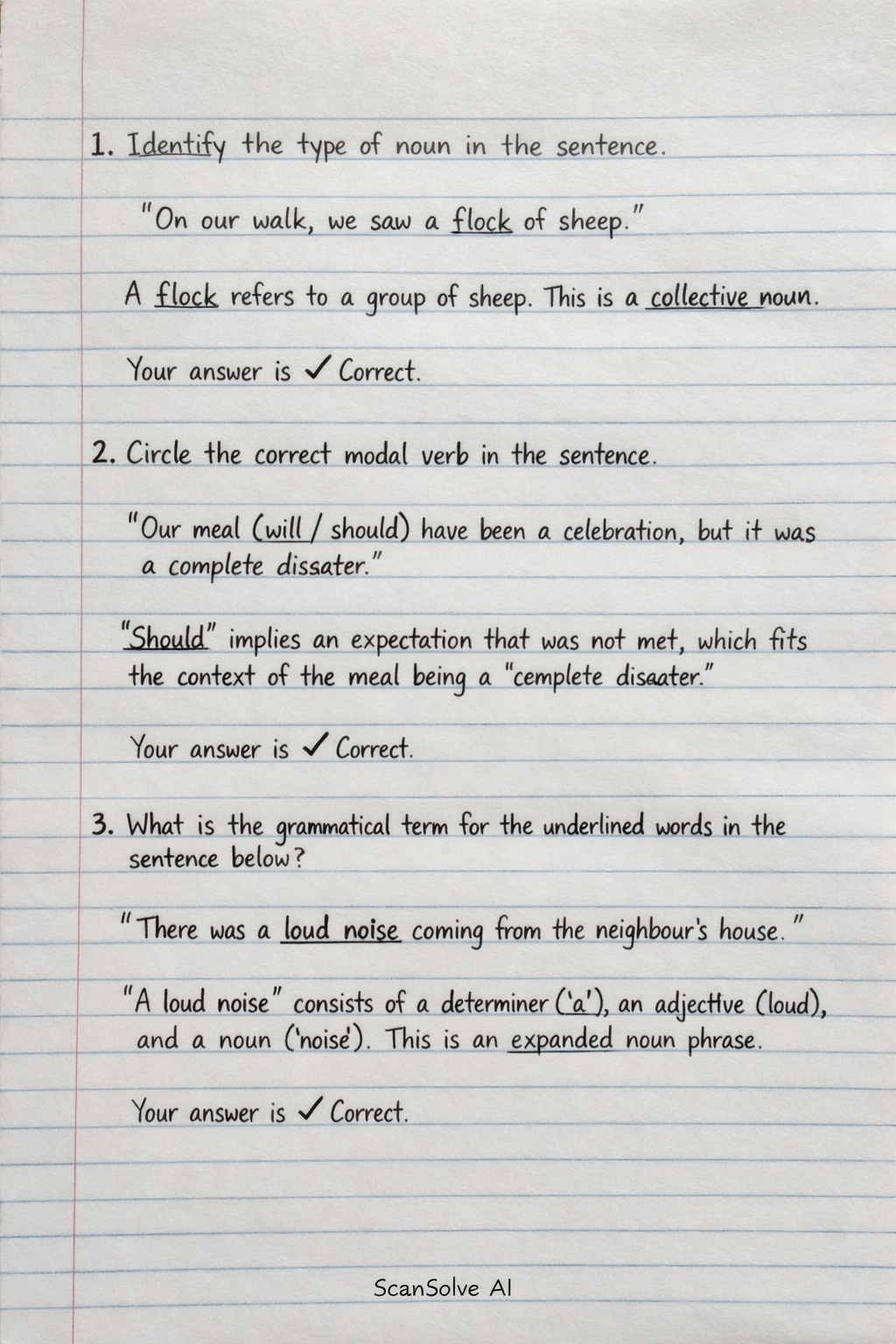
1. Identify the type of noun in the sentence.
"On our walk, we saw a flock of sheep."
A flock refers to a group of sheep. This is a collective noun.
Your answer is ✅ Correct.
2. Circle the correct modal verb in the sentence.
"Our meal (will / should) have been a celebration, but it was a complete disaster."
The word "should" implies an expectation that was not met, which fits the context of the meal being a "complete disaster."
Your answer is ✅ Correct.
3. What is the grammatical term for the underlined words in the sentence below?
"There was a loud noise coming from the neighbour's house."
The phrase "a loud noise" consists of a determiner ("a"), an adjective ("loud"), and a noun ("noise"). This is an expanded noun phrase.
Your answer is ✅ Correct.
4. Write a suitable pronoun to complete the sentence.
"Dad was happy with Julie: She had scored full marks in the maths test."
The pronoun refers to Julie, who is female and the subject of the second part of the sentence.
Your answer is ✅ Correct.
5. Insert the correct relative pronoun to complete the sentence.
"Our new teacher, who is in charge of PE, is called Miss Nelson."
"Who" is the correct relative pronoun to refer to a person (our new teacher) as the subject of the relative clause.
Your answer is ✅ Correct.
6. Circle the determiners in the sentence.
"The clown squirted water from a flower on his shirt and tricked the crowd with his tricks."
Determiners are words that introduce a noun and provide information about it.
The determiners are:
- The (clown)
- a (flower)
- his (shirt)
- the (crowd)
- his (tricks) Your answer correctly identified "The", "a", and "his". However, "on", "and", and "with" are not determiners; "on" and "with" are prepositions, and "and" is a conjunction.
7. Complete the sentence with an appropriate subordinate clause.
"We still went to the forest, although it was snowing."
A subordinate clause adds extra information to the main clause and starts with a subordinating conjunction like "although". Your clause "it was snowing" is grammatically correct and makes sense in the context.
Your answer is ✅ Correct.
Still stuck on this one?
Ask a follow-up, and the answer starts from this question.
More English Questions
Handwritten Step-by-Step Solution
Get this as a handwritten image on WhatsApp — like a tutor wrote it for you.
Try on WhatsApp