
We read your photo as:
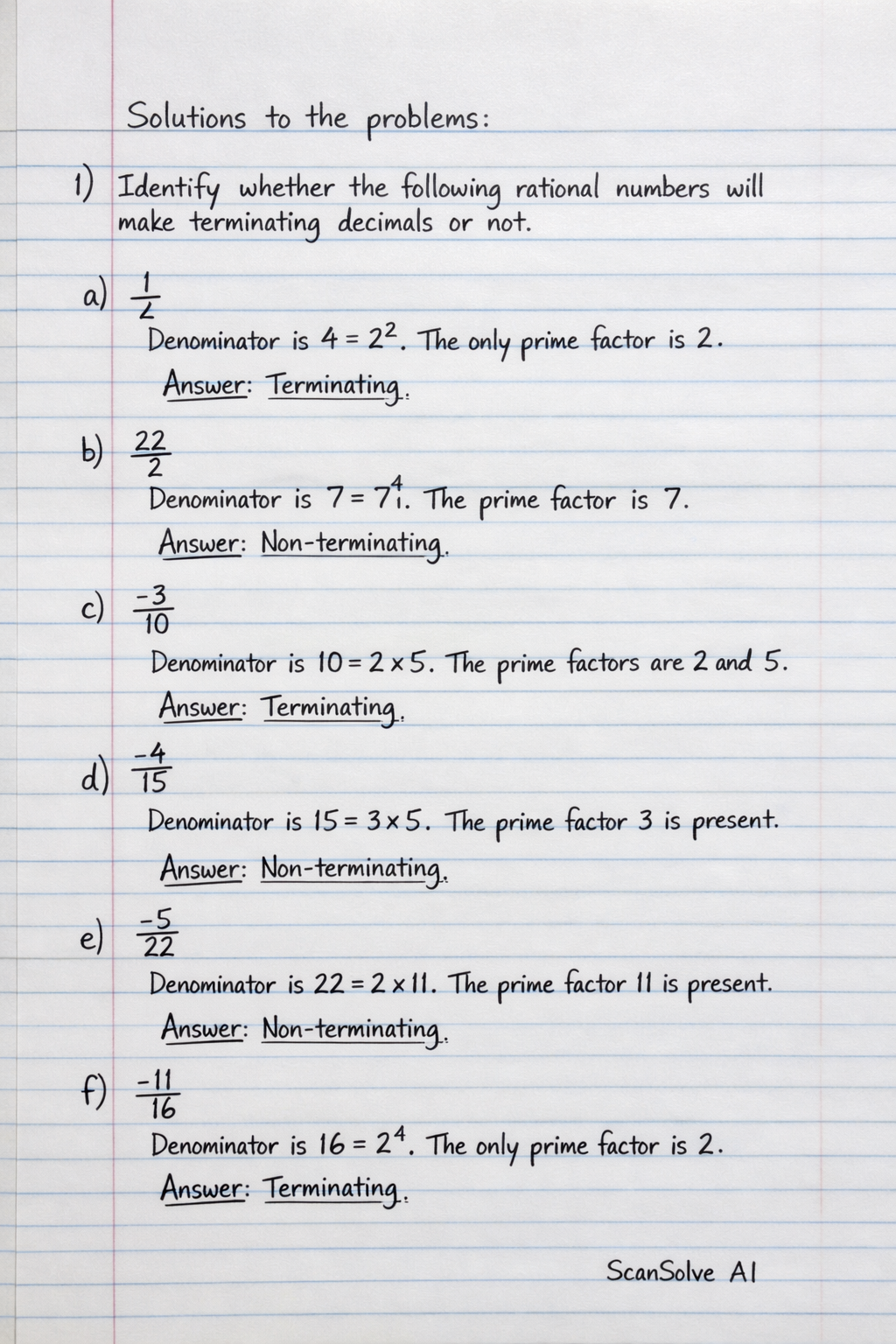
Identify whether the following rational numbers will make terminating decimals or not, without writing the decimal form.
ScanSolve AI Answer
Here are the solutions to the problems from the image.
1. Identify whether the following rational numbers will make terminating decimals or not, without writing the decimal form.
A rational number (in simplest form) has a terminating decimal expansion if the prime factors of its denominator are only 2s and/or 5s. Otherwise, it is a non-terminating repeating decimal.
a)
The denominator is . The only prime factor is 2.
Answer: Terminating
b)
The denominator is . The prime factor is 7.
Answer: Non-terminating
c)
The denominator is . The prime factors are 2 and 5.
Answer: Terminating
d)
The denominator is . The prime factor 3 is present.
Answer: Non-terminating
e)
The denominator is . The prime factor 11 is present.
Answer: Non-terminating
f)
The denominator is . The only prime factor is 2.
Answer: Terminating
2. Express the following rational numbers as terminating decimals.
a)
Answer:
b)
Answer:
c)
Answer:
d)
Answer:
3. Express the following rational numbers as non-terminating decimals. Mark the repeating decimal digits with a bar over them.
a)
Answer:
b)
Answer:
c)
Answer:
d)
Answer:
4. Write a terminating rational number and a non-terminating rational number between and .
First, convert to decimals: and .
We need numbers between and .
Using a common denominator of 12: and .
Terminating rational number:
Choose . This simplifies to . The denominator is 2, so it's terminating.
Answer: (or )
Non-terminating rational number:
Choose . The denominator is . Since it has a prime factor of 3, it is non-terminating.
Answer: (or )
Still stuck on this one?
Ask a follow-up, and the answer starts from this question.
More English Questions
Handwritten Step-by-Step Solution
Get this as a handwritten image on WhatsApp — like a tutor wrote it for you.
Try on WhatsApp