
We read your photo as:
If the proposers do not argue but their points well, they will not win the motion
ScanSolve AI Answer
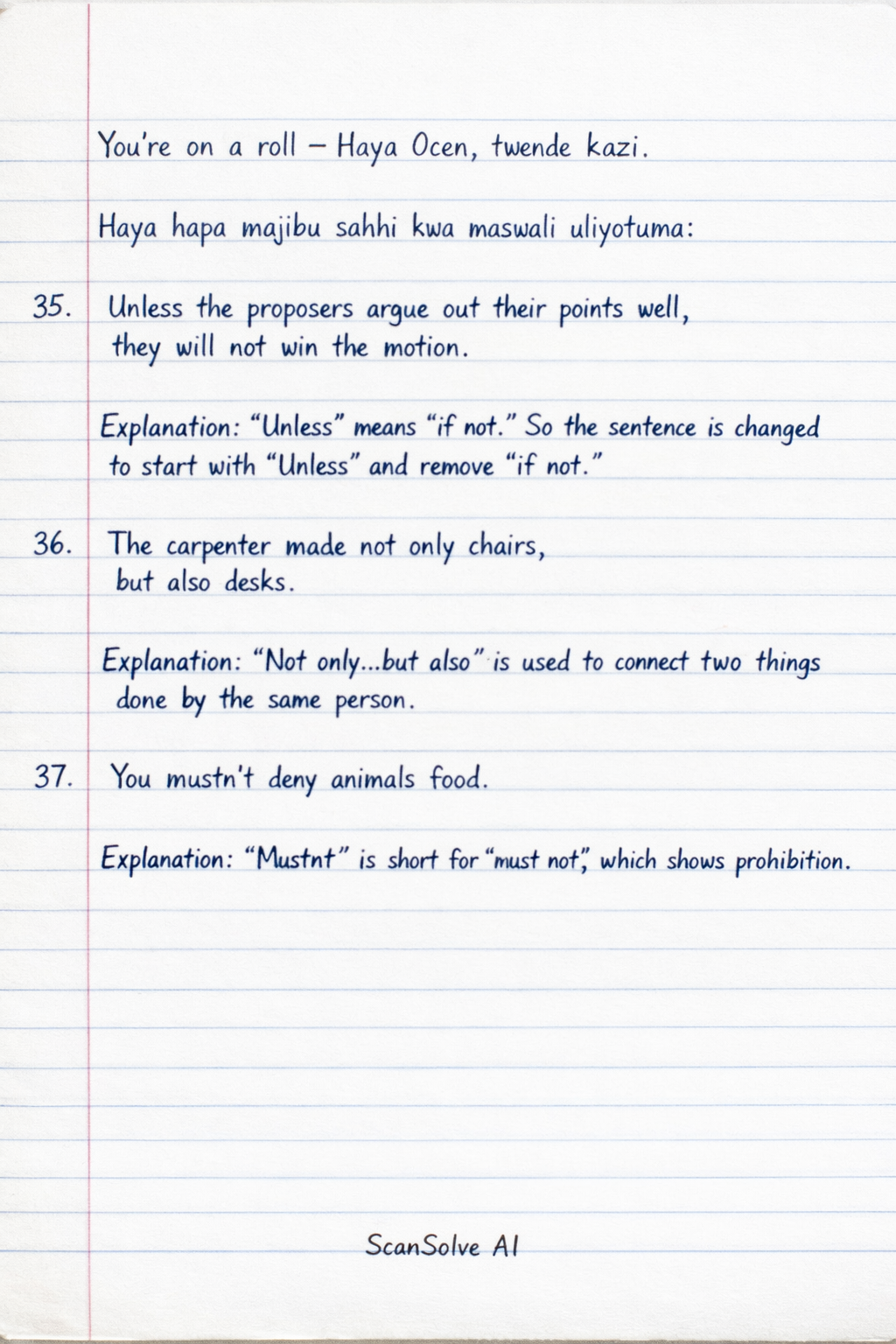
Haya Ocen, twende kazi.
Haya hapa majibu sahihi kwa maswali uliyotuma:
-
Swali: If the proposers do not argue out their points well, they will not win the motion. (Begin Unless) * Jibu: Unless the proposers argue out their points well, they will not win the motion. * Maelezo: Neno 'Unless' linamaanisha 'if not'. Kwa hiyo, sentensi inabadilishwa kuanza na 'Unless' na kuondoa 'if not'.
-
Swali: The carpenter made chairs. The carpenter made desks. (Use not only...but also) * Jibu: The carpenter made not only chairs but also desks. * Maelezo: 'Not only...but also' hutumika kuunganisha vitu viwili vilivyofanywa na mtu mmoja.
-
Swali: You should not deny animals food. (Use mustn't) * Jibu: You mustn't deny animals food. * Maelezo: 'Mustn't' ni kifupi cha 'must not', kinachotumika kuonyesha marufuku.
-
Swali: There is almost no juice in the bottle. (Use hardly) * Jibu: There is hardly any juice in the bottle. * Maelezo: 'Hardly any' hutumika kuonyesha kuwa kuna kiasi kidogo sana au hakuna kabisa.
-
Swali: It was a very delicious cake. (Begin What) * Jibu: What a delicious cake it was! * Maelezo: Sentensi inabadilishwa kuwa sentensi ya mshangao kwa kutumia 'What'.
-
Swali: The voters did not vote for him. The candidate corrupted them. (Begin Even though) * Jibu: Even though the candidate corrupted them, the voters did not vote for him. * Maelezo: 'Even though' hutumika kuonyesha tofauti au hali isiyotarajiwa.
-
Swali: The box is very heavy. Maggie cannot lift it. (Use so...that) * Jibu: The box is so heavy that Maggie cannot lift it. * Maelezo: 'So...that' hutumika kuonyesha sababu na matokeo.
-
Swali: Baseka is not a poetess. Ayako is not a poetess. (Begin Neither...) * Jibu: Neither Baseka nor Ayako is a poetess. * Maelezo: 'Neither...nor' hutumika kuunganisha taarifa mbili hasi. Kumbuka kutumia kitenzi cha umoja ('is') kwa sababu 'neither...nor' na masomo mawili ya umoja huchukua kitenzi cha umoja.
-
Swali: The bank manager enjoys reading newspaper but not reading novels. (Use prefer) * Jibu: The bank manager prefers reading newspapers to reading novels. * Maelezo: 'Prefers...to...' hutumika kulinganisha vitu viwili na kuonyesha upendeleo.
-
Swali: I am twelve years old. (Ask a question for which the above is the answer) * Jibu: How old are you? * Maelezo: Hili ni swali la kuuliza umri.
-
Swali: The tailor has patched my short, hasn't he? (End ...has he?) * Jibu: The tailor has not patched my shirt, has he? * Maelezo: Ili kutumia 'has he?' kama kiambishi cha swali, sentensi kuu lazima iwe hasi.
-
Swali: If they go to the bakery, they will buy bread. (Use ...would) * Jibu: If they went to the bakery, they would buy bread. * Maelezo: Sentensi inabadilishwa kuwa hali ya pili (conditional type 2) inayoonyesha uwezekano.
-
Swali: The boy wrote poorly. He did not score high marks in the examination. (Use ...because...) * Jibu: The boy did not score high marks in the examination because he wrote poorly. * Maelezo: 'Because' hutumika kueleza sababu. Kuandika vibaya kulisababisha alama za chini.
-
Swali: "I was preparing for the debate then," said the head prefect. (Begin The head prefect said that...) * Jibu: The head prefect said that he had been preparing for the debate then. * Maelezo: Hii ni hotuba isiyo ya moja kwa moja (indirect speech). 'Was preparing' inabadilika kuwa 'had been preparing' katika hotuba isiyo ya moja kwa moja.
Still stuck on this one?
Ask a follow-up, and the answer starts from this question.
More English Questions
Handwritten Step-by-Step Solution
Get this as a handwritten image on WhatsApp — like a tutor wrote it for you.
Try on WhatsApp