
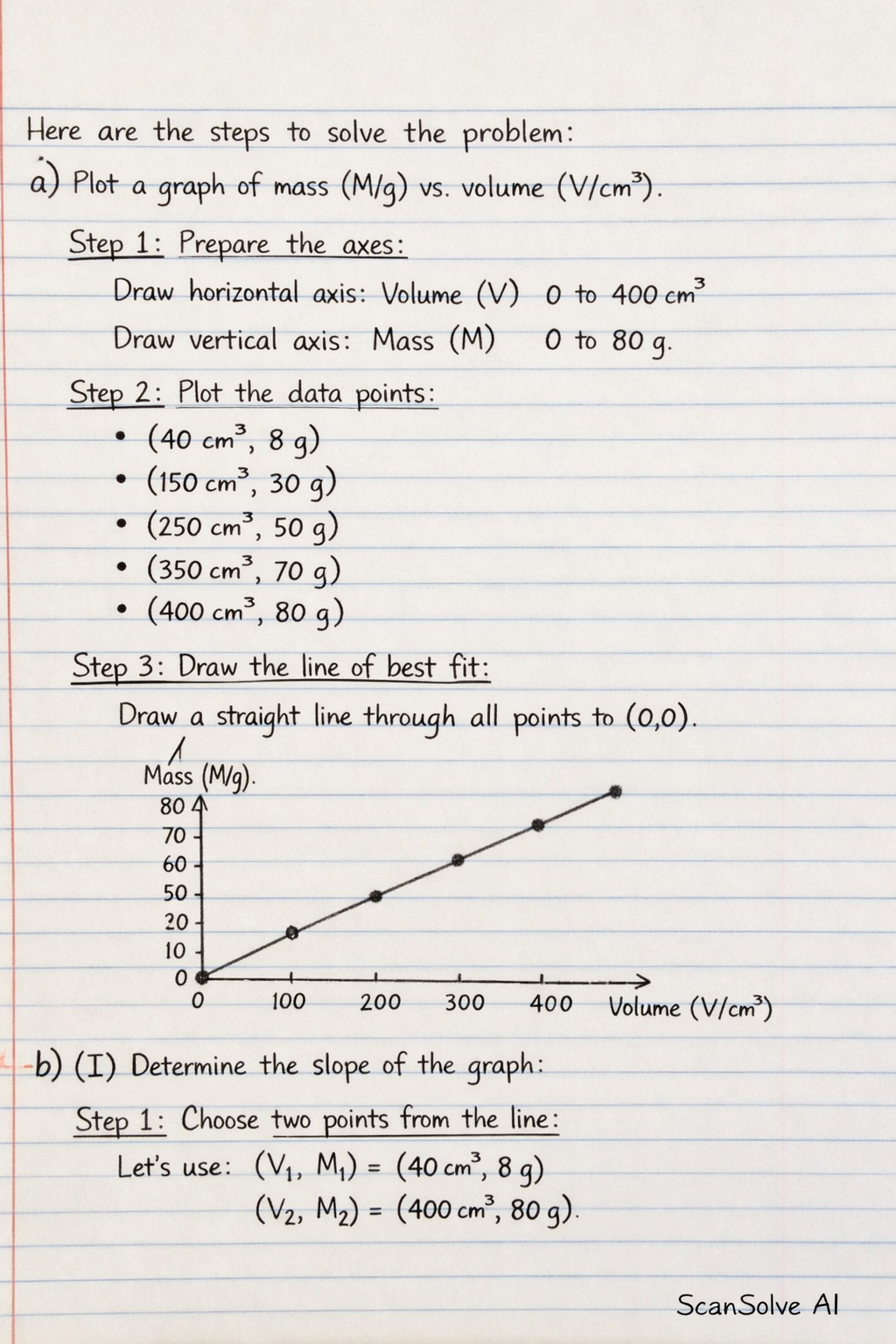
In an experiment to determine the molar concentration of a standard solution in the laboratory, different volumes of standard sodium hydroxide solution were dried to constant masses. The dried masses(M/g) of the solute sodium hydroxide and the corresponding volumes(V/cm cube) of the standard solution is as follows : Mass of NaOH=8,30,50,70,80 respectively. The volume of solute=40,150,250,350,400,respectively. a. Plot a graph of mass(M/g) on the vertical axis and volume(V/cm cube) on horizontal axis. b.( I) determine the slope of the graph. (Ii) state the significant of the slope. c. From the graph, determine the mass of the solute in 200cm cube of solution. d. Calculate the molar concentration of the sodium hydroxide in the standard solution. (Na=23,O=16,H=1) c.State two precautions to be taken when preparing the standard solution.
ScanSolve AI Answer
Answers
3 partsStep-by-step solution
10 stepsHere are the steps to solve the problem:
Part a· 3 steps
Plot a graph of mass (M/g) on the vertical axis and volume (V/cm) on the horizontal axis.
Prepare the axes.
Draw a horizontal axis for Volume (V/cm) ranging from 0 to at least 400 cm.
Draw a vertical axis for Mass (M/g) ranging from 0 to at least 80 g.Plot the data points.
Plot the following points:
Draw the line of best fit.
Draw a straight line that passes through all the plotted points and extends to the origin $(0,0)$.
Part b
(I) Determine the slope of the graph.
Choose two points from the line.
We can use any two points from the given data, for example, and .
Calculate the slope.
The slope is given by the formula:
Substitute the chosen points:
The slope of the graph is .
(II) State the significance of the slope.
The slope of the mass versus volume graph represents the mass concentration (or density) of the sodium hydroxide solution. It indicates the mass of NaOH solute present per unit volume of the solution.
Part c
From the graph, determine the mass of the solute in of solution.
Use the equation of the line.
Since the graph is a straight line passing through the origin, its equation is , where is the slope.
We found the slope .Calculate the mass for .
The mass of the solute in of solution is .
Part d
Calculate the molar concentration of the sodium hydroxide in the standard solution. (Na=23, O=16, H=1)
Calculate the molar mass of NaOH.
Molar mass of NaOH = Atomic mass of Na + Atomic mass of O + Atomic mass of H
Molar mass of NaOH =
Molar mass of NaOH =Convert the mass concentration (slope) from g/cm to g/L.
Mass concentration =
Since :
Mass concentration in g/L =
Mass concentration in g/L =Calculate the molar concentration.
Molar concentration =
Molar concentration =
Molar concentration =
The molar concentration of the sodium hydroxide in the standard solution is .
Part e
State two precautions to be taken when preparing the standard solution.
- Ensure the solute (NaOH) is pure and dry before weighing to avoid errors due to impurities or absorbed moisture.
- Use a volumetric flask of the correct capacity and ensure the solution is made up to the mark accurately at the meniscus to ensure precise volume measurement.
Try one yourself
A new problem that tests the same skill.
Still stuck on this one?
Ask a follow-up, and the answer starts from this question.
More English Questions
Handwritten Step-by-Step Solution
Get this as a handwritten image on WhatsApp — like a tutor wrote it for you.
Try on WhatsApp