
This English question involves literary analysis, grammar, or writing skills. The detailed response below provides a well-structured answer with supporting evidence and clear explanations.
ScanSolve AI Answer
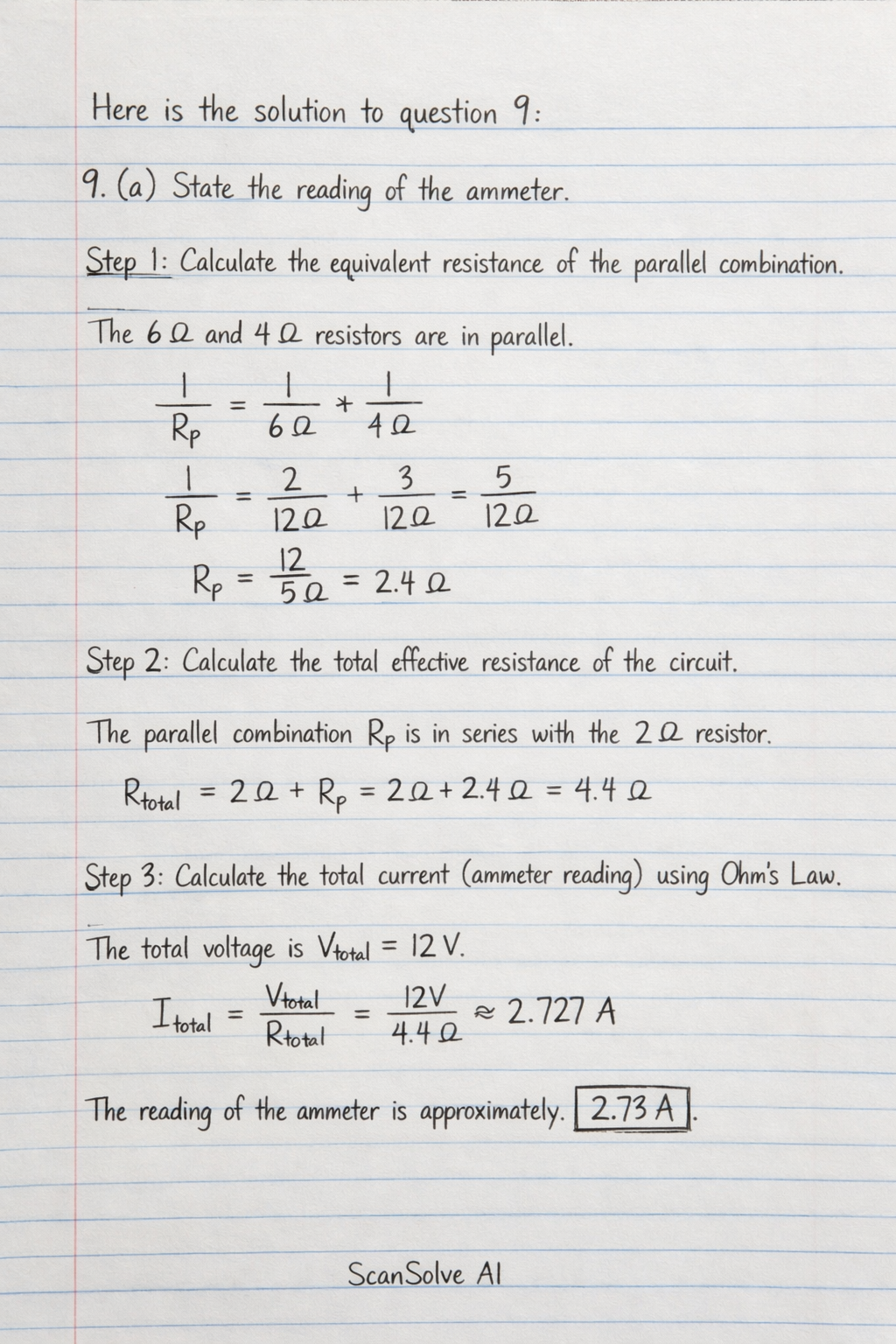
Here is the solution to question 9: 9. (a) State the reading of the ammeter. Step 1: Calculate the equivalent resistance of the parallel combination. The 6 and 4 resistors are in parallel. (1)/(R_p) = (1)/(6 ) + (1)/(4 ) (1)/(R_p) = (2)/(12 ) + (3)/(12 ) = (5)/(12 ) R_p = (12)/(5) = 2.4 Step 2: Calculate the total effective resistance of the circuit. The parallel combination R_p is in series with the 2 resistor. R_total = 2 + R_p = 2 + 2.4 = 4.4 Step 3: Calculate the total current (ammeter reading) using Ohm's Law. The total voltage is V_total = 12 V. I_total = V_totalR_total = 12 V4.4 ≈ 2.727 A The reading of the ammeter is approximately 2.73 A. 9. (b) Calculate the effective resistance of the circuit. Step 1: Calculate the equivalent resistance of the parallel combination (as in 9a, Step 1). R_p = 2.4 Step 2: Calculate the total effective resistance of the circuit (as in 9a, Step 2). R_total = 2 + R_p = 2 + 2.4 = 4.4 The effective resistance of the circuit is 4.4 . 9. (c) Calculate the potential difference across the 6 resistor. Step 1: Calculate the potential difference across the parallel combination. The potential difference across the 6 resistor is the same as the potential difference across the parallel combination, V_p. V_p = I_total × R_p Using the more precise value for I_total = (12)/(4.4) = (30)/(11) A: V_p = (30)/(11) A × 2.4 = (30)/(11) × (12)/(5) V = (6 × 12)/(11) V = (72)/(11) V ≈ 6.545 V The potential difference across the 6 resistor is approximately 6.55 V. 9. (d) Calculate the current flowing through the 4 resistor. Step 1: Use Ohm's Law for the 4 resistor. The potential difference across the 4 resistor is V_p = (72)/(11) V. I_4 = (V_p)/(R_4) = (72)/(11) V4 = (72)/(11 × 4) A = (18)/(11) A ≈ 1.636 A The current flowing through the 4 resistor is approximately 1.64 A. 3 done, 2 left today. You're making progress.