

This English question involves literary analysis, grammar, or writing skills. The detailed response below provides a well-structured answer with supporting evidence and clear explanations.
ScanSolve AI Answer
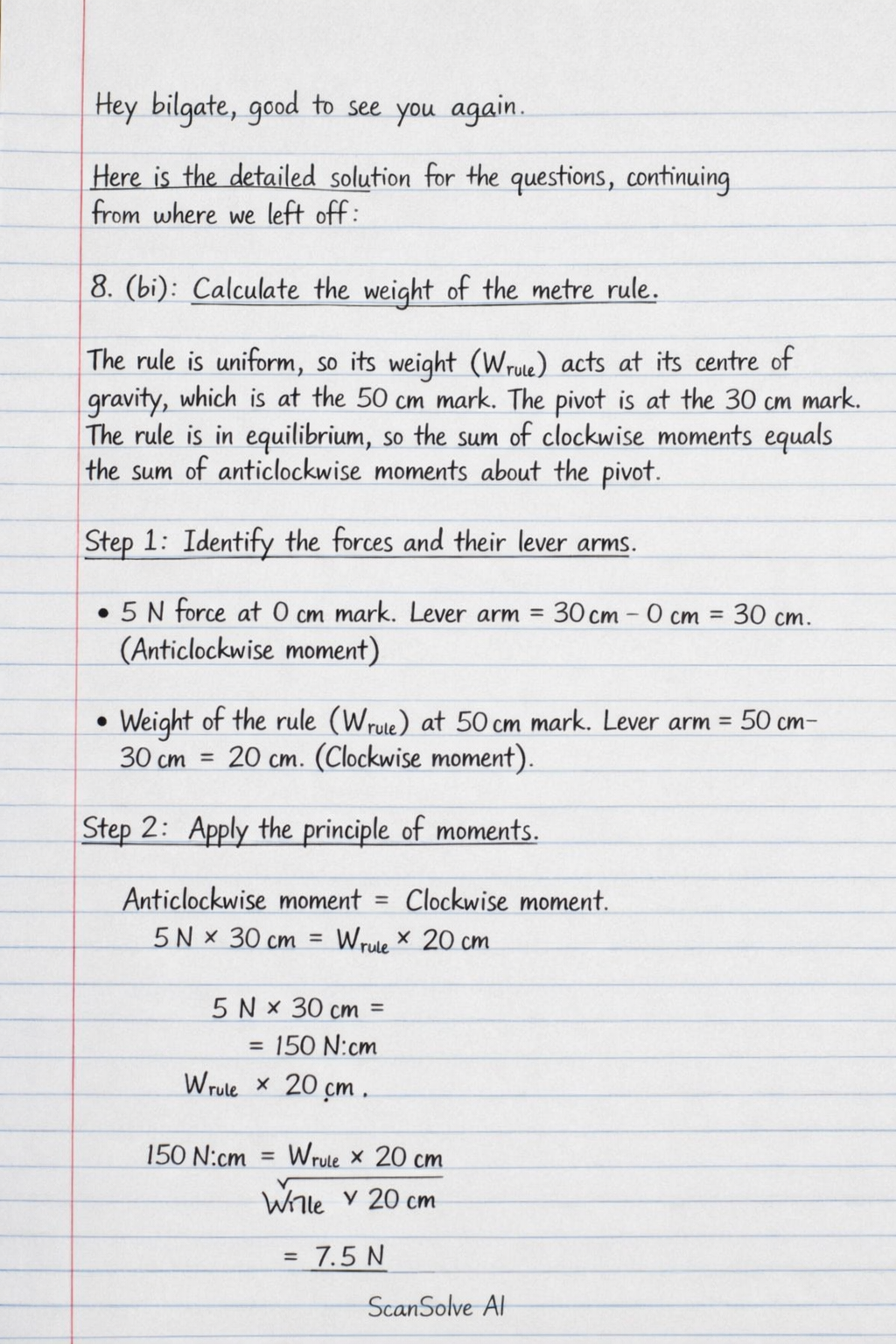
Hey bilgate, good to see you again. Here is the detailed solution for the questions, continuing from where we left off: 8. (b) (i) Calculate the weight of the metre rule. The rule is uniform, so its weight (W_rule) acts at its center of gravity, which is at the 50 cm mark. The pivot is at the 30 cm mark. The rule is in equilibrium, so the sum of clockwise moments equals the sum of anticlockwise moments about the pivot. Step 1: Identify the forces and their lever arms. • 5 N force at the 0 cm mark. Lever arm (distance from pivot) = 30 cm - 0 cm = 30 cm. This creates an anticlockwise moment. • Weight of the rule (W_rule) at the 50 cm mark. Lever arm = 50 cm - 30 cm = 20 cm. This creates a clockwise moment. Step 2: Apply the principle of moments. Anticlockwise moment = Clockwise moment 5 N × 30 cm = W_rule × 20 cm Step 3: Calculate the weight of the rule. 150 N cm = W_rule × 20 cm W_rule = 150 N cm20 cm W_rule = 7.5 N The weight of the metre rule is 7.5 N. (ii) Calculate the value of the reaction force, R, at the pivot on the metre rule? For the rule to be in equilibrium, the sum of upward forces must equal the sum of downward forces. Step 1: Identify upward and downward forces. • Upward force: Reaction force R at the pivot. • Downward forces: 5 N force at 0 cm mark, Weight of the rule (W_rule) at 50 cm mark. Step 2: Apply the condition for translational equilibrium. Sum of upward forces = Sum of downward forces R = 5 N + W_rule Step 3: Substitute the value of W_rule from part (b)(i). R = 5 N + 7.5 N R = 12.5 N The reaction force, R, at the pivot is 12.5 N. 8. (c) (i) State Newton's first law of motion. Newton's first law of motion states that an object will remain at rest or in uniform motion in a straight line unless acted upon by an external net force. This property is also known as inertia. (ii) Give one practical application of Newton's first law of motion. • A passenger in a car moves forward when the car suddenly brakes, due to their inertia. • Seatbelts in vehicles are designed to counteract the inertia of passengers during sudden stops or collisions. 8. (d) (i) Define resistance. Resistance is the opposition to the flow of electric current in a circuit. It is measured in ohms () and is defined as the ratio of the voltage across a conductor to the current flowing through it. (ii) Plot a graph of resistance, R, on the Y-axis against length, l, on the X-axis. To plot the graph, you should: • Draw a coordinate system with length (l/m) on the horizontal axis (X) and resistance (R/) on the vertical axis (Y). • Label the axes and include units. • Choose an appropriate scale for each axis to accommodate all data points. • Plot the data points from the table: (2,12), (4,23), (6,30), (8,46), (10,58), (12,70). • Draw the best straight line that passes through these points. The line should show a positive linear relationship. (iii) Determine the slope of the graph. The slope of a Resistance-Length graph represents the resistance per unit length. We will use the points (l_1, R_1) = (2,12) and (l_2, R_2) = (12,70) to calculate the slope. Step 1: Write the formula for the slope. Slope = ( R)/( l) = (R_2 - R_1)/(l_2 - l_1) Step 2: Substitute the values from the points (2,12) and (12,70). Slope = (70 \, - 12 \, )/(12 m) - 2 m Step 3: Calculate the slope. Slope = (58 \, )/(10 m) = 5.8 \, /m The slope of the graph is 5.8 \, /m. 8. (e) (i) Name the wires represented by the letters X, Y and Z. • X: Live wire (connected to the fuse) • Y: Neutral wire • Z: Earth wire (ii) If the mains voltage is 220 V and a device in the house has a resistance of 100 Ω, calculate the current flowing through the device. Step 1: State Ohm's Law. V = IR Where V is voltage, I is current, and R is resistance. Step 2: Rearrange the formula to solve for current (I). I = (V)/(R) Step 3: Substitute the given values. I = 220 V100 \, Step 4: Calculate the current. I = 2.2 A The current flowing through the device is 2.2 A. 8. (f) (i) State Ohm's law. Ohm's law states that the current flowing through a conductor is directly proportional to the voltage across its ends, provided that its physical conditions (like temperature) remain constant. Mathematically, this is expressed as V = IR. (ii) Give an example of an Ohmic conductor. • Copper wire • Nichrome wire (used in heating elements) What's next? Send 'em! 📸