We read your photo as:

Solve in english

English

ScanSolve AI Answer

Answer

1

Step-by-step solution

4 steps

The image is very blurry, but it appears to be asking for the sum of an infinite series. Based on the visible symbols, I will assume the question is to evaluate the sum of the series ∑n=1∞1n(n+1)\sum_{n=1}^{\infty} \frac{1}{n(n+1)}.

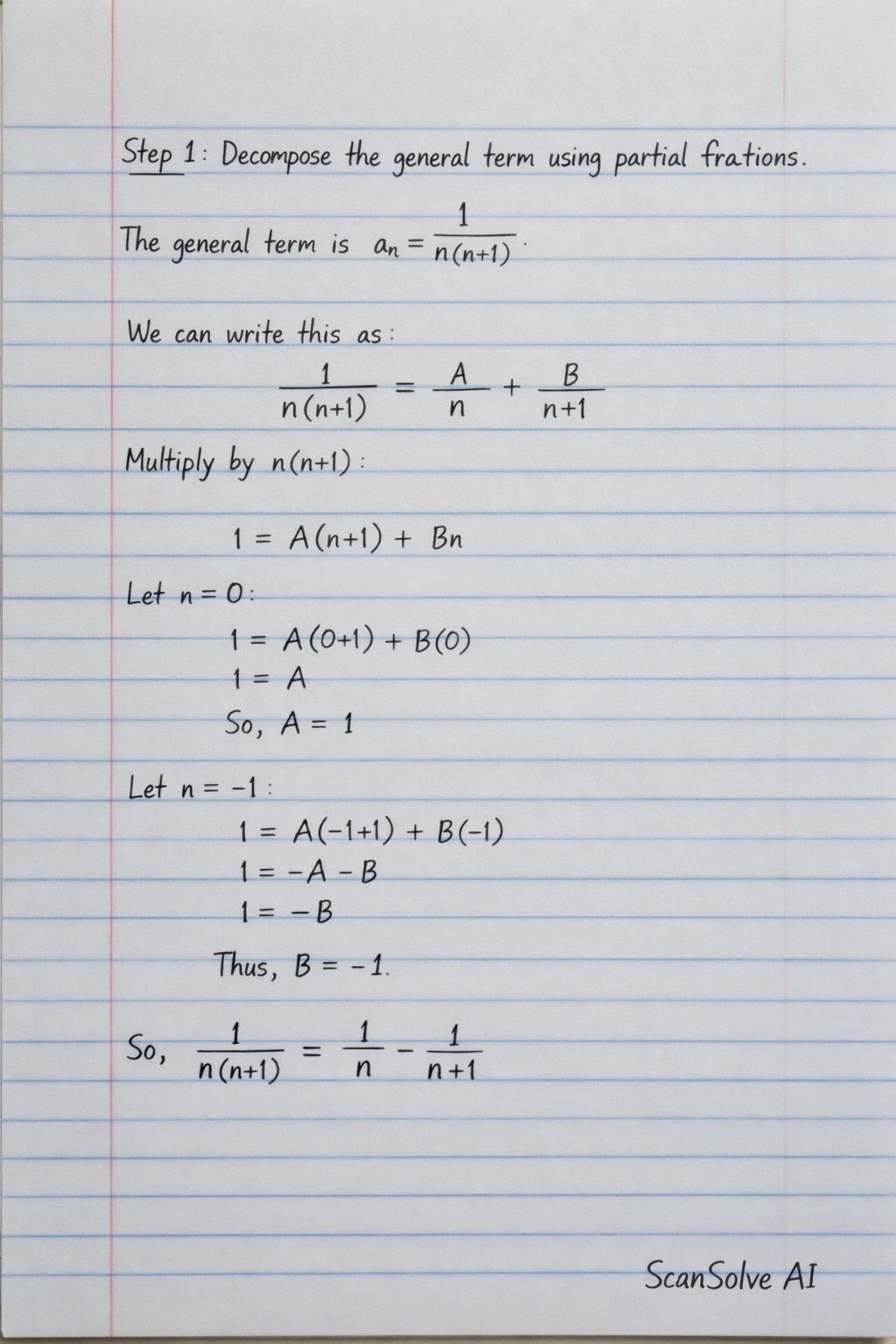
  1. Decompose the general term using partial fractions.

    The general term of the series is an=1n(n+1)a_n = \frac{1}{n(n+1)}. We can express this term as a difference of two fractions:

    1n(n+1)=An+Bn+1\frac{1}{n(n+1)} = \frac{A}{n} + \frac{B}{n+1}

    To find AA and BB, we multiply both sides by n(n+1)n(n+1):

    1=A(n+1)+Bn1 = A(n+1) + Bn

    Set n=0n=0: 1=A(0+1)+B(0)  ⟹  1=A1 = A(0+1) + B(0) \implies 1 = A.
    Set n=−1n=-1: 1=A(−1+1)+B(−1)  ⟹  1=−B  ⟹  B=−11 = A(-1+1) + B(-1) \implies 1 = -B \implies B = -1.
    So, the general term can be written as:

    1n(n+1)=1n−1n+1\frac{1}{n(n+1)} = \frac{1}{n} - \frac{1}{n+1}
  2. Write out the partial sum SNS_N.

    The partial sum SNS_N is the sum of the first NN terms:

    SN=∑n=1N(1n−1n+1)S_N = \sum_{n=1}^{N} \left(\frac{1}{n} - \frac{1}{n+1}\right)

    Let's write out the first few terms and the last term:

    SN=(1−12)+(12−13)+(13−14)+⋯+(1N−1N+1)S_N = \left(1 - \frac{1}{2}\right) + \left(\frac{1}{2} - \frac{1}{3}\right) + \left(\frac{1}{3} - \frac{1}{4}\right) + \dots + \left(\frac{1}{N} - \frac{1}{N+1}\right)
  3. Identify the telescoping sum.

    Notice that most of the terms cancel each other out. This is a telescoping series:

    SN=1−12+12−13+13−14+⋯+1N−1N+1S_N = 1 - \cancel{\frac{1}{2}} + \cancel{\frac{1}{2}} - \cancel{\frac{1}{3}} + \cancel{\frac{1}{3}} - \cancel{\frac{1}{4}} + \dots + \cancel{\frac{1}{N}} - \frac{1}{N+1}

    The partial sum simplifies to:

    SN=1−1N+1S_N = 1 - \frac{1}{N+1}
  4. Find the sum of the infinite series.

    To find the sum of the infinite series, we take the limit of the partial sum as NN approaches infinity:

    ∑n=1∞1n(n+1)=lim⁡N→∞SN=lim⁡N→∞(1−1N+1)\sum_{n=1}^{\infty} \frac{1}{n(n+1)} = \lim_{N \to \infty} S_N = \lim_{N \to \infty} \left(1 - \frac{1}{N+1}\right)

    As N→∞N \to \infty, the term 1N+1\frac{1}{N+1} approaches 0.

    lim⁡N→∞(1−1N+1)=1−0=1\lim_{N \to \infty} \left(1 - \frac{1}{N+1}\right) = 1 - 0 = 1

    The sum of the series is:

    11
Was this helpful?

Try one yourself

A new problem that tests the same skill.

Still stuck on this one?

Ask a follow-up, and the answer starts from this question.

Got a different question?Ask your own question
Handwritten step-by-step solution preview

Handwritten Step-by-Step Solution

Get this as a handwritten image on WhatsApp — like a tutor wrote it for you.

Try on WhatsApp