We read your photo as:

Solve in english

English

ScanSolve AI Answer

Answers

3 parts
a
4
b

−i−j−k-\mathbf{i} - \mathbf{j} - \mathbf{k}

c

10x+16y−z=−2510x + 16y - z = -25

Step-by-step solution

8 steps

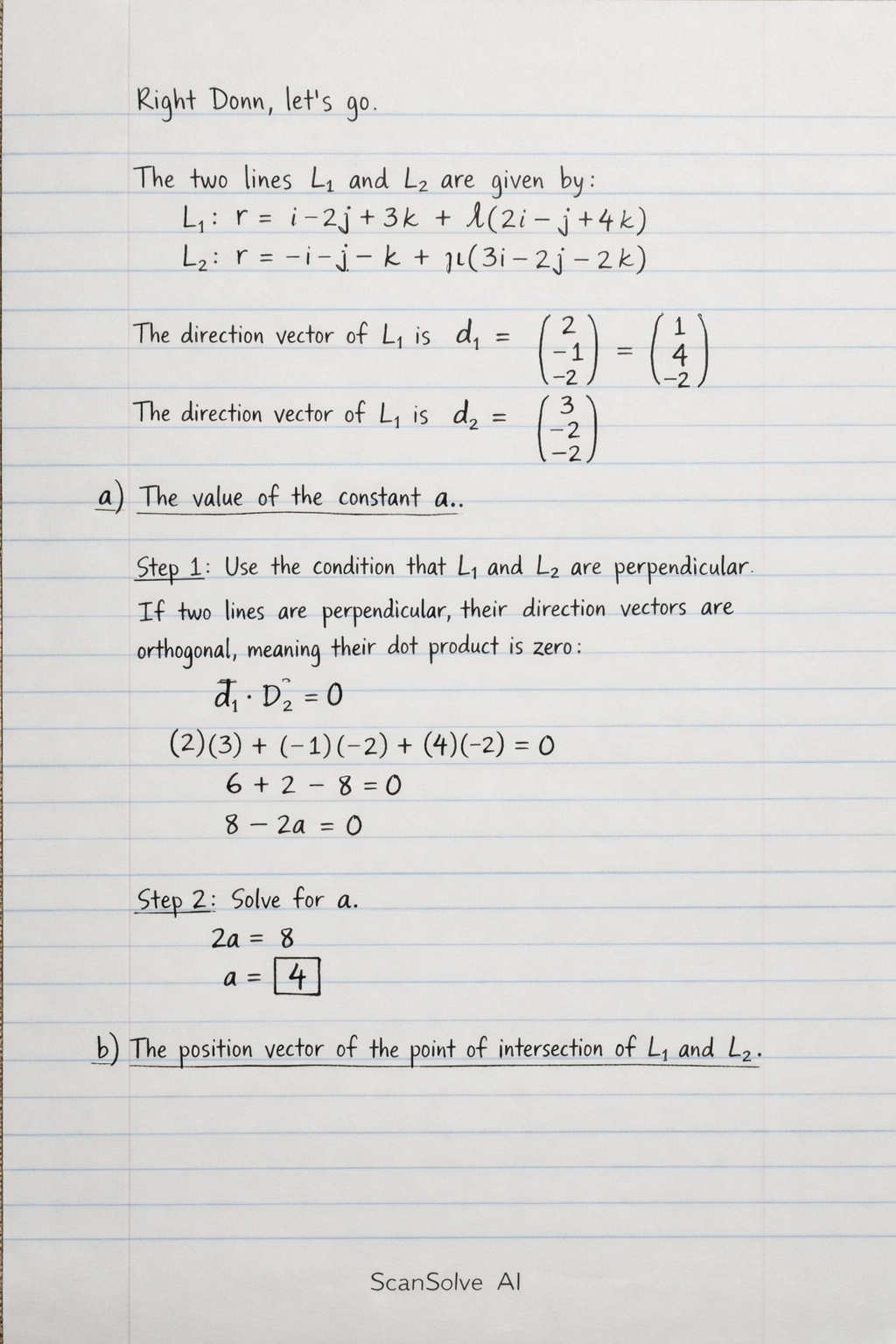
The two lines L1L_1 and L2L_2 are given by:
L1:r=i−2j+3k+λ(2i−j+ak)L_1: \mathbf{r} = \mathbf{i} - 2\mathbf{j} + 3\mathbf{k} + \lambda(2\mathbf{i} - \mathbf{j} + a\mathbf{k})
L2:r=−i−j−k+μ(3i−2j−2k)L_2: \mathbf{r} = -\mathbf{i} - \mathbf{j} - \mathbf{k} + \mu(3\mathbf{i} - 2\mathbf{j} - 2\mathbf{k})

The direction vector of L1L_1 is d1=(2−1a)\mathbf{d_1} = \begin{pmatrix} 2 \\ -1 \\ a \end{pmatrix}.
The direction vector of L2L_2 is d2=(3−2−2)\mathbf{d_2} = \begin{pmatrix} 3 \\ -2 \\ -2 \end{pmatrix}.

Part a· 2 steps

The value of the constant aa.

  1. Use the condition that L1L_1 and L2L_2 are perpendicular.

    If two lines are perpendicular, their direction vectors are orthogonal, meaning their dot product is zero: d1⋅d2=0\mathbf{d_1} \cdot \mathbf{d_2} = 0.

    (2)(3)+(−1)(−2)+(a)(−2)=0(2)(3) + (-1)(-2) + (a)(-2) = 0 6+2−2a=06 + 2 - 2a = 0 8−2a=08 - 2a = 0
  2. Solve for aa.

    2a=82a = 8 a=4a = \boxed{4}

Part b

−i−j−k-\mathbf{i} - \mathbf{j} - \mathbf{k}

The position vector of the point of intersection of L1L_1 and L2L_2.

  1. Equate the position vectors of the two lines.

    Substitute a=4a=4 into the equation for L1L_1:

    i−2j+3k+λ(2i−j+4k)=−i−j−k+μ(3i−2j−2k)\mathbf{i} - 2\mathbf{j} + 3\mathbf{k} + \lambda(2\mathbf{i} - \mathbf{j} + 4\mathbf{k}) = -\mathbf{i} - \mathbf{j} - \mathbf{k} + \mu(3\mathbf{i} - 2\mathbf{j} - 2\mathbf{k})

    Equate the components:
    For i\mathbf{i}: 1+2λ=−1+3μ  ⟹  2λ−3μ=−2(1)1 + 2\lambda = -1 + 3\mu \implies 2\lambda - 3\mu = -2 \quad (1)
    For j\mathbf{j}: −2−λ=−1−2μ  ⟹  −λ+2μ=1(2)-2 - \lambda = -1 - 2\mu \implies -\lambda + 2\mu = 1 \quad (2)
    For k\mathbf{k}: 3+4λ=−1−2μ  ⟹  4λ+2μ=−4  ⟹  2λ+μ=−2(3)3 + 4\lambda = -1 - 2\mu \implies 4\lambda + 2\mu = -4 \implies 2\lambda + \mu = -2 \quad (3)

  2. Solve the system of linear equations for λ\lambda and μ\mu.

    From equation (2), we can express λ\lambda in terms of μ\mu:

    λ=2μ−1\lambda = 2\mu - 1

    Substitute this into equation (3):

    2(2μ−1)+μ=−22(2\mu - 1) + \mu = -2 4μ−2+μ=−24\mu - 2 + \mu = -2 5μ=05\mu = 0 μ=0\mu = 0

    Now substitute μ=0\mu=0 back into the expression for λ\lambda:

    λ=2(0)−1\lambda = 2(0) - 1 λ=−1\lambda = -1

    Verify these values with equation (1): 2(−1)−3(0)=−2−0=−22(-1) - 3(0) = -2 - 0 = -2. The values are consistent.

  3. Substitute the value of λ\lambda (or μ\mu) into the respective line equation to find the intersection point.

    Using L1L_1 with λ=−1\lambda = -1:

    r=i−2j+3k+(−1)(2i−j+4k)\mathbf{r} = \mathbf{i} - 2\mathbf{j} + 3\mathbf{k} + (-1)(2\mathbf{i} - \mathbf{j} + 4\mathbf{k}) r=i−2j+3k−2i+j−4k\mathbf{r} = \mathbf{i} - 2\mathbf{j} + 3\mathbf{k} - 2\mathbf{i} + \mathbf{j} - 4\mathbf{k} r=(1−2)i+(−2+1)j+(3−4)k\mathbf{r} = (1-2)\mathbf{i} + (-2+1)\mathbf{j} + (3-4)\mathbf{k} r=−i−j−k\mathbf{r} = \boxed{-\mathbf{i} - \mathbf{j} - \mathbf{k}}

Part c

10x+16y−z=−2510x + 16y - z = -25

The Cartesian equation of the plane Π\Pi containing L1L_1 and L2L_2.

  1. Find a normal vector to the plane.

    The plane contains both lines, so its normal vector n\mathbf{n} must be perpendicular to both direction vectors d1\mathbf{d_1} and d2\mathbf{d_2}. We can find n\mathbf{n} by taking the cross product of d1\mathbf{d_1} and d2\mathbf{d_2}.
    Using a=4a=4, d1=(2−14)\mathbf{d_1} = \begin{pmatrix} 2 \\ -1 \\ 4 \end{pmatrix} and d2=(3−2−2)\mathbf{d_2} = \begin{pmatrix} 3 \\ -2 \\ -2 \end{pmatrix}.

    n=d1×d2=∣ijk2−143−2−2∣\mathbf{n} = \mathbf{d_1} \times \mathbf{d_2} = \begin{vmatrix} \mathbf{i} & \mathbf{j} & \mathbf{k} \\ 2 & -1 & 4 \\ 3 & -2 & -2 \end{vmatrix} n=i((−1)(−2)−(4)(−2))−j((2)(−2)−(4)(3))+k((2)(−2)−(−1)(3))\mathbf{n} = \mathbf{i}((-1)(-2) - (4)(-2)) - \mathbf{j}((2)(-2) - (4)(3)) + \mathbf{k}((2)(-2) - (-1)(3)) n=i(2−(−8))−j(−4−12)+k(−4−(−3))\mathbf{n} = \mathbf{i}(2 - (-8)) - \mathbf{j}(-4 - 12) + \mathbf{k}(-4 - (-3)) n=10i+16j−k\mathbf{n} = 10\mathbf{i} + 16\mathbf{j} - \mathbf{k}
  2. Use the normal vector and a point on the plane to find the Cartesian equation.

    The Cartesian equation of a plane is Ax+By+Cz=DAx + By + Cz = D, where (ABC)\begin{pmatrix} A \\ B \\ C \end{pmatrix} is the normal vector.
    So, the equation is 10x+16y−z=D10x + 16y - z = D.
    We know the point of intersection P(−1,−1,−1)P(-1, -1, -1) lies on the plane. Substitute these coordinates to find DD:

    10(−1)+16(−1)−(−1)=D10(-1) + 16(-1) - (-1) = D −10−16+1=D-10 - 16 + 1 = D −25=D-25 = D
  3. Write the Cartesian equation of the plane.

    10x+16y−z=−25\boxed{10x + 16y - z = -25}
Was this helpful?

Still stuck on this one?

Ask a follow-up, and the answer starts from this question.

Got a different question?Ask your own question
Handwritten step-by-step solution preview

Handwritten Step-by-Step Solution

Get this as a handwritten image on WhatsApp — like a tutor wrote it for you.

Try on WhatsApp