

This English question involves literary analysis, grammar, or writing skills. The detailed response below provides a well-structured answer with supporting evidence and clear explanations.
ScanSolve AI Answer
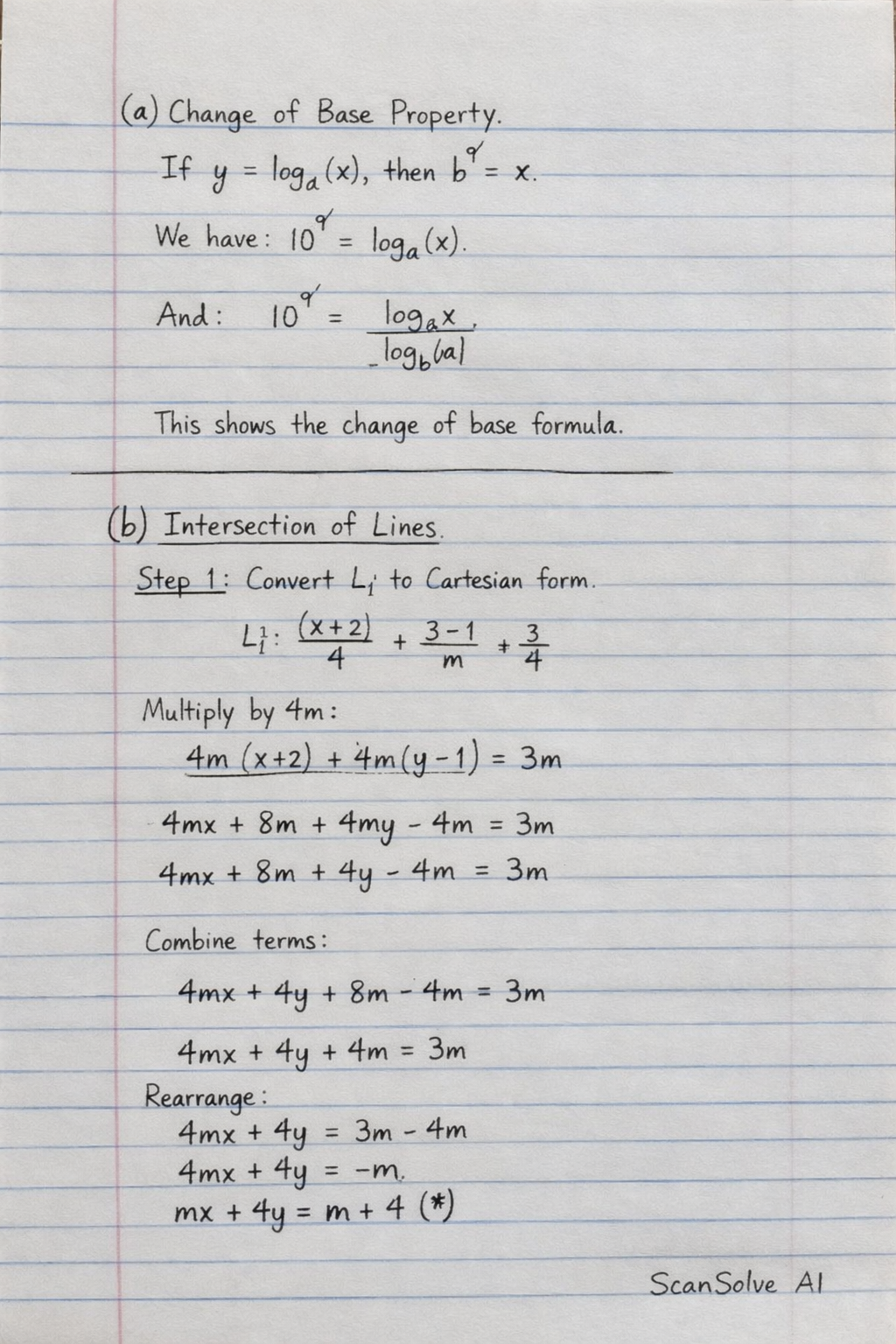
Here are the solutions to the problems you've provided. a) Logarithm Property This part appears to be stating a property of logarithms, specifically the change of base formula. If y = _b(x), then b^y = x. The statement 10^y = _a(x) and 10^y = (_b(x))/(_b(a)) seems to be illustrating how to change the base of a logarithm to base 10 (or any other base b). This is a definition/property rather than a problem to solve. b) Intersection of Lines We are given two lines, L_1 and L_2. We need to find the value(s) of m for which they intersect. Step 1: Convert L_1 to Cartesian form. The equation for L_1 is (x+2)/(4) + (y-1)/(m) = (3)/(4). To eliminate denominators, multiply the entire equation by 4m: m(x+2) + 4(y-1) = 3m mx + 2m + 4y - 4 = 3m Rearrange into the form Ax + By = C: mx + 4y = m + 4 (*) Step 2: Convert L_2 to Cartesian form. The equation for L_2 is given in vector form: r = 2i + 3j + t(i + mj). This means x = 2 + t and y = 3 + mt. From the first equation, t = x-2. Substitute this into the second equation: y = 3 + m(x-2) y = 3 + mx - 2m Rearrange into the form Ax + By = C: mx - y = 2m - 3 (**) Step 3: Determine the condition for intersection. For two lines to intersect, they must not be parallel and distinct. Lines are parallel if their slopes are equal. From mx + 4y = m+4, the slope is -(m)/(4). From mx - y = 2m-3, the slope is m. For the lines to be parallel, -(m)/(4) = m. -m = 4m 5m = 0 m = 0 If m=0, the lines are parallel. Let's check if they are distinct or identical when m=0: For m=0, equation (*) becomes: 0x + 4y = 0 + 4 4y = 4 y = 1 For m=0, equation (**) becomes: 0x - y = 2(0) - 3 -y = -3 y = 3 Since y=1 and y=3 are two different horizontal lines, they are parallel and distinct. Therefore, they do not intersect when m=0. For any other value of m (i.e., m 0), the slopes will not be equal, meaning the lines are not parallel. Non-parallel lines in a 2D plane always intersect at a unique point. Thus, the lines L_1 and L_2 intersect for all values of m except m=0. The value of m for which L_1 and L_2 intersect is m 0. c) Proof by Mathematical Induction We need to prove by mathematical induction that _r=1^n (r)/(2^r) = 2 - (n+2)/(2^n) for n 1. Step 1: Base Case (n=1). Let P(n) be the statement _r=1^n (r)/(2^r) = 2 - (n+2)/(2^n). For n=1: Left Hand Side (LHS): _r=1^1 (r)/(2^r) = (1)/(2^1) = (1)/(2). Right Hand Side (RHS): 2 - (1+2)/(2^1) = 2 - (3)/(2) = (4)/(2) - (3)/(2) = (1)/(2). Since LHS = RHS, P(1) is true. Step 2: Inductive Hypothesis. Assume that P(k) is true for some positive integer k 1. That is, assume _r=1^k (r)/(2^r) = 2 - (k+2)/(2^k). Step 3: Inductive Step. We need to prove that P(k+1) is true. That is, we need to show _r=1^k+1 (r)/(2^r) = 2 - ((k+1)+2)/(2^k+1) = 2 - (k+3)/(2^k+1). Start with the LHS of P(k+1): _r=1^k+1 (r)/(2^r) = (_r=1^k (r)/(2^r)) + (k+1)/(2^k+1) Using the inductive hypothesis for the sum _r=1^k (r)/(2^r): = (2 - (k+2)/(2^k)) + (k+1)/(2^k+1) To combine the fractional terms, find a common denominator, which is 2^k+1: = 2 - ((k+2) · 2)/(2^k · 2) + (k+1)/(2^k+1) = 2 - (2(k+2))/(2^k+1) + (k+1)/(2^k+1) = 2 - (2k+4)/(2^k+1) + (k+1)/(2^k+1) Combine the fractions: = 2 - ((2k+4) - (k+1))/(2^k+1) = 2 - (2k+4-k-1)/(2^k+1) = 2 - (k+3)/(2^k+1) This matches the RHS of P(k+1). Therefore, P(k+1) is true. Step 4: Conclusion. By the principle of mathematical induction, the statement _r=1^n (r)/(2^r) = 2 - (n+2)/(2^n) is true for all integers n 1. What's next?