
We read your photo as:
Solve in English
ScanSolve AI Answer
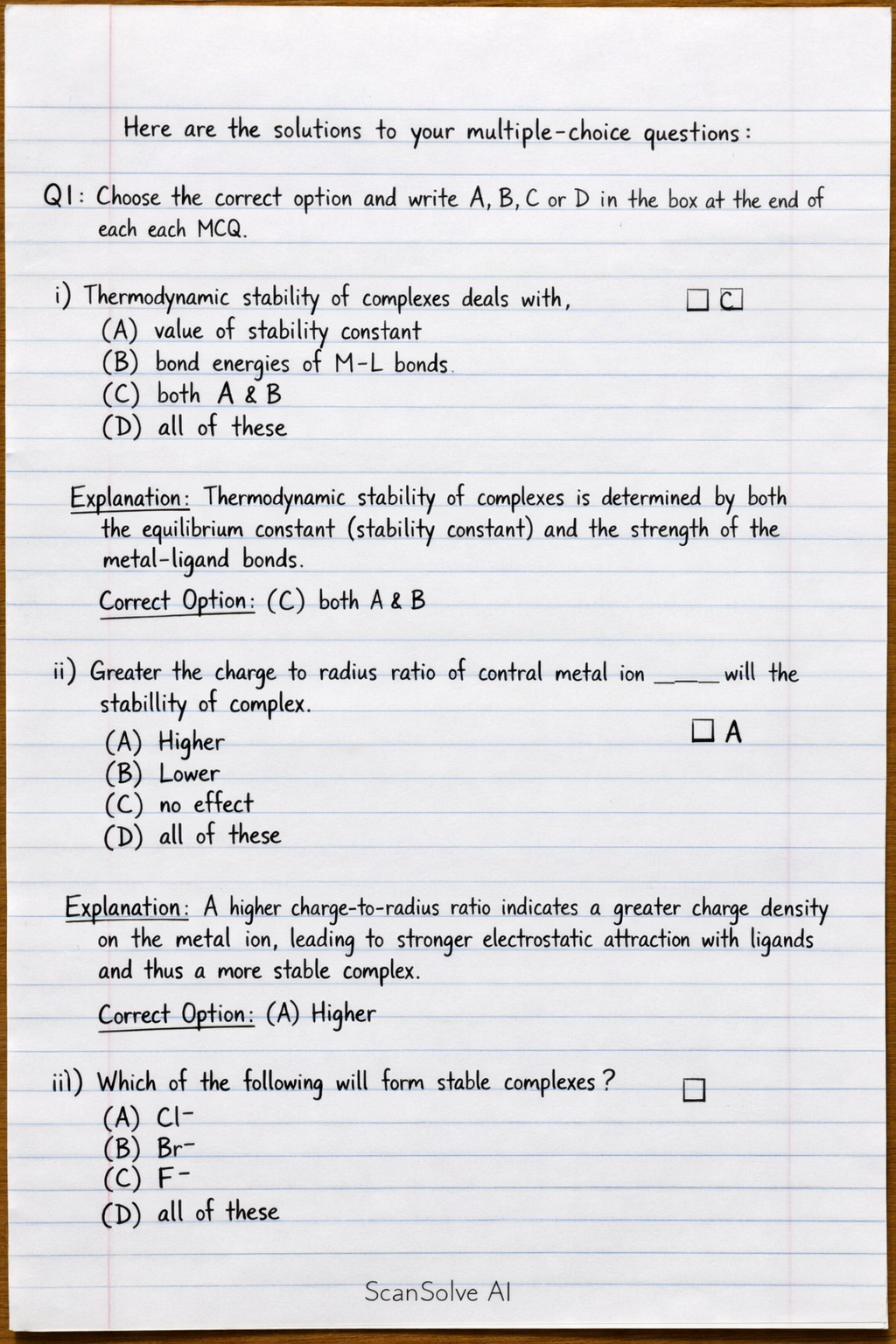
Here are the solutions to your multiple-choice questions:
Q1: Choose the correct option and write A,B,C or D in the box at the end of each MCQ.
i) Thermodynamics stability of complexes deals with,
(A) value of stability constant
(B) bond energies of M-L bonds
(C) both A&B
(D) all of these
- Explanation: Thermodynamic stability of complexes is determined by both the equilibrium constant (stability constant) and the strength of the metal-ligand bonds.
- Correct Option: (C) both A&B
ii) Greater the charge to radius ratio of central metal ion...... will the stability of complex
(A) Higher
(B) Blower
(C) no effect
(D) all of these
- Explanation: A higher charge-to-radius ratio indicates a greater charge density on the metal ion, leading to stronger electrostatic attraction with ligands and thus a more stable complex.
- Correct Option: (A) Higher
iii) Which of the following will form stable complexes?
(A)
(B)
(C)
(D) all of these
- Explanation: Among the halide ligands, is the smallest and most electronegative, making it a "hard" ligand that forms stronger bonds and more stable complexes with many metal ions compared to or .
- Correct Option: (C)
iv) John Teller-distortion applied to complexes of,
(A) symmetrical electronic configuration
(B) symmetrical E.C
(C) regular tetragonal
(D) all of these
- Explanation: Jahn-Teller distortion occurs in complexes with unsymmetrical electronic configurations in degenerate orbitals, leading to a distortion from ideal geometry, often resulting in a tetragonal (elongated or compressed octahedral) geometry.
- Correct Option: (C) regular tetragonal
v) The reaction in which solid is separated from solution is known as.
(A) metathetical
(B) solvolytic
(C) redox
(D) none
- Explanation: The process where a solid separates from a solution is called precipitation. Metathetical reactions (double displacement reactions) frequently lead to the formation of a precipitate.
- Correct Option: (A) metathetical
vi) The number of optical isomers formed by complex with formula are
(A) 15
(B) 3
(C) 10
(D) 30
- Explanation: An octahedral complex with six different monodentate ligands (MABCDEF) has 15 possible geometric isomers. Each of these 15 geometric isomers is chiral and exists as a pair of enantiomers. Therefore, the total number of optical isomers is .
- Correct Option: (D) 30
vii) The isomerism exhibit due different donor atoms of the same ligands is
(A) ionization
(B) ligand
(C) linkage
(D) coordination
- Explanation: This describes linkage isomerism, where an ambidentate ligand can bind to the metal center through two or more different donor atoms.
- Correct Option: (C) linkage
viii) Which of the following complexes do not show geometrical isomerism?
(A) tetrahedral
(B) square planner
(C) octahedral
(D) both A & B
- Explanation: Tetrahedral complexes do not exhibit geometrical isomerism because all ligand positions are equidistant and equivalent relative to each other. Any arrangement of ligands can be rotated to superimpose on another.
- Correct Option: (A) tetrahedral
ix) The nature of metal ligand bond in CFT is
(A) covalent
(B) electrostatics
(C) metallic
(D) all
- Explanation: In Crystal Field Theory (CFT), the metal-ligand bond is considered to be purely electrostatic, arising from the attraction between the positively charged metal ion and the negatively charged ligands (or the negative end of polar ligands).
- Correct Option: (B) electrostatics
x) Which of the following does not show optical isomerism?
(A) tetrahedral
(B) square planner
(C) octahedral
(D) both A & B
- Explanation: Square planar complexes typically possess at least one plane of symmetry (or a center of inversion), which makes them achiral and thus unable to exhibit optical isomerism.
- Correct Option: (B) square planner
Still stuck on this one?
Ask a follow-up, and the answer starts from this question.
Handwritten Step-by-Step Solution
Get this as a handwritten image on WhatsApp — like a tutor wrote it for you.
Try on WhatsApp