
This English question involves literary analysis, grammar, or writing skills. The detailed response below provides a well-structured answer with supporting evidence and clear explanations.
ScanSolve AI Answer
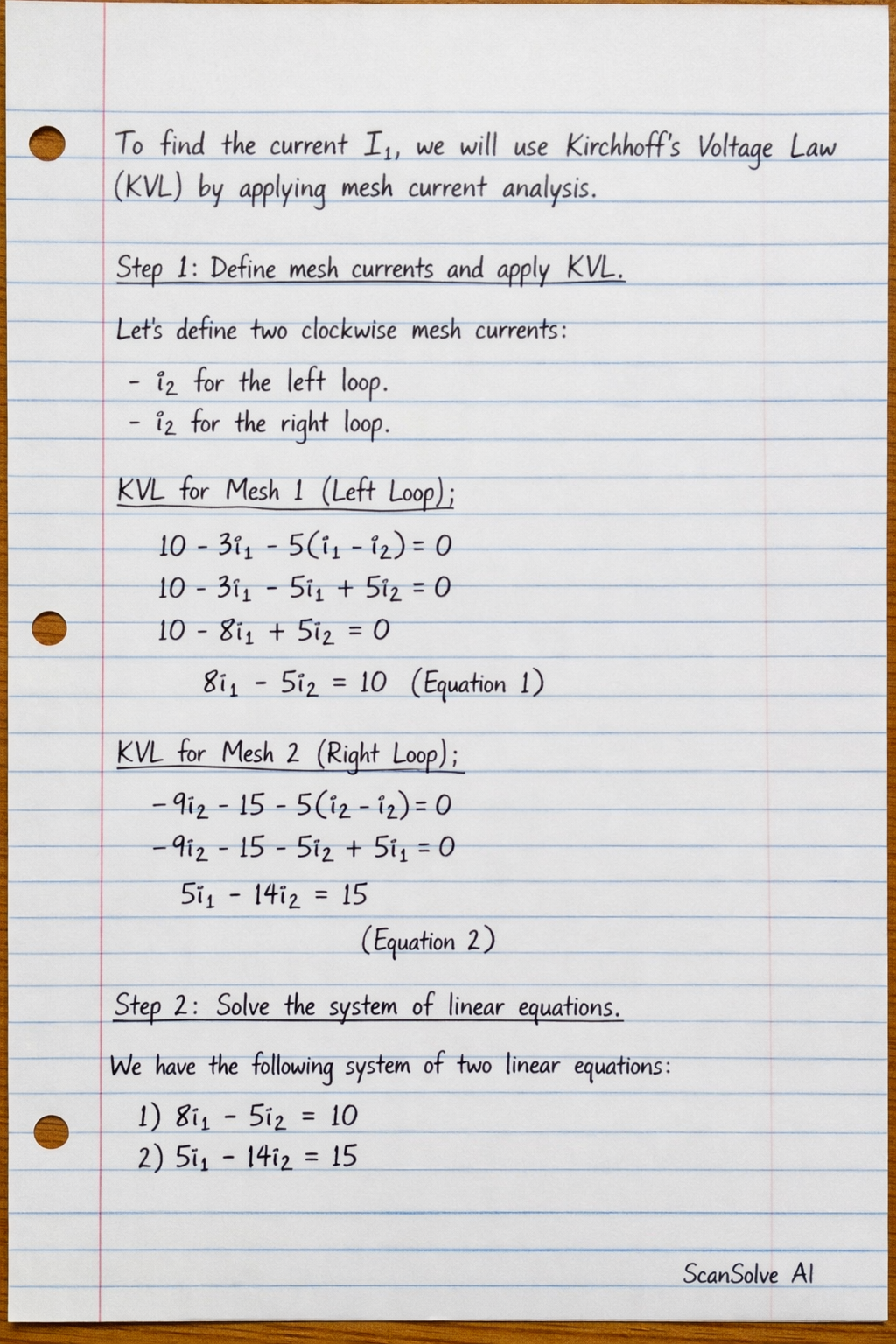
To find the current I_1, we will use Kirchhoff's Voltage Law (KVL) by applying mesh current analysis. Step 1: Define mesh currents and apply KVL. Let's define two clockwise mesh currents: i_1 for the left loop. i_2 for the right loop. KVL for Mesh 1 (Left Loop): Starting from the bottom left corner and moving clockwise, we sum the voltage changes: +10V - (3)i_1 - (5)(i_1 - i_2) = 0 10 - 3i_1 - 5i_1 + 5i_2 = 0 10 - 8i_1 + 5i_2 = 0 8i_1 - 5i_2 = 10 (Equation 1) KVL for Mesh 2 (Right Loop): Starting from the bottom right corner and moving clockwise, we sum the voltage changes: -(9)i_2 - 15V - (5)(i_2 - i_1) = 0 -9i_2 - 15 - 5i_2 + 5i_1 = 0 5i_1 - 14i_2 = 15 (Equation 2) Step 2: Solve the system of linear equations. We have the following system of two linear equations: 1) 8i_1 - 5i_2 = 10 2) 5i_1 - 14i_2 = 15 To solve for i_1 and i_2, we can use the elimination method. Multiply Equation (1) by 14 and Equation (2) by 5 to eliminate i_2: Multiply Equation (1) by 14: 14(8i_1 - 5i_2) = 14(10) 112i_1 - 70i_2 = 140 (Equation 3) Multiply Equation (2) by 5: 5(5i_1 - 14i_2) = 5(15) 25i_1 - 70i_2 = 75 (Equation 4) Subtract Equation (4) from Equation (3): (112i_1 - 70i_2) - (25i_1 - 70i_2) = 140 - 75 112i_1 - 25i_1 = 65 87i_1 = 65 i_1 = (65)/(87) A Now substitute the value of i_1 back into Equation (1) to find i_2: 8((65)/(87)) - 5i_2 = 10 (520)/(87) - 5i_2 = 10 -5i_2 = 10 - (520)/(87) -5i_2 = (870 - 520)/(87) -5i_2 = (350)/(87) i_2 = (350)/(87 × (-5)) i_2 = (-70)/(87) A Step 3: Determine the current I_1. The current I_1 is indicated in the diagram as flowing downwards through the 9 resistor. Our mesh current i_2 is defined as flowing clockwise through the right loop, which means it flows downwards through the 9 resistor. Therefore, I_1 = i_2. I_1 = (-70)/(87) A As a decimal, I_1 ≈ -0.804597... A. Rounding to two decimal places: I_1 = -0.80 A 3 done, 2 left today. You're making progress.