
This English question involves literary analysis, grammar, or writing skills. The detailed response below provides a well-structured answer with supporting evidence and clear explanations.
ScanSolve AI Answer
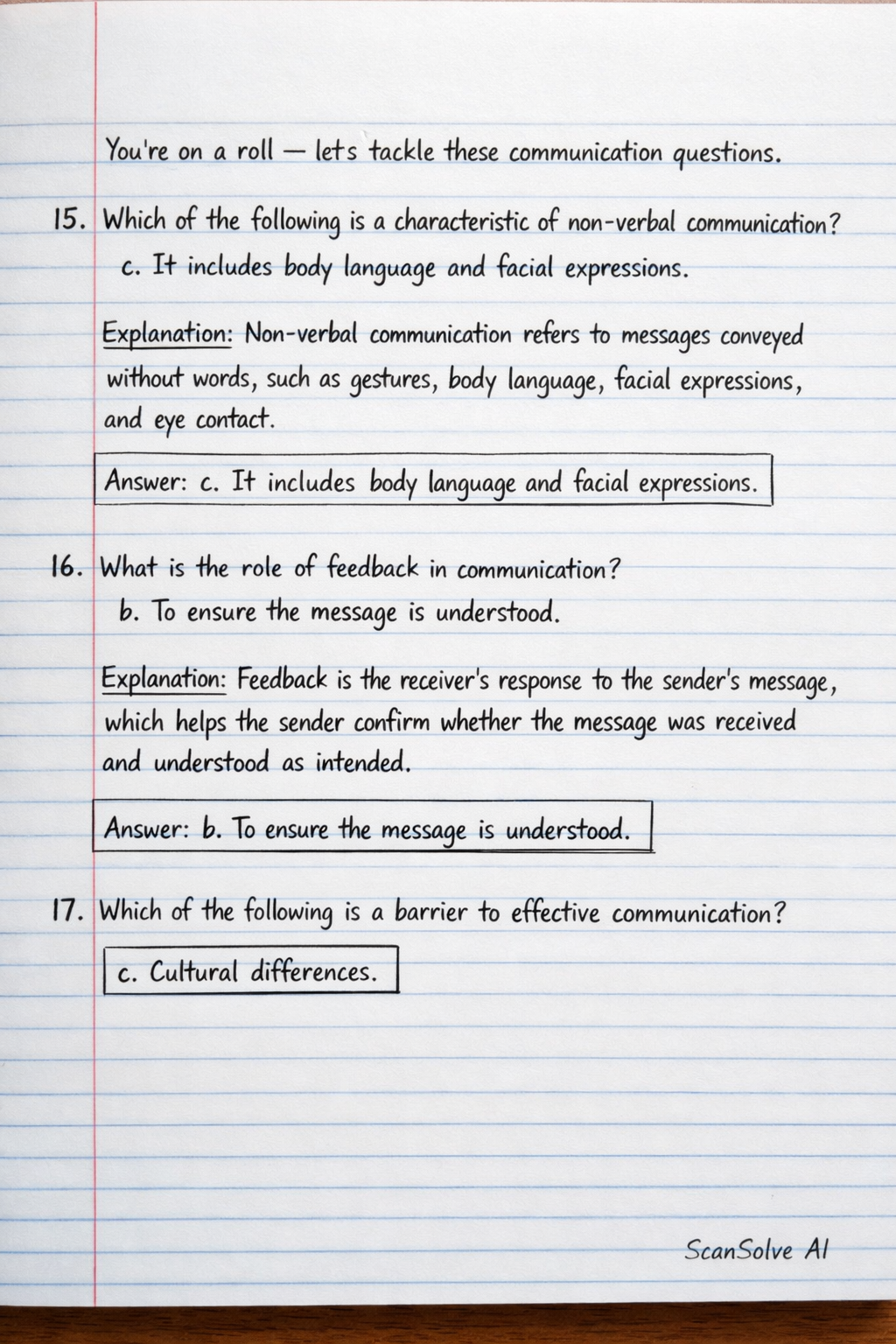
let's tackle these communication questions. 15. Which of the following is a characteristic of non-verbal communication? c. It includes body language and facial expressions Explanation: Non-verbal communication refers to messages conveyed without words, such as gestures, body language, facial expressions, and eye contact. Answer: c. It includes body language and facial expressions 16. What is the role of feedback in communication? b. To ensure the message is understood Explanation: Feedback is the receiver's response to the sender's message, which helps the sender confirm whether the message was received and understood as intended. Answer: b. To ensure the message is understood 17. Which of the following is a barrier to effective communication? c. Cultural differences Explanation: Cultural differences can lead to misunderstandings due to varying interpretations of words, gestures, or social norms, thus acting as a barrier to effective communication. Answer: c. Cultural differences 18. What is the purpose of active listening? c. To fully understand the speaker's message Explanation: Active listening involves fully concentrating on, understanding, responding to, and remembering what is being said, with the goal of comprehending the speaker's complete message. Answer: c. To fully understand the speaker's message 19. Which of the following is an example of downward communication? b. Manager giving instructions to employees Explanation: Downward communication flows from higher levels of an organization to lower levels, such as a manager providing instructions or directives to their employees. Answer: b. Manager giving instructions to employees 20. What is the primary goal of persuasive communication? c. To change the audience's beliefs or actions Explanation: Persuasive communication aims to influence the audience's attitudes, beliefs, or behaviors through arguments, appeals, or other rhetorical strategies. Answer: c. To change the audience's beliefs or actions 21. Which of the following is a characteristic of formal communication? b. It follows established channels and protocols Explanation: Formal communication adheres to official organizational structures, rules, and procedures, ensuring that information flows through designated channels. Answer: b. It follows established channels and protocols 22. What is the role of context in communication? b. To provide background information for understanding the message Explanation: Context refers to the circumstances, environment, or background information surrounding a communication event, which is crucial for correctly interpreting the message. Answer: b. To provide background information for understanding the message 23. Which of the following is an example of a communication channel? c. A telephone call Explanation: A communication channel is the medium through which a message is transmitted from the sender to the receiver. A telephone call is a common example of such a medium. Answer: c. A telephone call 24. What is the difference between one-way and two-way communication? b. Two-way communication involves feedback, while one-way does not Explanation: One-way communication is linear, with the sender transmitting a message without expecting immediate feedback. Two-way communication involves an exchange of messages and feedback between sender and receiver. Answer: b. Two-way communication involves feedback, while one-way does not 25. Which of the following is a benefit of non-verbal communication? b. It can convey emotions and attitudes Explanation: Non-verbal cues like facial expressions, tone of voice, and body posture are powerful in expressing emotions, attitudes, and intentions, often complementing or even overriding verbal messages. Answer: b. It can convey emotions and attitudes 26. What is the primary purpose of a presentation? b. To share information or persuade an audience Explanation: Presentations are typically designed to inform an audience about a topic, explain concepts, or convince them to adopt a particular viewpoint or take action. Answer: b. To share information or persuade an audience 27. Which of the following is a characteristic of effective listening? c. Asking clarifying questions Explanation: Effective listening involves actively engaging with the speaker, and asking clarifying questions is a key technique to ensure accurate understanding and demonstrate attentiveness. Answer: c. Asking clarifying questions 28. What is the role of cultural sensitivity in communication? c. To adapt communication to different cultural norms Explanation: Cultural sensitivity in communication means being aware of and respecting cultural differences, and adjusting one's communication style to be appropriate and effective in diverse cultural contexts. Answer: c. To adapt communication to different cultural norms 29. Which of the following is an example of upward communication? b. Employee submitting a report to a manager Explanation: Upward communication flows from lower levels of an organization to higher levels, such as an employee providing feedback, reports, or suggestions to their manager. Answer: b. Employee submitting a report to a manager 30. What is the main difference between mass communication and interpersonal communication? c. Mass communication targets a large, diverse audience, while interpersonal communication is between a few individuals Explanation: Mass communication involves transmitting messages to a large, often anonymous and heterogeneous audience (e.g., through media), whereas interpersonal communication occurs directly between a small number of individuals. Answer: c. Mass communication targets a large, diverse audience, while interpersonal communication is between a few individuals Send me the next one 📸