

This English question involves literary analysis, grammar, or writing skills. The detailed response below provides a well-structured answer with supporting evidence and clear explanations.
ScanSolve AI Answer
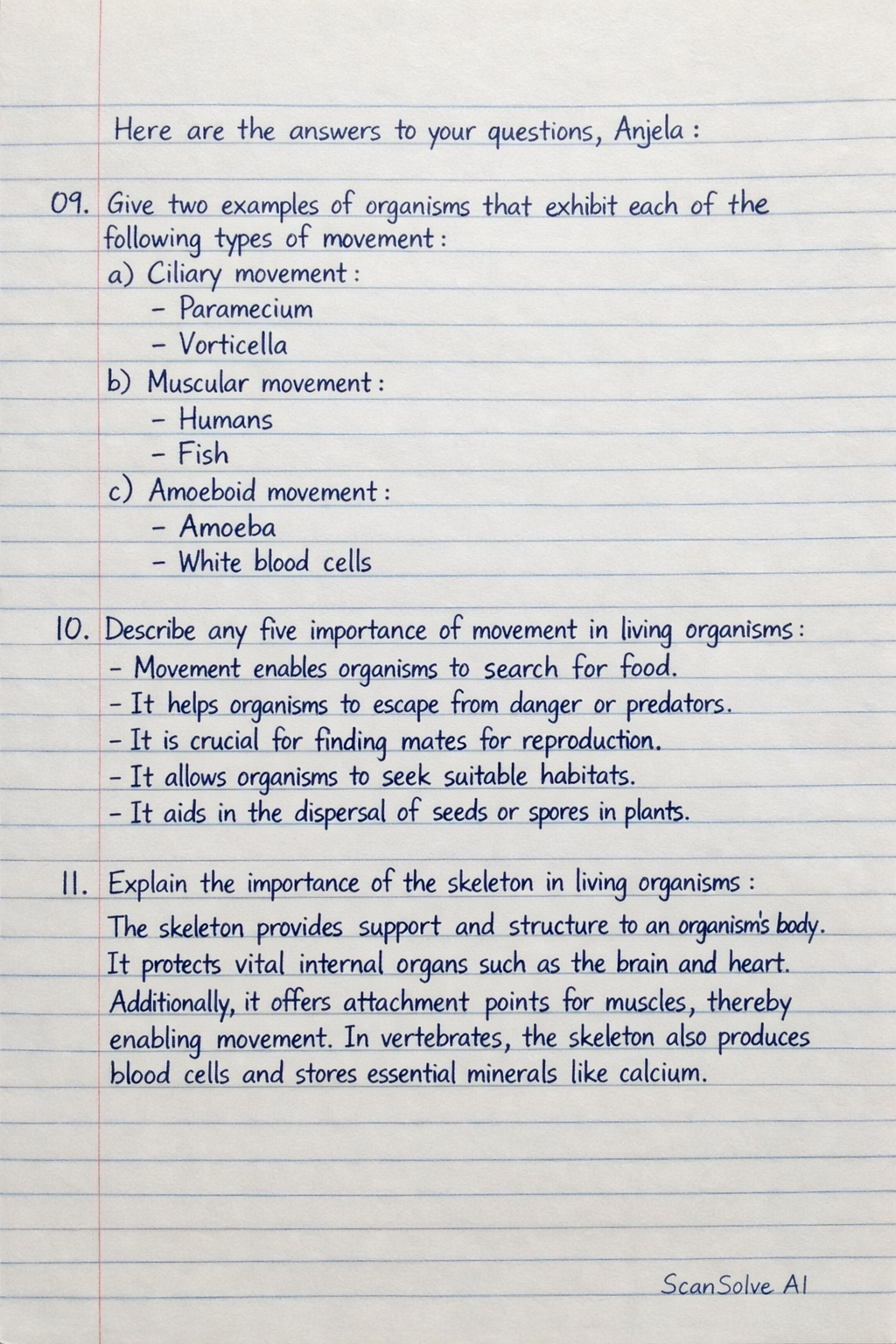
Here are the answers to your questions, Anjela: 09. Give two examples of organisms that exhibit each of the following types of movement: a) Ciliary movement: Paramecium* Vorticella* b) Muscular movement: Humans* Fish* c) Amoeboid movement: Amoeba* White blood cells* 10. Describe any five importance of movement in living organisms. Movement enables organisms to search for food*. It helps organisms to escape from danger* or predators. It is crucial for finding mates* for reproduction. It allows organisms to seek suitable habitats*. It aids in the dispersal of seeds* or spores in plants. 11. Explain the importance of the skeleton in living organisms. The skeleton provides support and structure to an organism's body. It protects vital internal organs such as the brain and heart. Additionally, it offers attachment points for muscles, thereby enabling movement. In vertebrates, the skeleton also produces blood cells and stores essential minerals like calcium. 12. a) Why are personal hygiene and food in general important in our daily life? Personal hygiene* is important because it prevents the spread of diseases, removes harmful microorganisms, and boosts self-confidence. Food is essential as it provides the energy needed for daily activities, supplies nutrients for growth and tissue repair, and strengthens the body's immune system*. b) Why is waste disposal a problem in our society (3 points)? Improper waste disposal leads to environmental pollution*, affecting land, water, and air. Accumulated waste attracts pests and rodents, causing the spread of diseases*. Waste buildup creates unpleasant odors* and degrades the aesthetic appeal of the community. 13. a) Explain how a plant cell prevents bursting when placed in a hypotonic solution. A plant cell has a rigid and inelastic cell wall. When placed in a hypotonic solution, water enters the cell by osmosis, causing the cell to swell and increase its turgor pressure. The cell wall prevents the cell from bursting by exerting an outward pressure that counteracts the internal pressure. b) What will be the effect on a recipient's blood when they have been transfused with incompatible blood from the donor? When incompatible blood is transfused, the recipient's immune system will attack the donor's red blood cells. This leads to clumping of blood cells (agglutination) and rupture of red blood cells (hemolysis), which can cause severe reactions such as fever, pain, kidney failure, and even death. c) State any three precautions to be taken during blood transfusion. Careful blood testing* to ensure compatibility between donor and recipient blood (blood grouping and cross-matching). Screening donor blood for diseases*, such as HIV, Hepatitis B and C, and syphilis. Monitoring the recipient* closely during and after the transfusion for any signs of adverse reactions. 14. An athlete in a running competition suddenly fell and was unable to stretch his legs due to severe pains. a) Name the process which occurred in plants and animals. The process that occurred is anaerobic respiration*. In animals, this leads to the accumulation of lactic acid, which causes muscle pain and fatigue. In plants, it also occurs under conditions of oxygen deficiency. b) Explain how this process is commercially and industrially useful (5 points). Food production: It is used in the production of bread (yeast produces carbon dioxide, making the dough rise) and alcoholic beverages* (yeast produces ethanol). Dairy products: Bacteria perform anaerobic respiration to produce yogurt, cheese*, and other fermented dairy products. Energy production: Ethanol produced through this process can be used as a biofuel*. Food preservation: It is used in the production of silage* for animal feed. Organic acid production:* Some important organic acids are produced using this process. 15. Explain the importance of the following biological facts: i) Ileum is very long The ileum is very long to increase the surface area for the absorption of nutrients* from digested food. This length, along with the presence of villi and microvilli, ensures efficient nutrient absorption. ii) Inactive form of pepsinogen in the stomach Pepsinogen is the inactive form of the enzyme pepsin. It exists in this form to protect the stomach walls* from self-digestion. It is converted to active pepsin only in the presence of hydrochloric acid, where it then begins to break down proteins. iii) Mucus in the gut Mucus in the gut is important for lubricating food so it can move easily through the digestive tract. It also forms a protective layer* that shields the gut lining from the strong stomach acid and digestive enzymes.