

This English question involves literary analysis, grammar, or writing skills. The detailed response below provides a well-structured answer with supporting evidence and clear explanations.
ScanSolve AI Answer
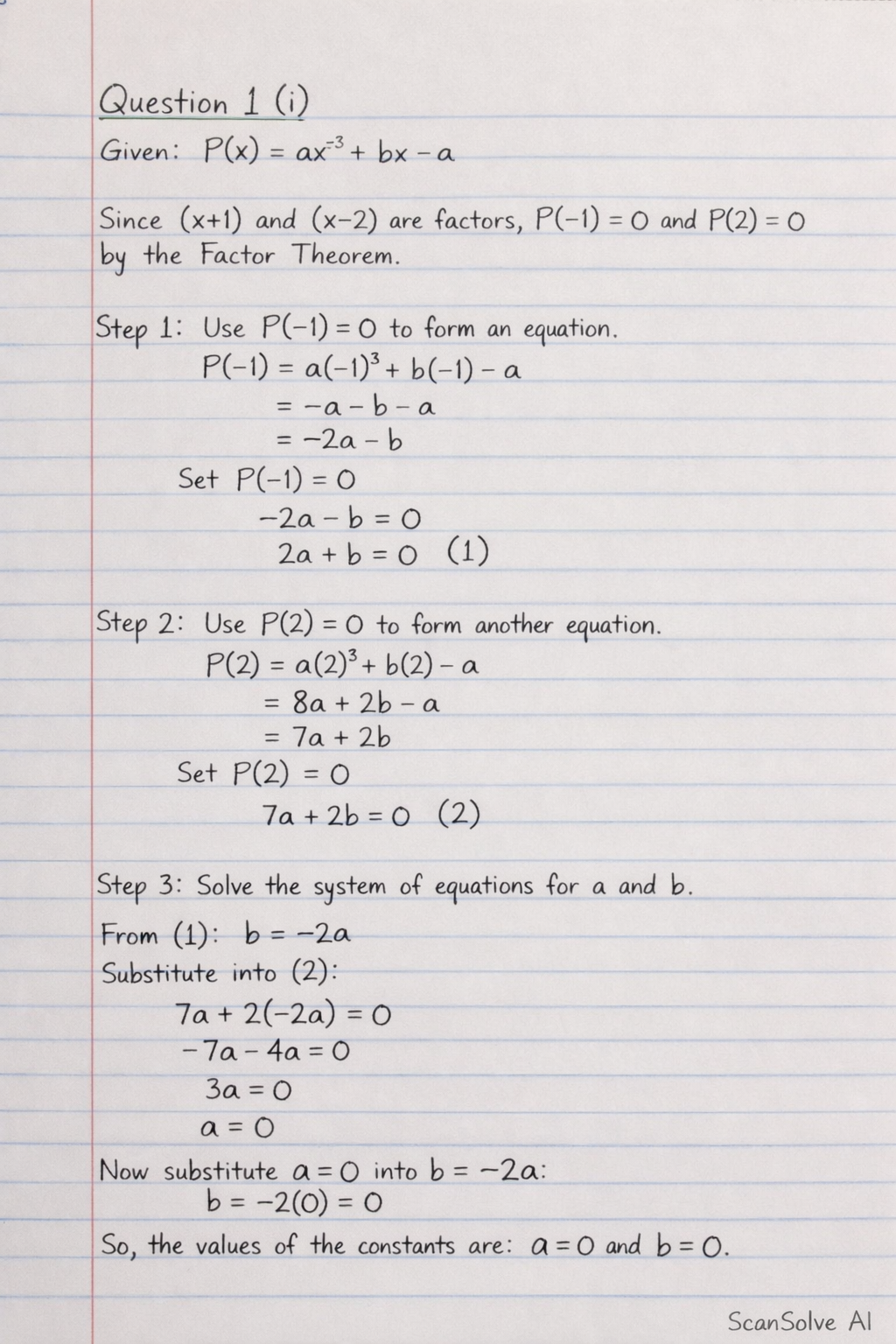
Here are the solutions to the questions from the image. Question 1 (i) Given the expression P(x) = ax^3 + bx - a. Since (x+1) and (x-2) are factors, by the Factor Theorem, P(-1) = 0 and P(2) = 0. Step 1: Use P(-1) = 0 to form an equation. P(-1) = a(-1)^3 + b(-1) - a = -a - b - a = -2a - b Setting P(-1) = 0: -2a - b = 0 2a + b = 0 (1) Step 2: Use P(2) = 0 to form another equation. P(2) = a(2)^3 + b(2) - a = 8a + 2b - a = 7a + 2b Setting P(2) = 0: 7a + 2b = 0 (2) Step 3: Solve the system of equations for a and b. From equation (1), we can express b in terms of a: b = -2a Substitute this into equation (2): 7a + 2(-2a) = 0 7a - 4a = 0 3a = 0 a = 0 Now substitute a=0 back into b = -2a: b = -2(0) = 0 So, the values of the constants are a=0 and b=0. Step 4: Find the remainder when the expression is divided by (x-1). The expression is P(x) = ax^3 + bx - a. With a=0 and b=0, the expression becomes P(x) = 0. By the Remainder Theorem, the remainder when P(x) is divided by (x-1) is P(1). P(1) = a(1)^3 + b(1) - a = a + b - a = b Since b=0, the remainder is 0. The values of the constants are a=0, b=0 and the remainder is 0. Question 1 (ii) Express as a single fraction (5)/(x^2+2x-3), simplifying the numerator. Step 1: Factor the denominator. We need to find two numbers that multiply to -3 and add to 2. These numbers are 3 and -1. So, x^2+2x-3 = (x+3)(x-1). Step 2: Write the fraction with the factored denominator. (5)/((x+3)(x-1)) The numerator is already simplified as it is a constant 5. The expression is already a single fraction. The simplified form of the fraction is (5)/((x+3)(x-1)). Question 6 (i) The functions f and g are defined by f(x) = (3)/(x-2), x R, x ≠ 2, and g(x) = (x-1)/(x+2), x R, x ≠ -2. (a) Find fg(x) and gf(x), stating their domains. Step 1: Find fg(x). fg(x) = f(g(x)) = f((x-1)/(x+2)). Substitute g(x) into f(x): fg(x) = (3)/((x-1)x+2) - 2 Simplify the denominator: (x-1)/(x+2) - 2 = (x-1)/(x+2) - (2(x+2))/(x+2) = (x-1 - 2x - 4)/(x+2) = (-x-5)/(x+2) So, fg(x) = (3)/(-x-5)x+2 = (3(x+2))/(-(x+5)) = -(3(x+2))/(x+5) Step 2: Determine the domain of fg(x). The domain of fg(x) requires two conditions: 1. x must be in the domain of g(x), so x ≠ -2. 2. g(x) must be in the domain of f(x), so g(x) ≠ 2. (x-1)/(x+2) ≠ 2 x-1 ≠ 2(x+2) x-1 ≠ 2x+4 -5 ≠ x Combining these, the domain of fg(x) is x R, x ≠ -2, x ≠ -5. fg(x) = -(3(x+2))/(x+5), Domain: \x R x ≠ -2, x ≠ -5\ Step 3: Find gf(x). gf(x) = g(f(x)) = g((3)/(x-2)). Substitute f(x) into g(x): gf(x) = ((3)/(x-2)) - 1((3)/(x-2)) + 2 Simplify the numerator: (3)/(x-2) - 1 = (3 - (x-2))/(x-2) = (5-x)/(x-2) Simplify the denominator: (3)/(x-2) + 2 = (3 + 2(x-2))/(x-2) = (3 + 2x - 4)/(x-2) = (2x-1)/(x-2) So, gf(x) = (5-x)/(x-2)(2x-1)/(x-2) = (5-x)/(2x-1) Step 4: Determine the domain of gf(x). The domain of gf(x) requires two conditions: 1. x must be in the domain of f(x), so x ≠ 2. 2. f(x) must be in the domain of g(x), so f(x) ≠ -2. (3)/(x-2) ≠ -2 3 ≠ -2(x-2) 3 ≠ -2x+4 2x ≠ 1 x ≠ (1)/(2) Combining these, the domain of gf(x) is x R, x ≠ 2, x ≠ (1)/(2). gf(x) = (5-x)/(2x-1), Domain: \x R x ≠ 2, x ≠ (1)/(2)\ (b) Show that g is not surjective. Step 1: Understand surjectivity. A function g: A B is surjective if for every element y in the codomain B, there exists at least one element x in the domain A such that g(x) = y. The function g(x) = (x-1)/(x+2) has a domain of R \-2\. Assuming the codomain is R. Step 2: Try to express x in terms of y. Let y = g(x). y = (x-1)/(x+2) Multiply both sides by (x+2): y(x+2) = x-1 yx + 2y = x-1 Rearrange to solve for x: 2y + 1 = x - yx 2y + 1 = x(1-y) x = (2y+1)/(1-y) Step 3: Identify values of y for which x does not exist. For x to be defined, the denominator 1-y cannot be zero. 1-y ≠ 0 y ≠ 1 This means that there is no value of x in the domain of g that can produce y=1. In other words, 1 is not in the range of g. Since the codomain of g is R (which includes 1), and the range of g does not include all values in the codomain (specifically, it does not include 1), the function g is not surjective. Since y=1 is not in the range of g(x), g is not surjective. Question 6 (ii) A relation R is defined on the set A = \1, 2, 3, 4, 5\ by aRb a+b = 2n, n N. List all the equivalence classes of A under R. Step 1: Understand the relation aRb. The condition a+b = 2n means that the sum a+b must be an even number. This occurs if and only if a and b have the same parity (both even or both odd). Step 2: Identify elements in set A by parity. Odd numbers in A: \1, 3, 5\ Even numbers in A: \2, 4\ Step 3: Determine the equivalence classes. An equivalence class [a] consists of all elements x A such that aRx. For a=1: [1] = \x A 1Rx\. This means 1+x must be even, so x must be odd. The odd numbers in A are \1, 3, 5\. So, [1] = \1, 3, 5\. For a=2: [2] = \x A 2Rx\. This means 2+x must be even, so x must be even. The even numbers in A are \2, 4\. So, [2] = \2, 4\. For a=3: [3] = \x A 3Rx\. This means 3+x must be even, so x must be odd. So, [3] = \1, 3, 5\. This is the same as [1]. For a=4: [4] = \x A 4Rx\. This means 4+x must be even, so x must be even. So, [4] = \2, 4\. This is the same as [2]. For a=5: [5] = \x A 5Rx\. This means 5+x must be even, so x must be odd. So, [5] = \1, 3, 5\. This is the same as [1]. The distinct equivalence classes are the sets of numbers with the same parity. The equivalence classes of A under R are \1, 3, 5\ and \2, 4\. Question 7 (i) This question was solved in a previous turn. The solution was = ()/(6), ()/(2), (5)/(6), (3)/(2). Question 7 (ii) This question was solved in a previous turn. The solution was Since (M) = -41 ≠ 0, the matrix M is invertible.. Last free one today — make it count tomorrow, or type /upgrade for unlimited.