
We read your photo as:
In the passage below, the numbered gaps indicate missing words. Against each number in the passage, five options are offered in columns lettered A to E. Fill each numbered gap with the most appropriate of the options (Nos. 71 - 80).
ScanSolve AI Answer
Answer
Step-by-step solution
20 stepsHere are the solutions to the passage completion questions:
Part 71· 2 steps
The sentence discusses the branches of government combined in a parliamentary system.
It mentions the "legislative branches."
In a parliamentary system, the executive and legislative branches are often combined, as the executive (prime minister and cabinet) is drawn from the legislature.
The correct option is C.
- C. executive
Part 72· 2 steps
The sentence refers to the "political head of state" who is chosen by the majority party.
In a parliamentary system, this figure is commonly called a "prime minister."
The correct option is C.
- C. minister
Part 73· 2 steps
The sentence states the prime minister is "chosen by the majority party in -73-."
The prime minister is chosen from within the parliament, which is the legislative body.
The correct option is A.
- A. parliament
Part 74· 2 steps
The sentence continues, "...to serve as the head of the -74- party."
The prime minister is the head of the majority party that forms the government.
The correct option is C.
- C. majority
Part 75· 2 steps
The sentence compares the prime minister's role to "the president plays in a -75- system."
A president is the head of state and government in a presidential system.
The correct option is C.
- C. presidential
Part 76· 2 steps
The sentence states, "...it is easier to pass -76- in a parliamentary system..."
Legislatures are primarily responsible for passing laws.
The correct option is A.
- A. laws
Part 77· 2 steps
The sentence explains that prime ministers are "neither directly -77- by the -78-."
Prime ministers are not directly elected by the general populace; they are chosen by the majority party in parliament.
The correct option is D.
- D. elected
Part 78· 2 steps
The sentence refers to who would directly elect a leader, contrasting with how prime ministers are chosen
"neither directly elected by the -78-."
If a leader were directly elected, it would be by the people.
The correct option is A.
- A. people
Part 79· 2 steps
The sentence mentions removal "through a no-confidence -79-."
A "no-confidence vote" is a standard procedure in parliamentary systems to challenge the government.
The correct option is A.
- A. vote
Part 80· 2 steps
The sentence concludes, "...if they were to lose the support of their -80-."
A prime minister needs to maintain the support of their party to remain in power.
The correct option is C.
- C. party
Try one yourself
A new problem that tests the same skill.
Still stuck on this one?
Ask a follow-up, and the answer starts from this question.
More English Questions
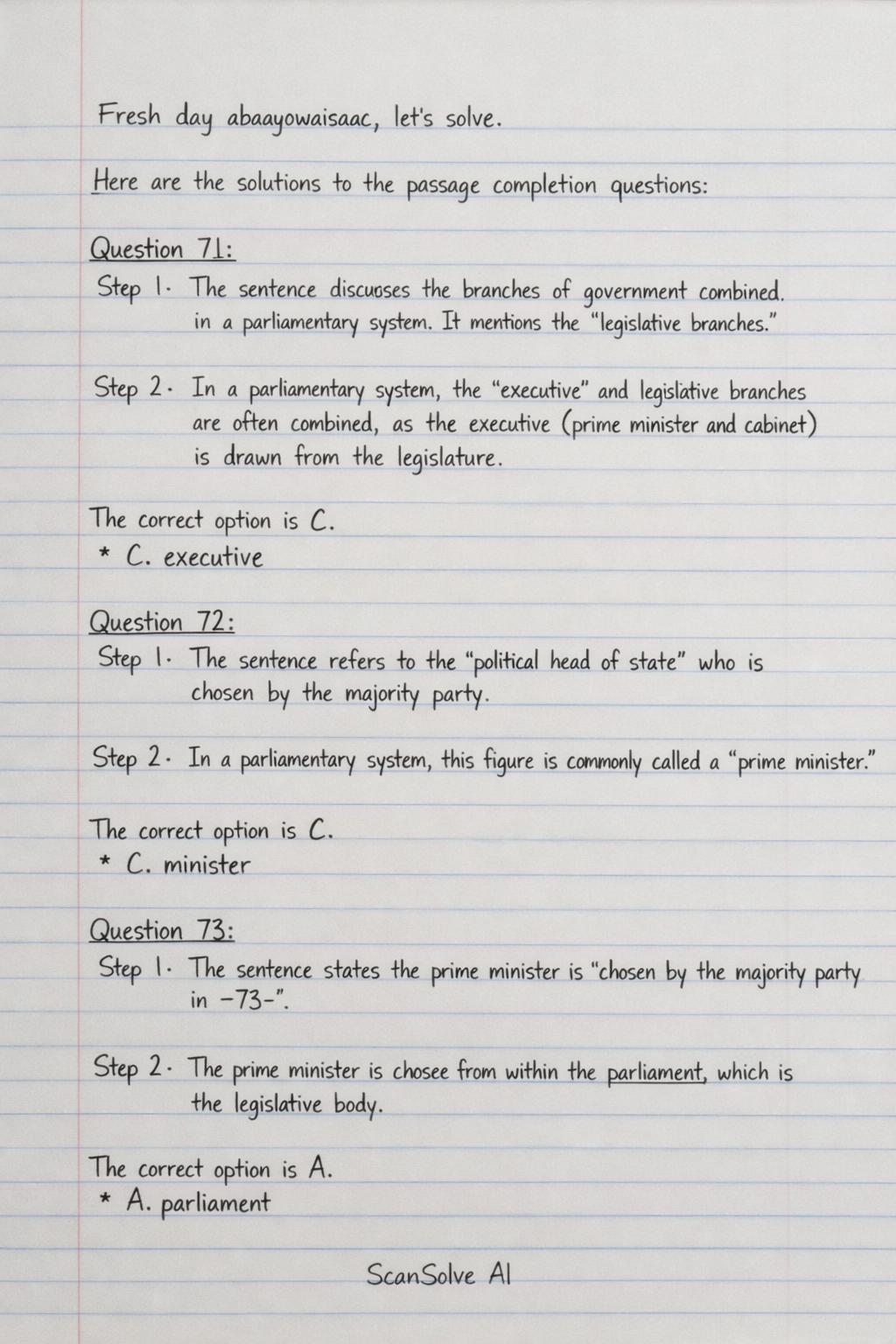
Handwritten Step-by-Step Solution
Get this as a handwritten image on WhatsApp — like a tutor wrote it for you.
Try on WhatsApp