

This English question involves literary analysis, grammar, or writing skills. The detailed response below provides a well-structured answer with supporting evidence and clear explanations.
ScanSolve AI Answer
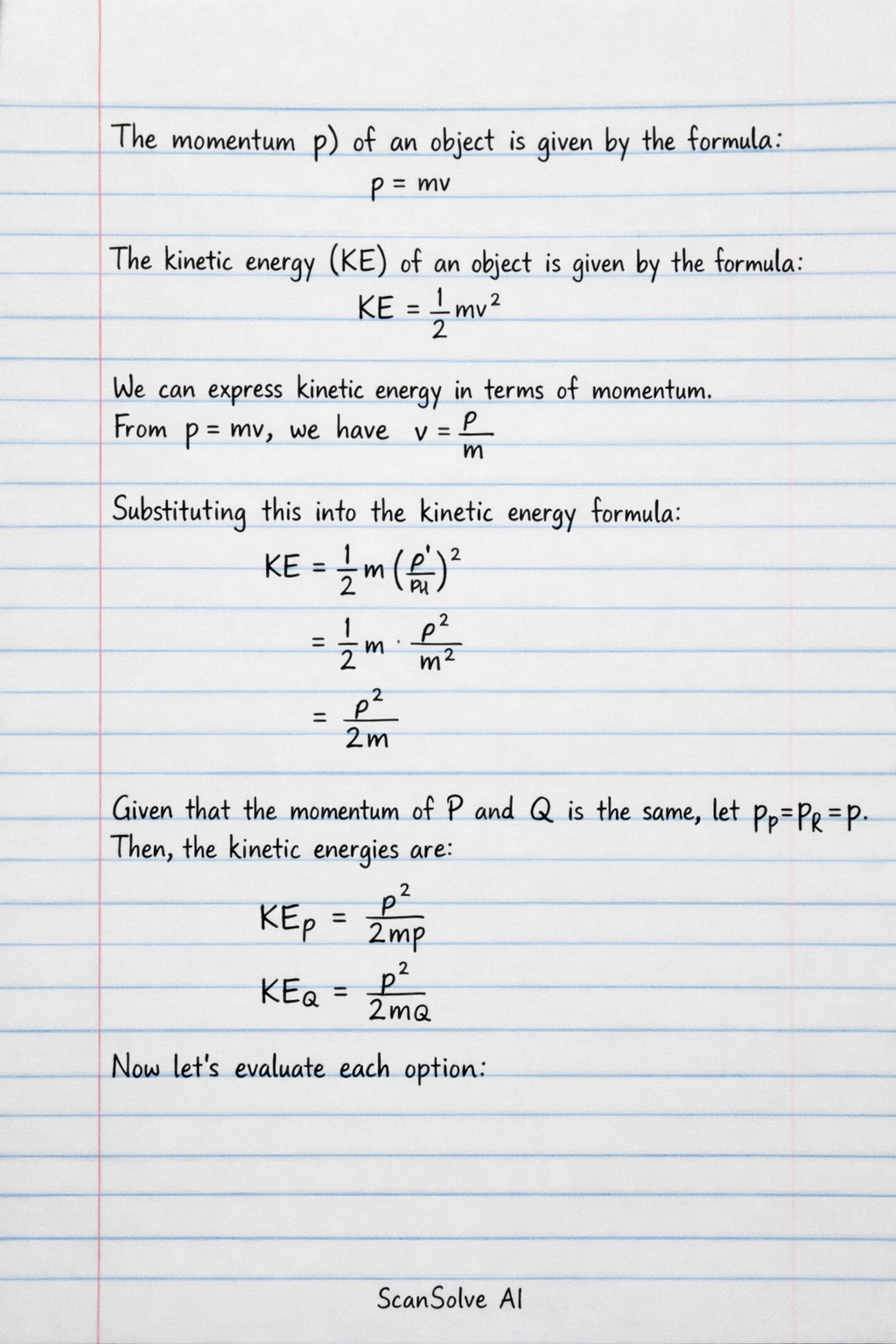
Here's the solution to the question: The question states that two objects P and Q have the same momentum. We need to determine which of the given statements is correct. Let m_P and v_P be the mass and velocity of object P, and m_Q and v_Q be the mass and velocity of object Q. The momentum (p) of an object is given by the formula: p = mv The kinetic energy (KE) of an object is given by the formula: KE = (1)/(2)mv^2 We can express kinetic energy in terms of momentum. From p = mv, we have v = (p)/(m). Substituting this into the kinetic energy formula: KE = (1)/(2)m((p)/(m))^2 = (1)/(2)m(p^2)/(m^2) = (p^2)/(2m) Given that the momentum of P and Q is the same, let p_P = p_Q = p. Then, the kinetic energies are: KE_P = (p^2)/(2m_P) KE_Q = (p^2)/(2m_Q) Now let's evaluate each option: (A) Kinetic energy of P equal to that of Q. For KE_P = KE_Q, we would need (p^2)/(2m_P) = (p^2)/(2m_Q). Since p is the same for both, this implies m_P = m_Q. However, the problem does not state that the masses of P and Q are equal. If their masses are different, their kinetic energies will be different. Therefore, this statement is not necessarily correct. (B) Kinetic energy of P is not equal to that of Q. This statement implies KE_P ≠ KE_Q. This is true if m_P ≠ m_Q. If m_P = m_Q, then KE_P = KE_Q. Since the masses are not specified, we cannot definitively say that their kinetic energies are always unequal. However, in physics, when two distinct objects are mentioned without specifying their masses, it is generally understood that their masses can be different. If their masses are different, then their kinetic energies will be different. This option highlights the fact that having the same momentum does not guarantee the same kinetic energy, which is a key concept. (C) Momentum of P and Q depends on velocity only. Momentum p = mv. It depends on both mass (m) and velocity (v). Therefore, this statement is incorrect. (D) The object with smaller mass has a lower kinetic energy. From the formula KE = (p^2)/(2m), if the momentum p is constant, kinetic energy (KE) is inversely proportional to mass (m). This means that an object with a smaller mass will have a higher kinetic energy. Therefore, this statement is incorrect. Comparing options (A) and (B), both are conditionally true. However, in the context of such physics questions, the intent is often to highlight that momentum and kinetic energy are distinct quantities and that equal momentum does not automatically imply equal kinetic energy. If the masses of the two objects are different, their kinetic energies will be different. Since the masses are not specified to be equal, it is a valid and common scenario for their kinetic energies to be unequal. The most appropriate answer, emphasizing the distinction between momentum and kinetic energy when masses can differ, is that the kinetic energies are not necessarily equal. The final answer is B. Drop the next question.