
We read your photo as:
Solve it in English from question 16 to 19
ScanSolve AI Answer
Answers
4 partsStep-by-step solution
8 stepsHere are the solutions for questions 16 to 19:
Part 16· 2 steps
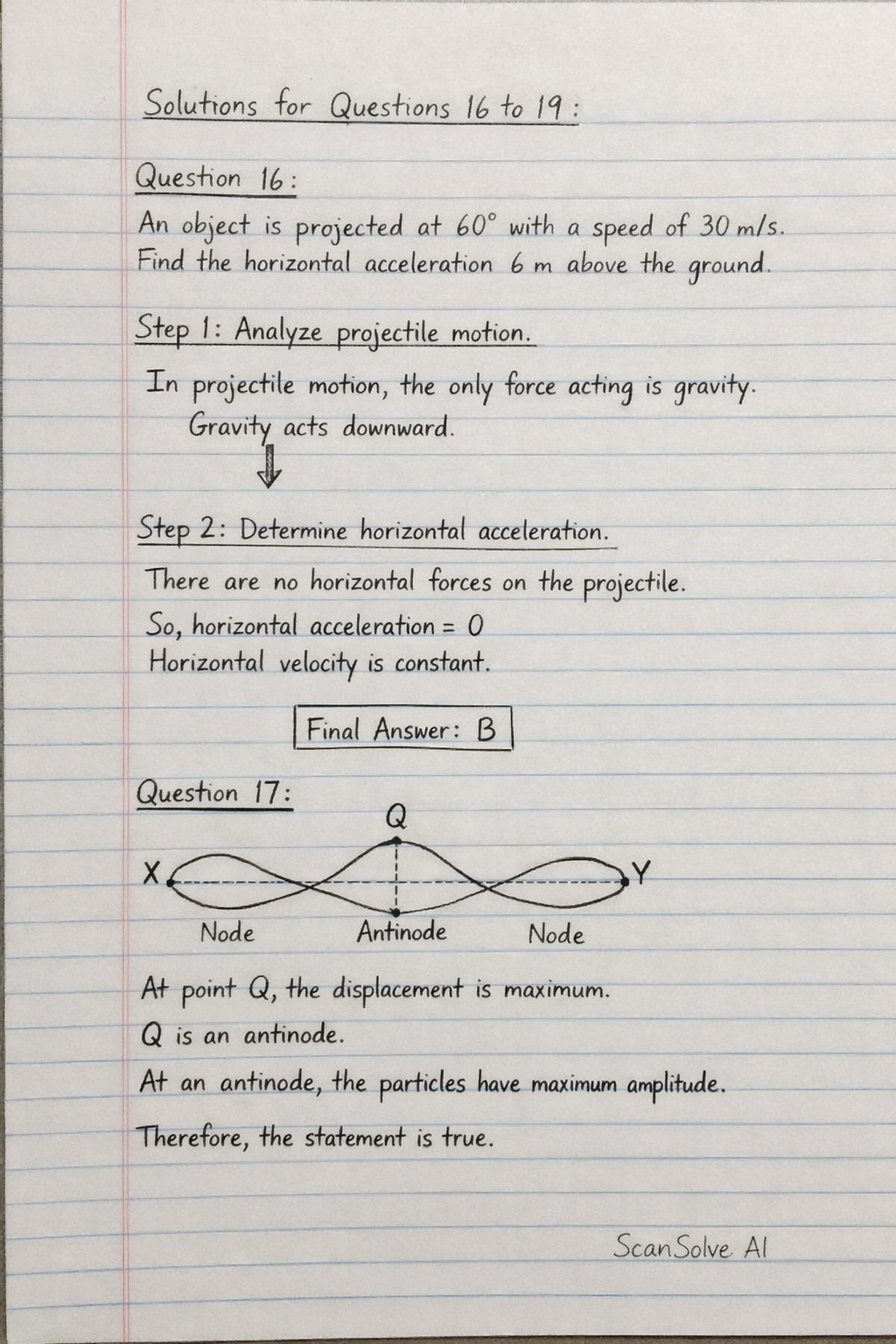
- Problem Statement: An object is projected from the ground at an angle of to the ground with a speed of . The horizontal acceleration at a point above is?
Understand projectile motion.
In projectile motion, assuming negligible air resistance, the only force acting on the object after it is launched is the force of gravity. Gravity acts vertically downwards.
Determine horizontal acceleration.
Since there are no horizontal forces acting on the projectile (ignoring air resistance), there is no horizontal acceleration. The horizontal velocity remains constant throughout the flight.
The final answer is .
Part 17
- Problem Statement: The figure below shows a stationary wave X to Y. The displacement at Q is maximum. Which of the following statements is true?
Analyze the stationary wave pattern.
The figure shows a stationary wave with nodes at X, P, R, and Y. The points of maximum displacement (antinodes) are between X and P, P and R, and R and Y. There are three antinodes shown.
A stationary wave with antinodes corresponds to the -th harmonic. Therefore, this wave is the 3rd harmonic ().Evaluate each statement.
- (A) The distance from P to R is one wavelength. P and R are consecutive nodes. The distance between two consecutive nodes in a stationary wave is half a wavelength (). So, this statement is incorrect.
- (B) A short time later, the string at R will move up. R is a node. Nodes are points on a stationary wave that always have zero displacement and zero velocity. They do not move. So, this statement is incorrect.
- (C) The lowest possible frequency for this string is one third of its current value. The current wave is the 3rd harmonic (). The fundamental frequency () is the lowest possible frequency. For a string fixed at both ends, the frequencies of the harmonics are integer multiples of the fundamental frequency: . So, . This means . Therefore, the lowest possible frequency is one third of its current value. This statement is correct.
- (D) The kinetic energy of the string has its maximum value. The problem states that the displacement at Q (an antinode) is maximum. At the instant of maximum displacement, all points on a stationary wave are momentarily at rest (zero velocity). Therefore, the kinetic energy of the entire string is zero at this instant, not maximum. The kinetic energy is maximum when the string passes through its equilibrium position (zero displacement). So, this statement is incorrect.
The final answer is .
Part 18
- Problem Statement: What is the phase difference between two points apart on a progressive sound wave of frequency given that the speed of sound is ?
Calculate the wavelength () of the sound wave.
The relationship between wave speed (), frequency (), and wavelength () is .
Substitute the given values:
Calculate the phase difference ().
The phase difference () between two points separated by a distance on a progressive wave is given by:
Substitute the calculated wavelength and the given distance:
This value is very close to , which is .
Let's verify with fractions:
If .
And . The values are very close, suggesting the intended answer is .The final answer is .
Part 19
- Problem Statement: When light of wavelength is incident normally on a diffraction grating, the fourth-order maximum is observed at an angle of . What is the number of lines per meter on the grating?
Use the diffraction grating equation to find the grating spacing ().
The condition for constructive interference (maxima) for a diffraction grating is given by:
Where:
- is the grating spacing (distance between adjacent lines).
- is the angle of the maximum ().
- is the order of the maximum (4 for the fourth-order maximum).
- is the wavelength of light ().
Rearrange the equation to solve for :
Substitute the given values:
We know that .
Calculate the number of lines per meter ().
The number of lines per meter () is the reciprocal of the grating spacing ():
Substitute the calculated value of :
The final answer is .
Try one yourself
A new problem that tests the same skill.
Still stuck on this one?
Ask a follow-up, and the answer starts from this question.
More English Questions
Handwritten Step-by-Step Solution
Get this as a handwritten image on WhatsApp — like a tutor wrote it for you.
Try on WhatsApp