
We read your photo as:
Solve it in English language and step by step
ScanSolve AI Answer
Answers
3 partsStep-by-step solution
15 steps1. Prove that is irrational.
Step 1: Assume, for the sake of contradiction, that is a rational number.
If is rational, it can be expressed as a fraction , where and are integers, , and and are coprime (their greatest common divisor is 1).
Step 2: Square both sides of the equation.
Rearrange the equation:
This implies that is a multiple of 5. If a prime number divides , then divides . Thus, is a multiple of 5.
Step 3: Since is a multiple of 5, we can write for some integer .
Substitute into the equation :
Step 4: Divide both sides by 5.
This implies that is a multiple of 5. Therefore, is also a multiple of 5.
Step 5: From Step 2, we found that is a multiple of 5. From Step 4, we found that is a multiple of 5.
This means that and have a common factor of 5.
Step 6: This contradicts our initial assumption in Step 1 that and are coprime.
Therefore, our initial assumption that is rational must be false.
Hence, is an irrational number.
2. Prove that is irrational.
Step 1: Assume, for the sake of contradiction, that is a rational number.
If is rational, it can be expressed as a fraction , where and are integers, , and and are coprime.
Step 2: Isolate the term.
Subtract 3 from both sides:
Step 3: Divide by 2 to completely isolate .
Step 4: Analyze the right-hand side of the equation.
Since and are integers, is an integer, and is a non-zero integer.
Therefore, is a rational number.
Step 5: This implies that is a rational number.
However, we know that is irrational.
Step 6: This is a contradiction. Our initial assumption that is rational must be false.
Therefore, is an irrational number.
3. Prove that the following are irrationals:
Part i· 5 steps
Assume, for the sake of contradiction, that is a rational number.
If is rational, it can be expressed as a fraction , where and are integers, , and and are coprime.
Rearrange the equation to isolate .
Take the reciprocal of both sides:
Analyze the right-hand side of the equation.
Since and are integers, and , is a rational number.
This implies that is a rational number.
However, it is a known mathematical fact that is irrational.
This is a contradiction.
Our initial assumption that is rational must be false.
Therefore, is an irrational number.
Part ii
Assume, for the sake of contradiction, that is a rational number.
If is rational, it can be expressed as a fraction , where and are integers, , and and are coprime.
Isolate .
Divide both sides by 7:
Analyze the right-hand side of the equation.
Since and are integers, is an integer, and is a non-zero integer.
Therefore, is a rational number.This implies that is a rational number.
However, we know that is irrational.
This is a contradiction.
Our initial assumption that is rational must be false.
Therefore, is an irrational number.
Part iii
Assume, for the sake of contradiction, that is a rational number.
If is rational, it can be expressed as a fraction , where and are integers, , and and are coprime.
Isolate .
Subtract 6 from both sides:
Analyze the right-hand side of the equation.
Since and are integers, is an integer, and is a non-zero integer.
Therefore, is a rational number.This implies that is a rational number.
However, it is a known mathematical fact that is irrational.
This is a contradiction.
Our initial assumption that is rational must be false.
Therefore, is an irrational number.
Try one yourself
A new problem that tests the same skill.
Still stuck on this one?
Ask a follow-up, and the answer starts from this question.
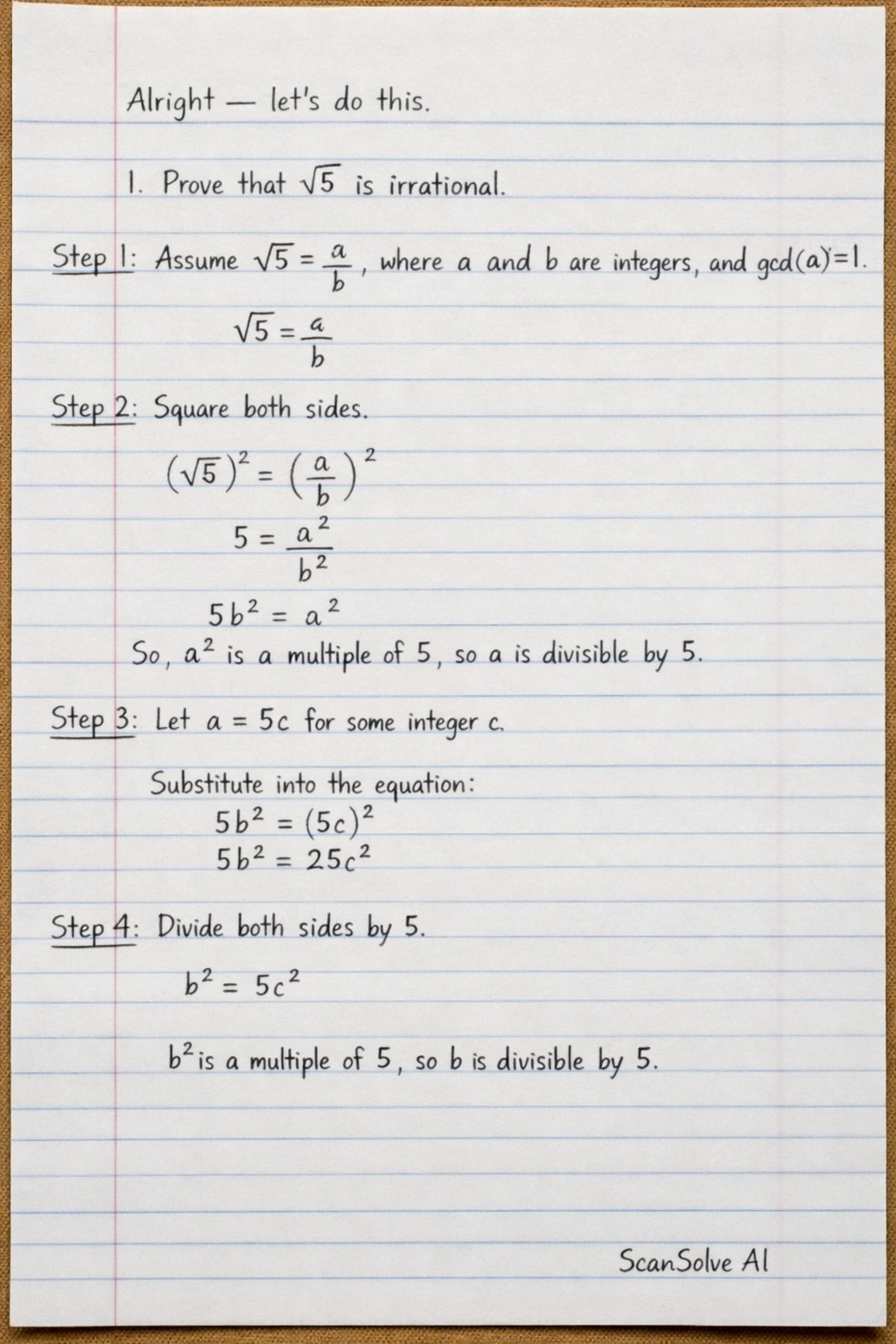
Handwritten Step-by-Step Solution
Get this as a handwritten image on WhatsApp — like a tutor wrote it for you.
Try on WhatsApp