
We read your photo as:
Solve it in English No mistakes
English
ScanSolve AI Answer
Step-by-step solution
3 stepsTo show that a matrix M is invertible, we need to demonstrate that its determinant is non-zero.
Identify the given matrix.
The matrix M is given as:
Calculate the determinant of the matrix M.
For a matrix , the determinant is calculated as .
For matrix M, we have , , , and .Conclude whether the matrix is invertible.
Since the determinant of M is , which is not equal to zero (), the matrix M is invertible.
Was this helpful?
Still stuck on this one?
Ask a follow-up, and the answer starts from this question.
Got a different question?Ask your own question
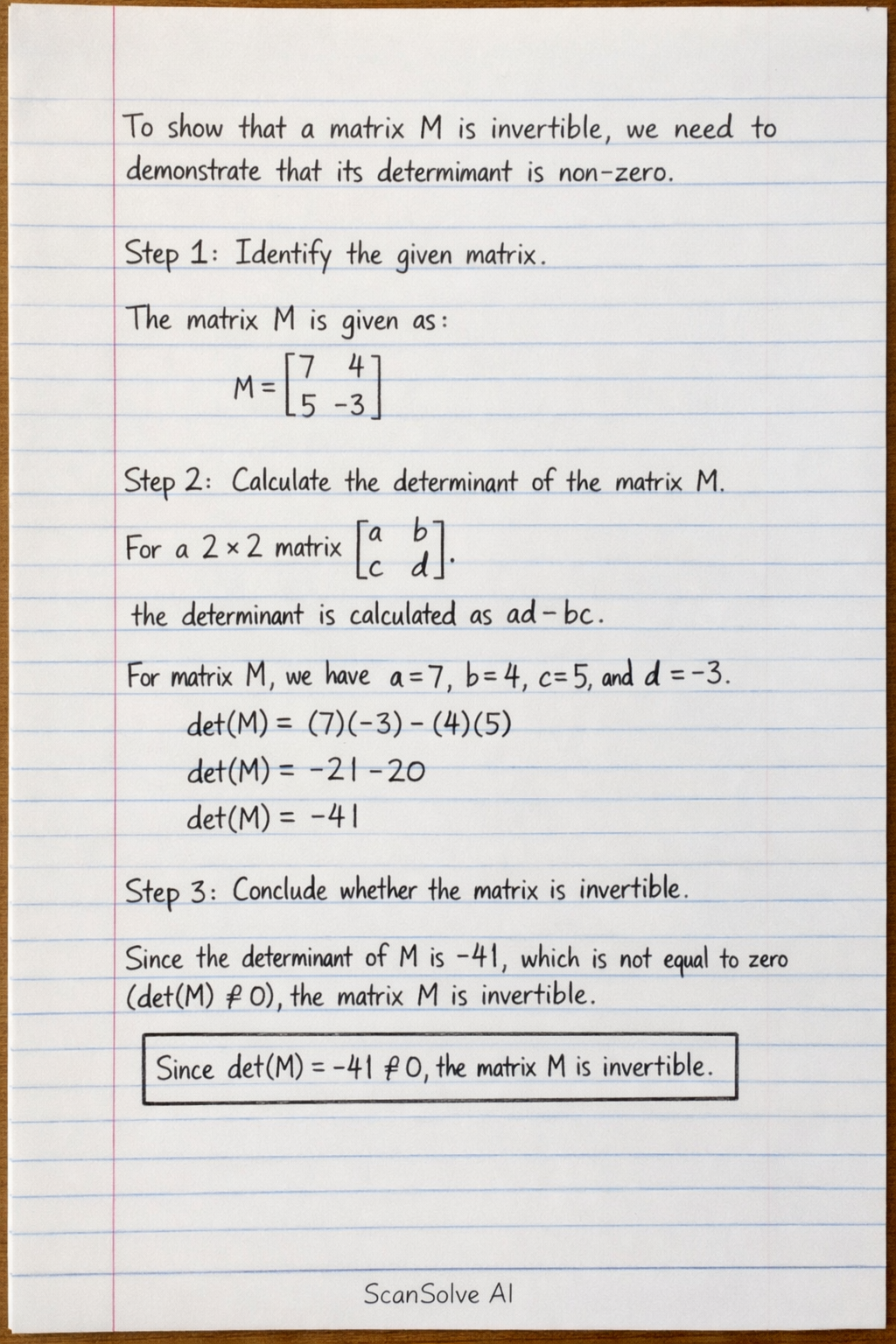
Handwritten Step-by-Step Solution
Get this as a handwritten image on WhatsApp — like a tutor wrote it for you.
Try on WhatsApp