
We read your photo as:
It should be sove in english
ScanSolve AI Answer
Answers
2 partsStep-by-step solution
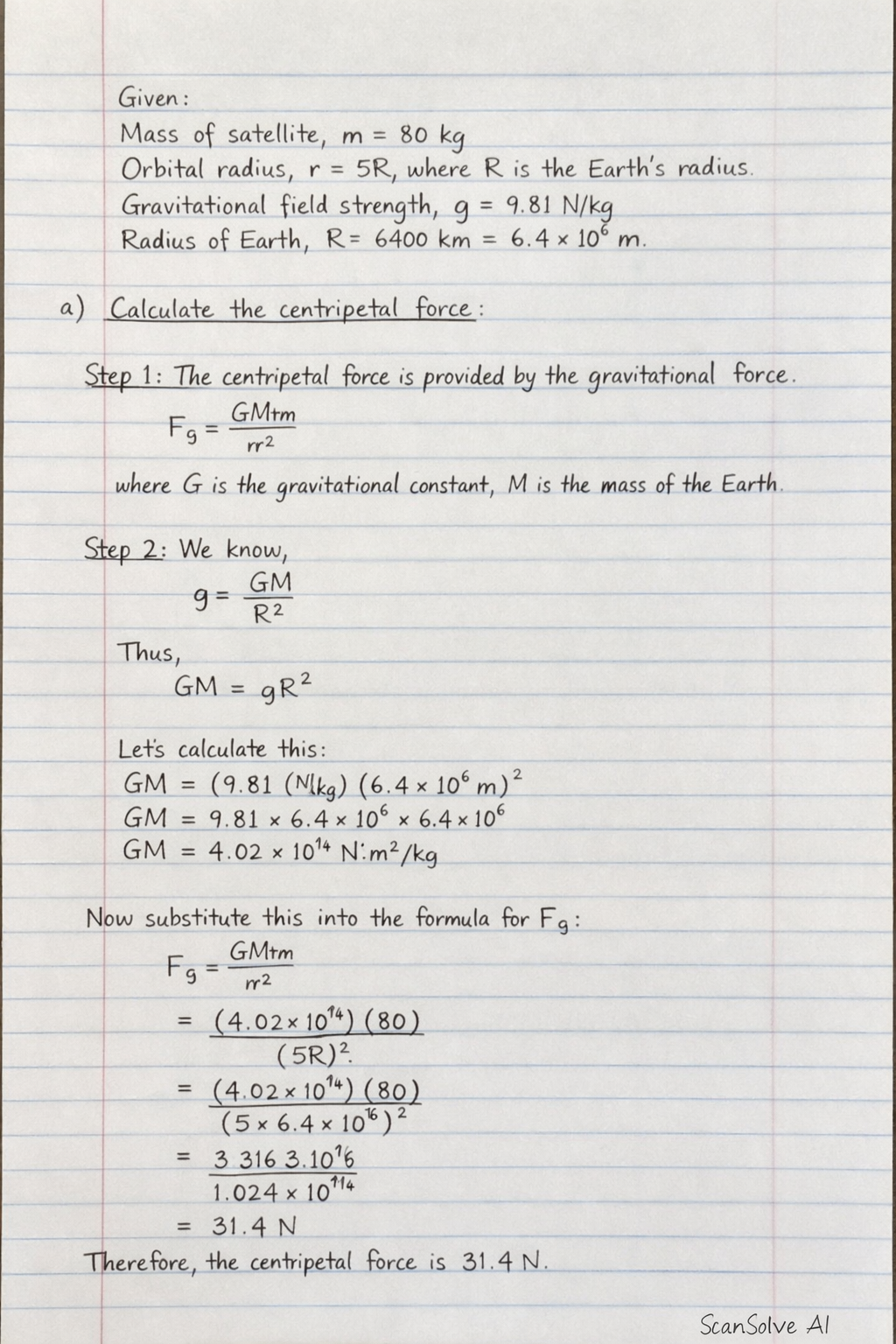
10 stepsHere's the information provided:
- Mass of the satellite,
- Orbital radius, , where is the mean radius of the Earth.
- Gravitational field strength at the Earth's surface,
- Radius of the Earth,
Part a· 4 steps
Calculate the centripetal force
The centripetal force required to keep the satellite in orbit is provided by the gravitational force.
The gravitational force is given by Newton's Law of Universal Gravitation:
where is the gravitational constant and is the mass of the Earth.
We know that the gravitational field strength at the Earth's surface is .
From this, we can express as .
Substitute this expression for into the gravitational force formula.
Since the centripetal force is equal to the gravitational force :
Given that the orbital radius is , substitute this value:
The terms cancel out:
Now, substitute the numerical values
The centripetal force is .
Part b
Calculate the period of the satellite in orbit
For a satellite in a circular orbit, the centripetal force is equal to the gravitational force.
The centripetal force can also be expressed as , where is the orbital speed of the satellite.
So, we have:Simplifying and :
The orbital speed is also related to the period by the relation .
Squaring this gives:
Equate the two expressions for
Rearrange to solve for :
Substitute and into the equation for
Take the square root to find
Now, substitute the numerical values
The period of the satellite is approximately .
Try one yourself
A new problem that tests the same skill.
Still stuck on this one?
Ask a follow-up, and the answer starts from this question.
Handwritten Step-by-Step Solution
Get this as a handwritten image on WhatsApp — like a tutor wrote it for you.
Try on WhatsApp