
JAMB MOCK CHEMISTRY QUESTIONS: 1. H₂S(g) + Cl₂(g) → 2HCl(g) + S(s) - the oxidizing agent is? A. S B. HCl C. Cl₂ D. H₂S 2. N₂ + 3H₂ ⇌ 2NH₃ ΔH = −90KJ - yield of ammonia decreased by? A. Increasing temperature B. Adding catalyst C. Increasing pressure D. Removing ammonia 3. Organic compound with 29.3% C, 5.7% H, 65.0% Br - empirical formula? A. C₃H₇Br B. C₂H₆Br C. CH₃Br D. C₄H₇Br 4. Organic compound giving effervescence with NaHCO₃ is? A. Alkanoate B. Alkanoic Acid C. Alkanone D. Amine 5. Molecular formula for 2-methylpropanoic acid? A. CH₃(CH₂)₃COOH B. CH₃(CH₂)₂COOH C. (CH₃)₂CHCOOH D. CH₃CH₂COOH 6. Alkaline derivative used as disinfectant? A. CHI₃ B. CHF₃ C. CHCl₃ D. CCl₄ 7. CH₃CH₂COOC₂H₅ is the product of reaction between? A. Ethanoic acid and Propanol B. Propanoic acid and Ethanol C. Propanoic acid and Propanol D. Ethanoic acid and Ethanol 8. Detergents are manufactured with straight hydrocarbon chains to make them? A. Foamy B. Soluble C. Biodegradable D. Alkaline 9. Product of decarboxylation of phenylmethanoic acid? A. Ethane B. Ethene C. Butanol D. Benzene 10. Residual solids from fractional distillation of petroleum used as? A. Fuel for tractors B. Coatings for pipes C. Raw materials for cracking D. Aviation fuels 11. Organic compound formed when acid anhydrides are treated with concentrated NH₃? A. Amines B. Amino acids C. Ethanoate D. Amides 12. Reduction of Alkanones with LiAlH₄ produces? A. Secondary alkanols B. Primary alkanols C. Polyhydric alkanols D. Tertiary alkanols 13. A certain mass of hydrogen gas collected over water at 20°C and 760 mmHg has a volume of 40 cm³. Calculate volume when dry at STP. A. 41.9 B. 36.4 C. 51.2 D. 37.3 14. Volume occupied by 25 moles of ideal gas at −23°C and 4 atm? A. 15.17 dm³ B. 38.84 dm³ C. 80 dm³ D. 128.1 dm³ 15. Non-volatile residue from destructive distillation of coal? A. Coal tar B. Lamp black C. Coke D. Coal gas 16. Gas used as anaesthetic? A. NO₂ B. N₂O C. NH₃ D. NO 17. Product when chlorine is added to slaked lime? A. Trioxochlorate(V) salt B. Chlorinated water C. Oxychlorate D. Bleaching powder 18. When chlorine gas bleaches, gas liberated is? A. O₂ B. HCl(g) C. H₂ D. Cl₂ 19. When stream of air passed through alkaline pyrogallol and caustic potash, constituents removed are? A. CO₂ & O₂ B. O₂ & CO₂ C. N₂ & O₂ D. O₂ & N₂ 20. Type of iron for making objects not requiring high tensile strength? A. Pig iron B. Cast iron C. Wrought iron D. Iron rust 21. Aqua regia - ratio of concentrated HCl to HNO₃? A. 1:1 B. 2:1 C. 3:1 D. 1:3 22. The number of valence electrons in X₈ and Y₁₄ are? A. 8, 4 B. 4, 8 C. 2, 6 D. 6, 2 23. A source of tartaric acid is? A. Grapes B. Lemons C. Oranges D. Apples 24. Salt used in making gunpowder and matches is? A. Potassium nitrate B. Sodium nitrate C. Calcium carbonate D. Sodium chloride 25. Bond between H₂O and H⁺? A. Dative B. Ionic C. Covalent D. Metallic 26. Solution conducting highest electricity? A. 2.0M HCl B. 0.5M Ethanoic acid C. 2.0M Ethanoic acid D. 0.5M HCl 27. Ionization energy of fluorine is far higher than potassium due to differences in? A. Atomic size B. Electron config C. Nuclear charge D. All of the above 28. A chemical reaction in which enthalpy change is positive is? A. Endothermic B. Exothermic C. Neutral D. Spontaneous 29. Members of a homologous series? A. Same functional group B. Same molecular formula C. Same physical properties D. Same reactivity 30. Use of tetraethyl lead in petrol reduced because? A. Toxic B. Expensive C. Polluting D. Ineffective 31. Raw material for manufacture of synthetic plastics? A. Ethene B. Propene C. Butene D. Benzene 32. Gas used in fountain experiment? A. HCl B. SO₂ C. NO₂ D. H₂S 33. Zone of a flame representing incomplete combustion? A. Luminous zone B. Non-luminous zone C. Inner cone D. Outer cone 34. Commercial preparation of hydrogen? A. Steam reforming B. Electrolysis C. Reaction with acid D. Thermal decomposition 35. Gold does not require extraction because? A. It's inert B. It occurs free in nature C. Expensive to extract D. Rare 36. Major effect of oil pollution in coastal water? A. Harm aquatic life B. Affect tourism C. Contaminate water D. All of the above 37. Major advantage of hard water over soft water? A. Better lather B. Health benefits C. Forms stalactites D. Less soap needed 38. During filtration, the filtrate and residue respectively are? A. Solution, solid B. Solid, solution C. Liquid, solid D. Solid, liquid 39. Phenomenon when molecules escaping from liquid equals those returning? A. Equilibrium B. Evaporation C. Condensation D. Sublimation 40. Stainless steel is an alloy of iron with? A. Mn and Mg B. Cr and Ni C. Copper D. Pb 41. Sudan III reagent reacts with fats/oils to give what colour? A. Brown B. Red C. White D. Yellow 42. Electrolysis calculation (It/cf = m/M)? A. Faraday's law B. Ohm's law C. Coulomb's law D. Avogadro's law 43. Two solubility calculations A. (calculations needed) B. (calculations needed) 44. Compound used for removing grease? A. CHCl₃ B. CCl₄ C. CH₄ D. CH₃Cl 45. Which gas law relates pressure and volume at constant temperature? (Boyle's) A. Charles' law B. Boyle's law C. Avogadro's law D. Gay-Lussac's law 46. Total protons and neutrons present in X²⁺? A. Mass number B. Atomic number C. Proton number D. Neutron number 47. Calculation on empirical formula? A. (calculation needed) 48. Find density of resulting mixture: 32g of kerosene (density 0.8 g/cm³) mixed with 8g of water? A. 0.8 g/cm³ B. 1 g/cm³ C. 0.9 g/cm³ D. 1.2 g/cm³ 49. Phosphorus has decay constant 5.85 × 10⁻³ s⁻¹. Find its half-life. A. 5.85×10⁻³ s B. 170.9 s C. 118.461 s D. 5s 50. Equation for oxidation of SO₂ into SO₃? A. SO₂ + O₂ → SO₃ B. 2SO₂ + O₂ → 2SO₃ C. SO + O → SO₃ D. 2SO₃ → 2SO₂ + O₂ 51. Which is involved in the Bosch Process? A. SO₂ + O₂ → SO₃ B. C + H₂O → CO + H₂ C. 2Al(OH)₃ → Al₂O₃ + 3H₂O D. N₂ + 3H₂ → 2NH₃ 52. Why isn't gold extracted? A. It's inert B. It occurs free in nature C. Expensive to extract D. Rare 53. Chemical property between CH₃CH₂OH and CH₃OCH₃? A. Isomerism B. Allotropy C. Isotopy D. Resonance 54. Why is hard water preferred over soft water? A. Better lather B. Tastes better C. Forms stalactites D. Less soap needed 55. Glucose is a type of? A. Monosaccharide B. Disaccharide C. Polysaccharide D. Carbohydrate 56. Oxidation product of ethanol? A. Ethanoic acid B. Methanoic acid C. Propanoic acid D. Butanoic acid 57. Element with atomic number 16? A. Sulfur B. Oxygen C. Nitrogen D. Phosphorus 58. Members of a homologous series have? A. Same functional group B. Same molecular formula C. Same physical properties D. Same reactivity 59. Aqua regia composition? A. 3 parts HCl to 1 part HNO₃ B. 1 part HCl to 3 parts HNO₃ C. 2 parts HCl to 1 part HNO₃ D. 1 part HCl to 2 parts
English
ScanSolve AI Answer
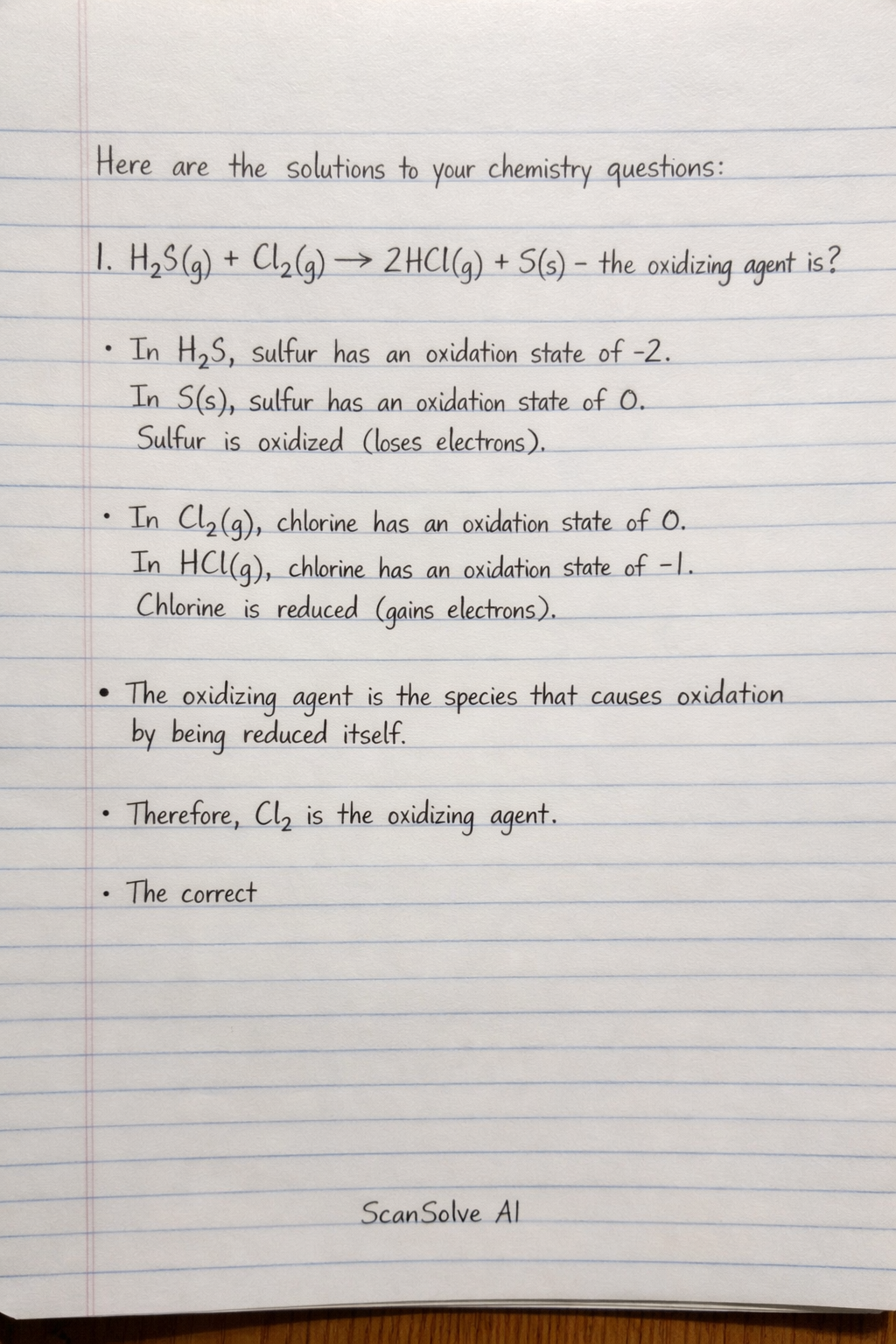
Here are the solutions to your chemistry questions:
- H₂S(g) + Cl₂(g) → 2HCl(g) + S(s) - the oxidizing agent is?
- In H₂S, sulfur has an oxidation state of -2. In S(s), sulfur has an oxidation state of 0. Sulfur is oxidized (loses electrons).
- In Cl₂(g), chlorine has an oxidation state of 0. In HCl(g), chlorine has an oxidation state of -1. Chlorine is reduced (gains electrons).
- The oxidizing agent is the species that causes oxidation by being reduced itself.
- Therefore, Cl₂ is the oxidizing agent.
- The correct
Was this helpful?
Still stuck on this one?
Ask a follow-up, and the answer starts from this question.
Got a different question?Ask your own question
More English Questions
QJune 2026 50 O-Level Chemistry MCQs The number of protons in an atom is called its A. Mass number B…Q10 𝗝𝗔𝗠𝗕 𝗖𝗛𝗘𝗠𝗜𝗦𝗧𝗥𝗬 𝗣𝗔𝗦𝗧 𝗤𝗨𝗘𝗦𝗧𝗜𝗢𝗡𝗦 — 𝘊𝘈𝘕 𝘠𝘖𝘜 𝘚𝘊𝘖𝘙𝘌 8/10? React…QHere’s CHM 101 – General Chemistry I, ABSU Uturu, First Semester 2023/2024 — all questions written…QChemistry Jamb questions 1. Which particle determines the identity of an element? A. Neutron B…QAbsolutely. Here are 30 objective questions suitable for a Year 6/7 learner, covering physical and…
Handwritten Step-by-Step Solution
Get this as a handwritten image on WhatsApp — like a tutor wrote it for you.
Try on WhatsApp