
We read your photo as:
List nursery rhymes you remember, identify your favorites and why, explain the utility of rhyme in poetry, and discuss if all poems must rhyme, referencing a Shakespearean sonnet.
ScanSolve AI Answer
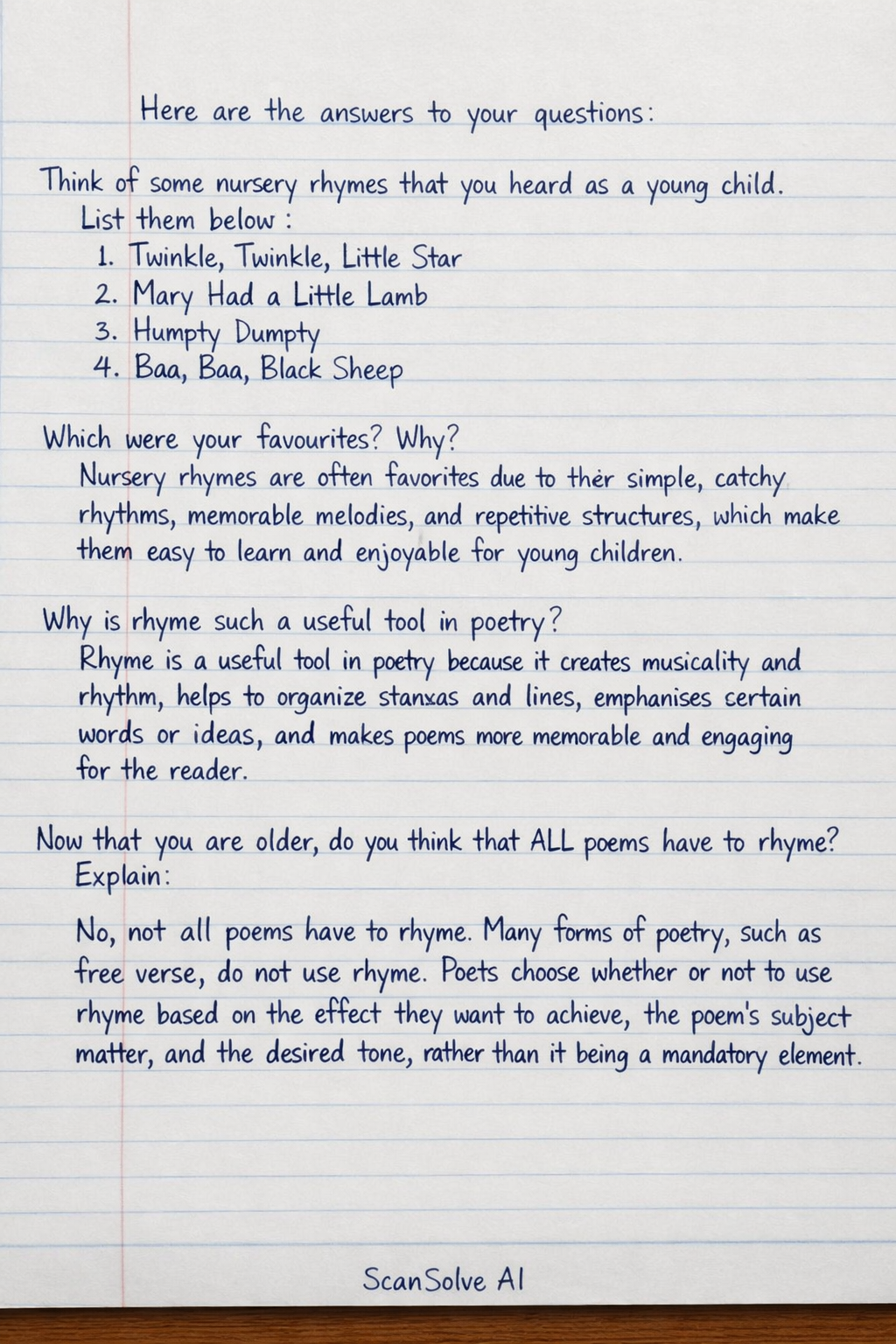
Here are the answers to your questions:
Think of some nursery rhymes that you heard as a young child. List them below:
- Twinkle, Twinkle, Little Star
- Mary Had a Little Lamb
- Humpty Dumpty
- Baa, Baa, Black Sheep
Which were your favourites? Why?
Nursery rhymes are often favorites due to their simple, catchy rhythms, memorable melodies, and repetitive structures, which make them easy to learn and enjoyable for young children.
Why is rhyme such a useful tool in poetry?
Rhyme is a useful tool in poetry because it creates musicality and rhythm, helps to organize stanzas and lines, emphasizes certain words or ideas, and makes poems more memorable and engaging for the reader.
Now that you are older, do you think that ALL poems have to rhyme? Explain.
No, not all poems have to rhyme. Many forms of poetry, such as free verse, do not use rhyme. Poets choose whether or not to use rhyme based on the effect they want to achieve, the poem's subject matter, and the desired tone, rather than it being a mandatory element.
Remember the Shakespeare Sonnet you did in Term 1? Do you remember which words RHYMED? Here it is again: PROLOGUE
Based on the provided PROLOGUE, the rhyming words are:
- dignity / mutiny
- scene / unclean
- foes / overthrows
- life / strife
- love / remove
- rage / stage
The final two lines, "ears" and "strive to", do not rhyme in the provided text.
Still stuck on this one?
Ask a follow-up, and the answer starts from this question.
More English Questions
Handwritten Step-by-Step Solution
Get this as a handwritten image on WhatsApp — like a tutor wrote it for you.
Try on WhatsApp