
We read your photo as:
Solve all questions in English language
English
ScanSolve AI Answer
Answer
Step-by-step solution
5 stepsHere's how to solve the problem using the potentiometer principle:
Identify the given values.
The electromotive force (e.m.f.) of the standard cell is .
The balance length for the standard cell is .
The e.m.f. of the unknown dry cell is .
The balance length for the unknown dry cell is .Apply the potentiometer principle.
For a potentiometer, the e.m.f. of a cell is directly proportional to its balance length. This relationship can be expressed as:
Substitute the known values into the formula.
Solve for .
To find , rearrange the equation:
Round the answer to an appropriate number of significant figures.
Rounding to three significant figures (consistent with 1.50 V):
Was this helpful?
Try one yourself
A new problem that tests the same skill.
Still stuck on this one?
Ask a follow-up, and the answer starts from this question.
Got a different question?Ask your own question
More English Questions
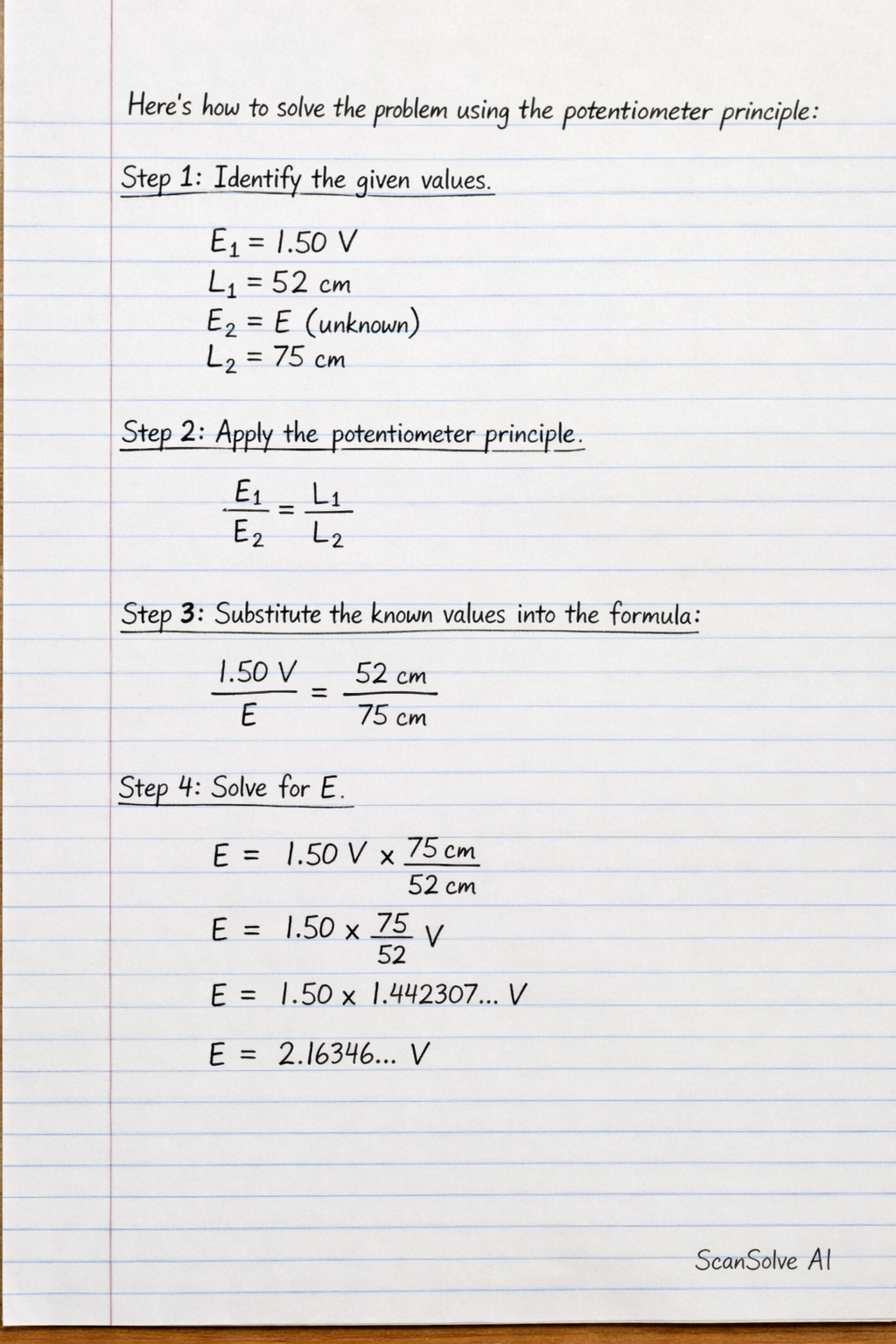
Handwritten Step-by-Step Solution
Get this as a handwritten image on WhatsApp — like a tutor wrote it for you.
Try on WhatsApp