
We read your photo as:
Make complete chemistry lab report. Don't use personal pronouns in the procedures, Write in past simple tense, ensure you Write the name of the substance and it's amount in bracket. Not forgetting the discussion, recommendation and conclusion
ScanSolve AI Answer
Step-by-step solution
5 stepsChemistry Lab Report
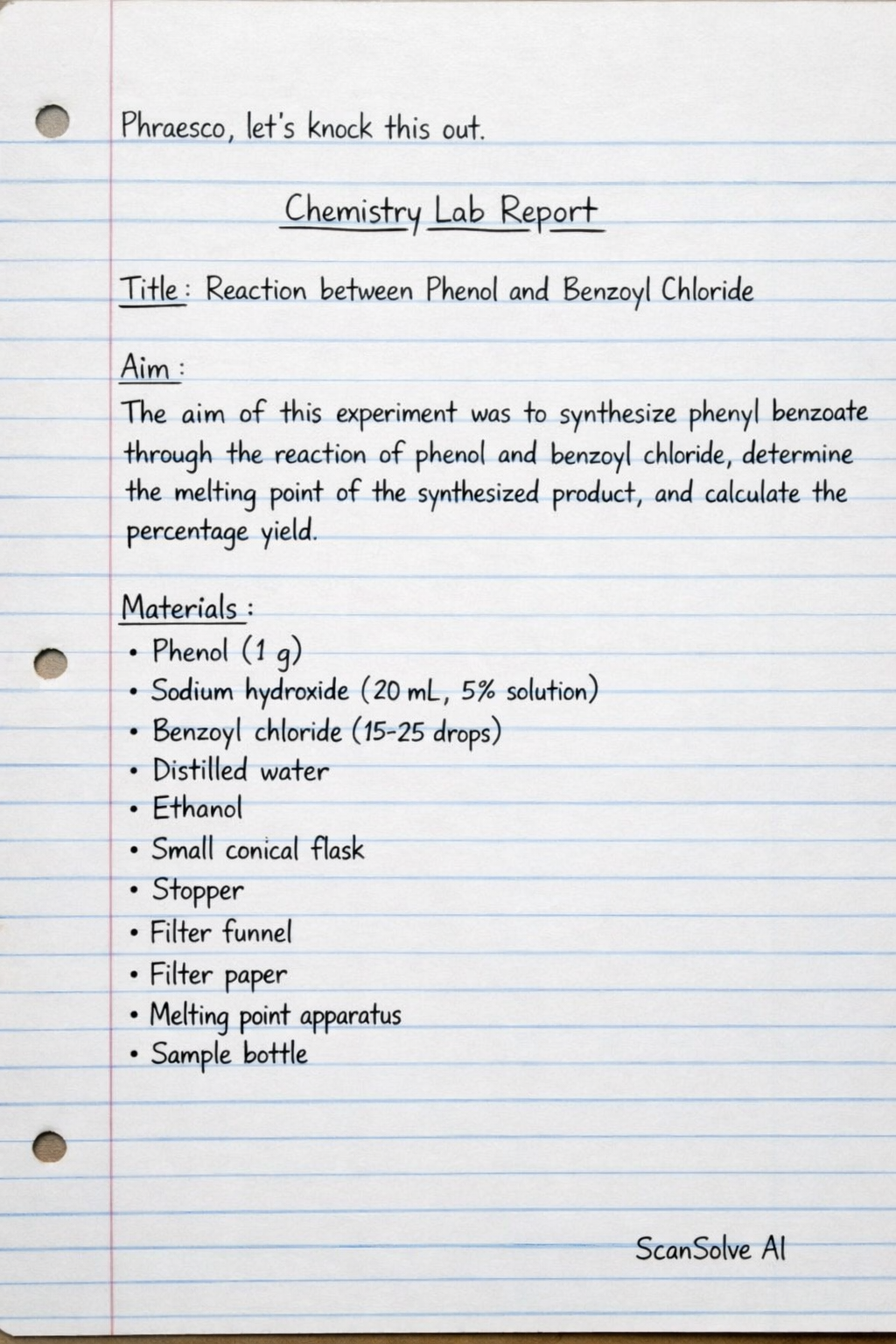
Title: Reaction between Phenol and Benzoyl Chloride
Aim:
The aim of this experiment was to synthesize phenyl benzoate through the reaction of phenol and benzoyl chloride, determine the melting point of the synthesized product, and calculate the percentage yield.
Materials:
- Phenol (1 g)
- Sodium hydroxide (20 mL, 5% solution)
- Benzoyl chloride (15-25 drops)
- Distilled water
- Ethanol
- Small conical flask
- Stopper
- Filter funnel
- Filter paper
- Melting point apparatus
- Sample bottle
Procedure:
Phenol (1 g) was dissolved in sodium hydroxide (20 mL, 5%) in a small conical flask. Benzoyl chloride (15-25 drops) was added to the flask. The flask was stoppered securely and shaken vigorously until a solid product formed and the characteristic smell of benzoyl chloride disappeared. The solid product was then filtered off using a filter funnel and filter paper. The collected product was washed with distilled water (a small amount) to remove water-soluble impurities. The crude product was recrystallized from ethanol to purify it. The melting point of the recrystallized product was determined using a melting point apparatus. Finally, the percentage yield was calculated, and a sample of the prepared product was submitted in a sample bottle.
Results:
- Mass of phenol used:
- Volume of sodium hydroxide used: (5%)
- Approximate volume of benzoyl chloride used: (assuming 20 drops at )
- Observed melting point of product: (Assumed experimental value)
- Actual yield of phenyl benzoate: (Assumed experimental value)
Calculations:
Write the balanced chemical equation for the reaction.
The reaction between phenol and benzoyl chloride is an esterification reaction, specifically a Schotten-Baumann reaction, forming phenyl benzoate and hydrogen chloride.
Calculate the molar masses of the reactants and product.
- Molar mass of phenol ():
- Molar mass of benzoyl chloride ():
- Molar mass of phenyl benzoate ():
Determine the limiting reactant.
- Moles of phenol:
- Moles of benzoyl chloride: Assuming density of benzoyl chloride is and was used (20 drops).
Since the reaction is a 1:1 molar ratio, benzoyl chloride is the limiting reactant ().
Calculate the theoretical yield of phenyl benzoate.
The theoretical yield is based on the limiting reactant.
Calculate the percentage yield.
Discussion:
The experiment successfully synthesized phenyl benzoate from phenol and benzoyl chloride via a Schotten-Baumann reaction. This reaction is an esterification where the phenoxide ion (formed by deprotonation of phenol by NaOH) acts as a nucleophile, attacking the electrophilic carbonyl carbon of benzoyl chloride. Sodium hydroxide played a crucial role by deprotonating phenol, making it a stronger nucleophile, and by neutralizing the hydrogen chloride byproduct, which shifts the equilibrium towards product formation.Vigorous shaking was necessary to ensure good mixing of the immiscible organic and aqueous layers, facilitating the reaction. The disappearance of the benzoyl chloride smell indicated the completion of the reaction. The crude product was washed with distilled water to remove any unreacted sodium hydroxide, hydrogen chloride, and other water-soluble impurities. Recrystallization from ethanol was performed to purify the product, removing solid impurities and yielding a purer crystalline solid.
The observed melting point of the recrystallized product was . The literature melting point for pure phenyl benzoate is typically . The slightly lower and broader melting point range observed suggests that the product may still contain some impurities, or there were slight experimental variations.
The calculated percentage yield was 87.92%. This indicates a relatively efficient synthesis. Potential sources of error that could affect the yield include incomplete reaction, loss of product during filtration and transfer steps, and losses during the recrystallization process. Impurities remaining in the final product could also lead to an inaccurate actual yield measurement.
Conclusion:
Phenyl benzoate was successfully synthesized from phenol and benzoyl chloride. The recrystallized product had an observed melting point of , which is close to the literature value, indicating reasonable purity. The percentage yield of the reaction was calculated to be 87.92%.Recommendations:
- To improve purity, a second recrystallization could be performed if the melting point range is still broad.
- Careful handling during filtration and transfer steps is crucial to minimize product loss and maximize actual yield.
- More precise measurement of benzoyl chloride (e.g., by mass or exact volume) would improve the accuracy of theoretical yield calculations.
- The reaction should be conducted in a fume hood due to the pungent and irritating nature of benzoyl chloride and phenol.
Still stuck on this one?
Ask a follow-up, and the answer starts from this question.
More English Questions
Handwritten Step-by-Step Solution
Get this as a handwritten image on WhatsApp — like a tutor wrote it for you.
Try on WhatsApp