
We read your photo as:
Explain monophthongs, diphthongs, and the three types of conjunctions with examples.
English
ScanSolve AI Answer
-
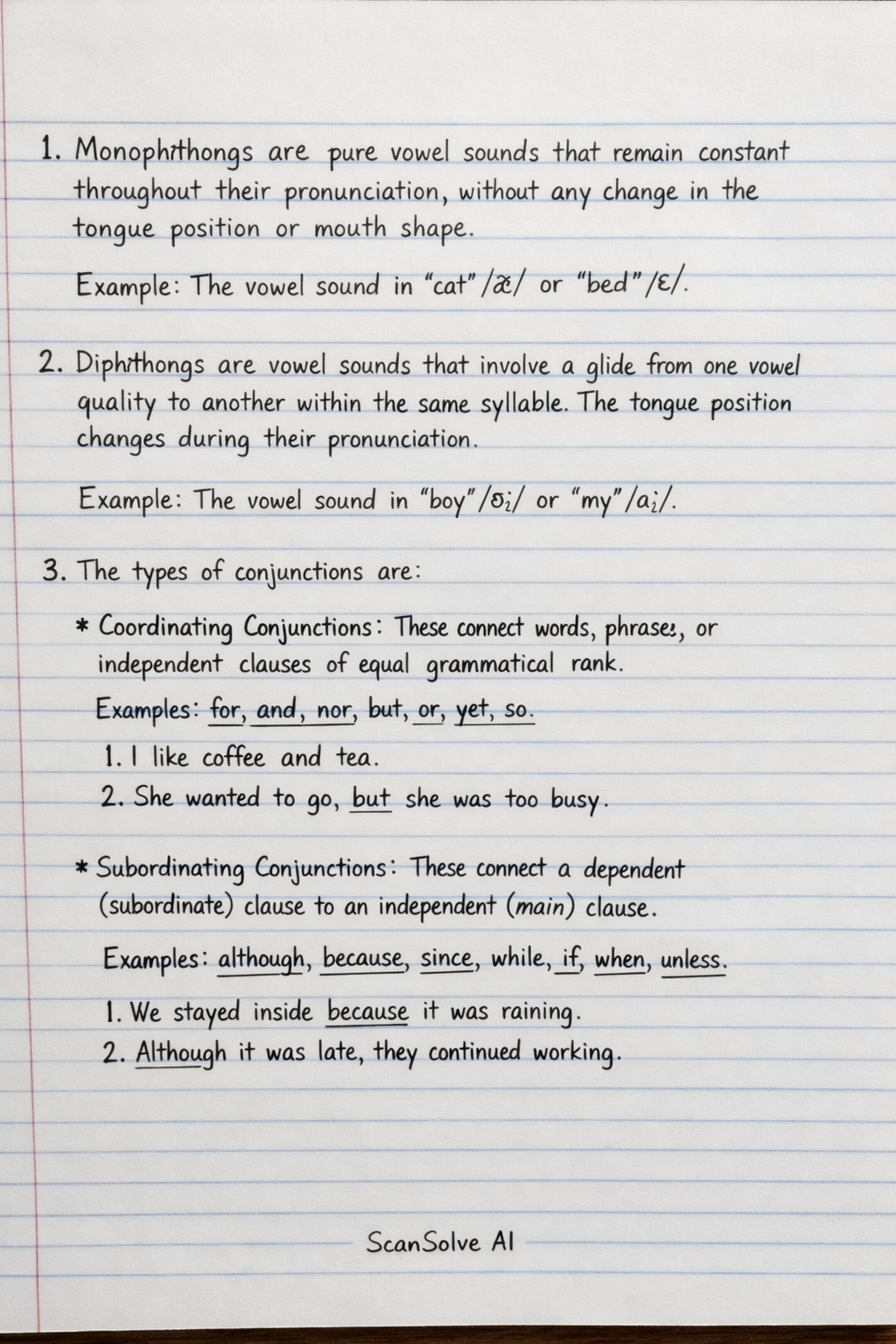
Monophthongs are pure vowel sounds that remain constant throughout their pronunciation, without any change in the tongue position or mouth shape. Example: The vowel sound in "cat" /æ/ or "bed" /ɛ/.
-
Diphthongs are vowel sounds that involve a glide from one vowel quality to another within the same syllable. The tongue position changes during their pronunciation. Example: The vowel sound in "boy" /ɔɪ/ or "my" /aɪ/.
-
The types of conjunctions are:
- Coordinating Conjunctions: These connect words, phrases, or independent clauses of equal grammatical rank.
Examples: for, and, nor, but, or, yet, so.
- I like coffee and tea.
- She wanted to go, but she was too busy.
- Subordinating Conjunctions: These connect a dependent (subordinate) clause to an independent (main) clause.
Examples: although, because, since, while, if, when, unless.
- We stayed inside because it was raining.
- Although it was late, they continued working.
- Correlative Conjunctions: These are pairs of conjunctions that work together to connect grammatically equal elements in a sentence.
Examples: both...and, either...or, neither...nor, not only...but also, whether...or.
- Both John and Mary are coming to the party.
- You can either stay or leave.
- Coordinating Conjunctions: These connect words, phrases, or independent clauses of equal grammatical rank.
Examples: for, and, nor, but, or, yet, so.
Was this helpful?
Still stuck on this one?
Ask a follow-up, and the answer starts from this question.
Got a different question?Ask your own question
More English Questions
QDefine and give examples of monosyllabic, bisyllabic, and polysyllabic words, and explain the…QMake a word list 20 diphthong and triphthong in EnglishQHow many diphthongs are there in the English language?QExplain how to convert phrases with conjunctions into hyphenated word-pairs and the impact of…QComplete the sentences using the correct conjunctions, and explain why you chose each one.
Handwritten Step-by-Step Solution
Get this as a handwritten image on WhatsApp — like a tutor wrote it for you.
Try on WhatsApp