
We read your photo as:
Define and discuss the roles, features, and functions of oral literature forms like riddles and proverbs.
English
ScanSolve AI Answer
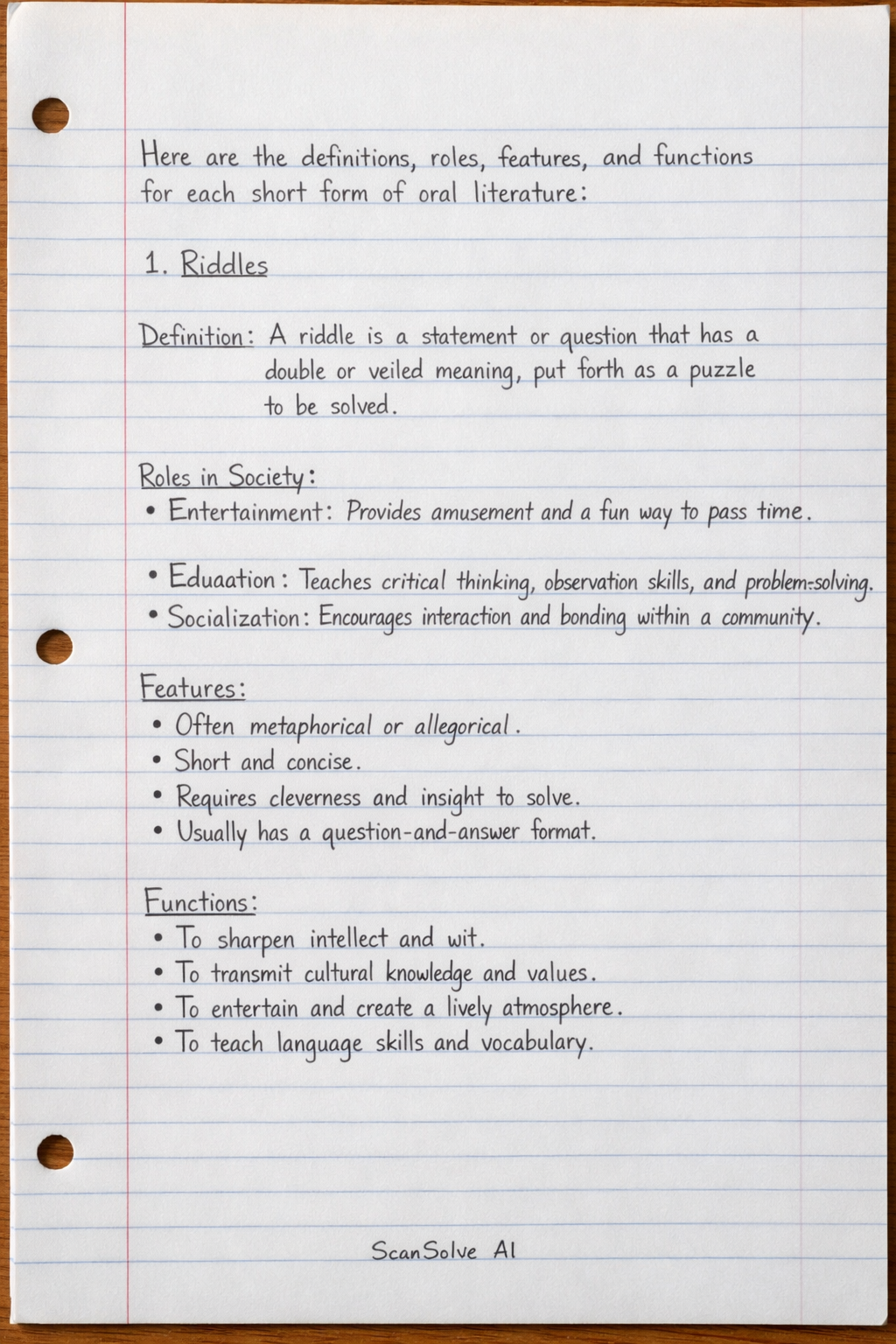
Here are the definitions, roles, features, and functions for each short form of oral literature:
1. Riddles
- Definition: A riddle is a statement or question that has a double or veiled meaning, put forth as a puzzle to be solved.
- Roles in Society:
- Entertainment: Provides amusement and a fun way to pass time.
- Education: Teaches critical thinking, observation skills, and problem-solving.
- Socialization: Encourages interaction and bonding within a community.
- Features:
- Often metaphorical or allegorical.
- Short and concise.
- Requires cleverness and insight to solve.
- Usually has a question-and-answer format.
- Functions:
- To sharpen intellect and wit.
- To transmit cultural knowledge and values.
- To entertain and create a lively atmosphere.
- To teach language skills and vocabulary.
2. Proverbs
- Definition: A proverb is a short, popular saying that expresses a general truth or piece of advice.
- Roles in Society:
- Moral Guidance: Offers ethical lessons and wisdom.
- Social Control: Reinforces societal norms and expected behaviors.
- Education: Transmits cultural values, history, and practical knowledge across generations.
- Features:
- Concise and memorable.
- Often uses metaphorical or symbolic language.
- Reflects cultural beliefs and experiences.
- Generally accepted as true or wise.
- Functions:
- To advise, warn, or encourage.
- To comment on human behavior and situations.
- To enrich language and communication.
- To preserve and transmit cultural heritage.
3. Tongue Twisters
- Definition: A tongue twister is a sequence of words that is difficult to pronounce correctly and quickly.
- Roles in Society:
- Entertainment: Provides amusement and a challenge.
- Language Development: Helps in articulation and pronunciation practice.
- Social Bonding: Used in games and playful interactions.
- Features:
- Repetitive sounds or similar-sounding words.
- Often uses alliteration or assonance.
- Designed to be difficult to say quickly without error.
- Functions:
- To improve speech clarity and diction.
- To entertain and challenge speakers.
- To develop phonetic awareness.
- To serve as a fun linguistic exercise.
4. Wise Sayings
- Definition: A wise saying is a short, pithy statement that expresses a profound truth or observation about life, often with a moral or philosophical undertone.
- Roles in Society:
- Guidance: Offers practical advice and insights for navigating life.
- Reflection: Encourages contemplation and understanding of human nature.
- Cultural Transmission: Passes down accumulated wisdom from elders.
- Features:
- Concise and impactful.
- Expresses a universal or culturally specific truth.
- Often attributed to wise individuals or ancient traditions.
- Can be direct or subtly profound.
- Functions:
- To impart wisdom and life lessons.
- To inspire thought and introspection.
- To provide comfort or perspective in difficult situations.
- To reinforce community values.
5. Jokes
- Definition: A joke is a short story or phrase with a humorous twist, designed to make people laugh.
- Roles in Society:
- Entertainment: Provides amusement and lightens the mood.
- Social Bonding: Creates shared laughter and strengthens relationships.
- Stress Relief: Offers a way to cope with tension and difficult situations.
- Features:
- Usually short and structured with a setup and a punchline.
- Relies on wordplay, irony, exaggeration, or unexpected twists.
- Aims to evoke laughter.
- Functions:
- To entertain and amuse.
- To relieve tension and stress.
- To build rapport and foster social connections.
- To sometimes subtly critique social norms or situations.
6. Puns
- Definition: A pun is a form of wordplay that exploits multiple meanings of a word, or words that sound similar but have different meanings, for an intended humorous or rhetorical effect.
- Roles in Society:
- Entertainment: Provides clever humor and amusement.
- Language Play: Highlights the nuances and complexities of language.
- Social Interaction: Used in casual conversation to add wit.
- Features:
- Relies on homophones (words that sound alike) or polysemy (words with multiple meanings).
- Often creates a double meaning.
- Typically short and integrated into speech or writing.
- Functions:
- To create humor and wit.
- To add emphasis or a clever twist to a statement.
- To demonstrate linguistic skill.
- To engage the audience's intellect through wordplay.
Was this helpful?
Still stuck on this one?
Ask a follow-up, and the answer starts from this question.
Got a different question?Ask your own question
More English Questions
QIdentify and explain features, genres, and functions of oral literature.QWhat are riddles? Describe their purpose.QWhat are the definitions and examples of different types of stories and proverbs?QIdentify and describe the form of oral literature you have collected.QExplain the meaning and types of proverbs. Identify proverbs and their types in the given sentences.
Browse by topic:Literature
Handwritten Step-by-Step Solution
Get this as a handwritten image on WhatsApp — like a tutor wrote it for you.
Try on WhatsApp