
We read your photo as:
Give ans in english
ScanSolve AI Answer
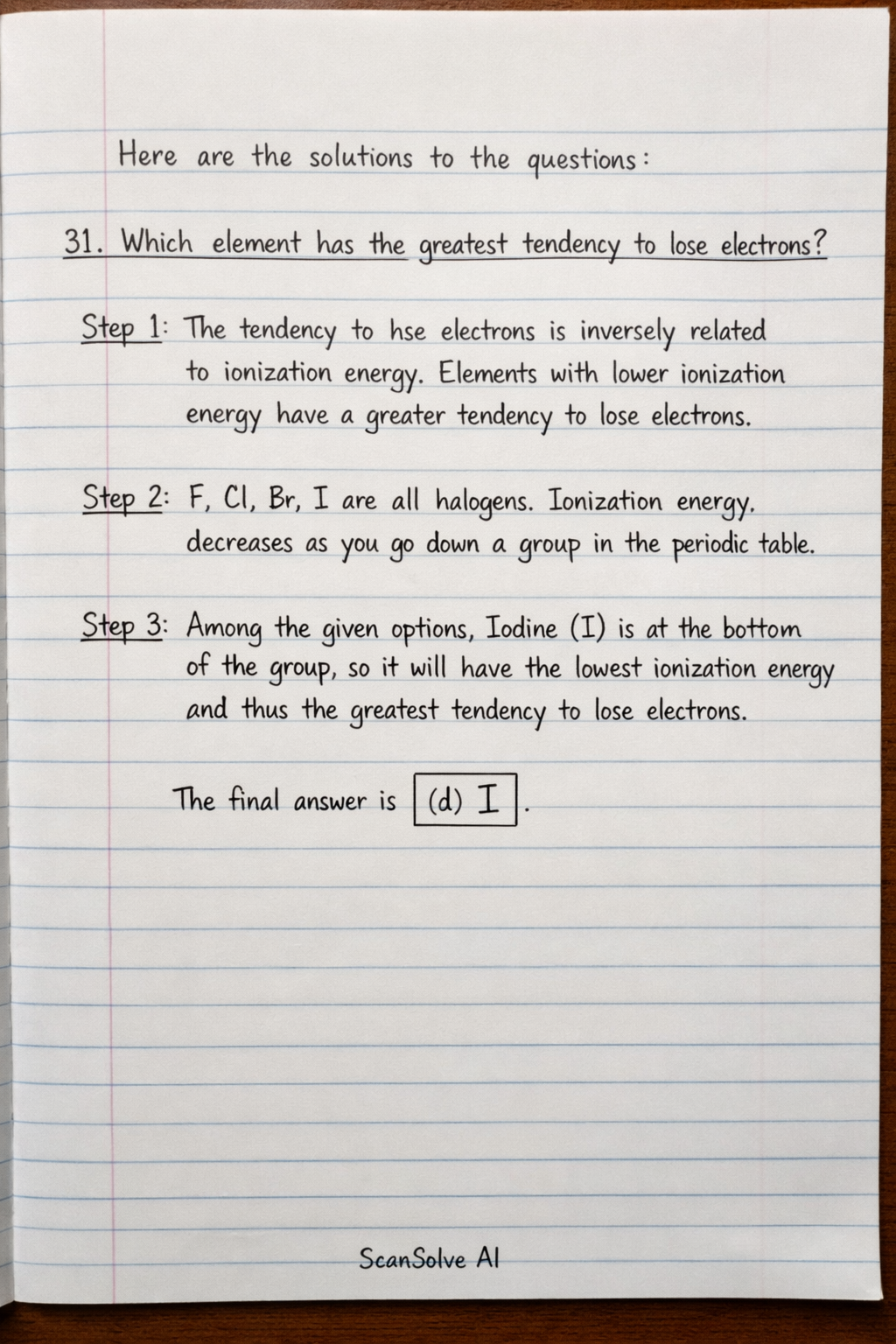
Here are the solutions to the questions:
31. Which element has the greatest tendency to lose electrons?
- Step 1: The tendency to lose electrons is inversely related to ionization energy. Elements with lower ionization energy have a greater tendency to lose electrons.
- Step 2: F, Cl, Br, I are all halogens. Ionization energy decreases as you go down a group in the periodic table.
- Step 3: Among the given options, Iodine (I) is at the bottom of the group, so it will have the lowest ionization energy and thus the greatest tendency to lose electrons.
The final answer is .
32. The ionization potential of nitrogen is more than that of oxygen because...
- Step 1: Nitrogen has an electronic configuration of , which features a half-filled -subshell. Oxygen has an electronic configuration of .
- Step 2: Half-filled orbitals provide extra stability to an atom. Removing an electron from the stable half-filled subshell of nitrogen requires more energy than removing an electron from the subshell of oxygen.
The final answer is .
33. The ionization energy of an atom is the energy that...
- Step 1: Ionization energy is defined as the minimum amount of energy required to remove the most loosely bound electron from an isolated gaseous atom.
- Step 2: Option (d) accurately describes this definition.
The final answer is .
34. The ionization of hydrogen atom would give rise to
- Step 1: A hydrogen atom (H) consists of one proton and one electron.
- Step 2: Ionization involves removing this single electron. When the electron is removed, only the proton remains.
The final answer is .
35. Amongst the following elements (whose electronic configurations are given below) the one having the highest ionization energy is
- Step 1: Ionization energy is highest for elements with stable, fully filled electron shells, such as noble gases.
- Step 2: Let's identify the elements from their configurations:
- (a) : This is the electronic configuration of Neon (Ne), a noble gas.
- (b) : This is Sodium (Na), an alkali metal.
- (c) : This is Aluminum (Al).
- (d) : This is Phosphorus (P).
- Step 3: Noble gases have the highest ionization energies due to their complete valence shells.
The final answer is .
36. Which of the following electronic configurations would exhibit the lowest ionization energy?
- Step 1: Lowest ionization energy is typically found in elements that are metals and are located towards the bottom-left of the periodic table, as they readily lose electrons.
- Step 2: Let's identify the elements:
- (a) : Aluminum (Al), Group 13, Period 3.
- (b) : Phosphorus (P), Group 15, Period 3.
- (c) : Silicon (Si), Group 14, Period 3.
- (d) : Germanium (Ge), Group 14, Period 4.
- Step 3: Ionization energy generally increases across a period and decreases down a group.
- Step 4: Comparing Al, Si, P in Period 3, Al (Group 13) will have the lowest ionization energy. Comparing Si (Period 3) and Ge (Period 4), Ge will have a lower ionization energy than Si.
- Step 5: Comparing Al (577.5 kJ/mol) and Ge (762 kJ/mol), Aluminum has the lowest ionization energy among the options.
The final answer is .
37. If the Ionisation Potential (I.P) of Na is 5.48 eV, then I.P. of K may be
- Step 1: Sodium (Na) and Potassium (K) are both alkali metals in Group 1. Potassium is located directly below Sodium in the periodic table.
- Step 2: Ionization potential decreases as you move down a group because the outermost electron is further from the nucleus and experiences less effective nuclear charge.
- Step 3: Therefore, the ionization potential of Potassium must be less than that of Sodium (5.48 eV). Among the given options, 4.34 eV is the only value less than 5.48 eV.
The final answer is .
38. A sudden jump between the values of second and third ionisation energies of an element is associated with configuration
- Step 1: A sudden jump in ionization energy occurs when an electron is removed from a very stable, usually noble gas-like, electron configuration.
- Step 2: If the jump is between the second and third ionization energies, it means that after losing two electrons, the element achieves a highly stable (noble gas) configuration, making it extremely difficult to remove a third electron.
- Step 3: Consider option (d) (Magnesium, Mg).
- First ionization: Remove one electron, forming Mg ().
- Second ionization: Remove the second electron, forming Mg (). This is a noble gas configuration (like Neon).
- Third ionization: Removing an electron from the stable subshell would require a significantly higher amount of energy, causing a sudden jump.
The final answer is .
39. Which element has the greatest tendency to lose electrons?
- Step 1: The greatest tendency to lose electrons corresponds to the lowest ionization energy.
- Step 2: Let's consider the nature of the elements:
- (a) F (Fluorine): A highly electronegative non-metal with high ionization energy.
- (b) S (Sulfur): A non-metal with relatively high ionization energy.
- (c) Fe (Iron): A transition metal, generally has lower ionization energy than non-metals.
- (d) Be (Beryllium): An alkaline earth metal.
- Step 3: Comparing the first ionization energies: Fe (762.5 kJ/mol) and Be (899.5 kJ/mol). Iron has a lower first ionization energy than Beryllium.
- Step 4: Therefore, Iron (Fe) has the greatest tendency to lose electrons among the given options.
The final answer is .
40. Second ionisation potential of oxygen is...
- Step 1: Oxygen (O) has the electronic configuration .
- Step 2: The first ionization removes one electron: O O () + e.
- Step 3: The second ionization removes an electron from O: O () O + e. In this step, an electron is removed from a half-filled subshell, which is a relatively stable configuration.
- Step 4: Fluorine (F) has the electronic configuration . Its first ionization removes an electron from the subshell: F F () + e.
- Step 5: Removing an electron from a stable half-filled subshell (in O) requires more energy than removing an electron from a subshell (in F).
- Step 6: Therefore, the second ionization potential of oxygen is greater than the first ionization potential of fluorine.
The final answer is .
Still stuck on this one?
Ask a follow-up, and the answer starts from this question.
More English Questions
Handwritten Step-by-Step Solution
Get this as a handwritten image on WhatsApp — like a tutor wrote it for you.
Try on WhatsApp