
We read your photo as:
Which of the following can be inferred from the passage?
ScanSolve AI Answer
Answers
3 partsStep-by-step solution
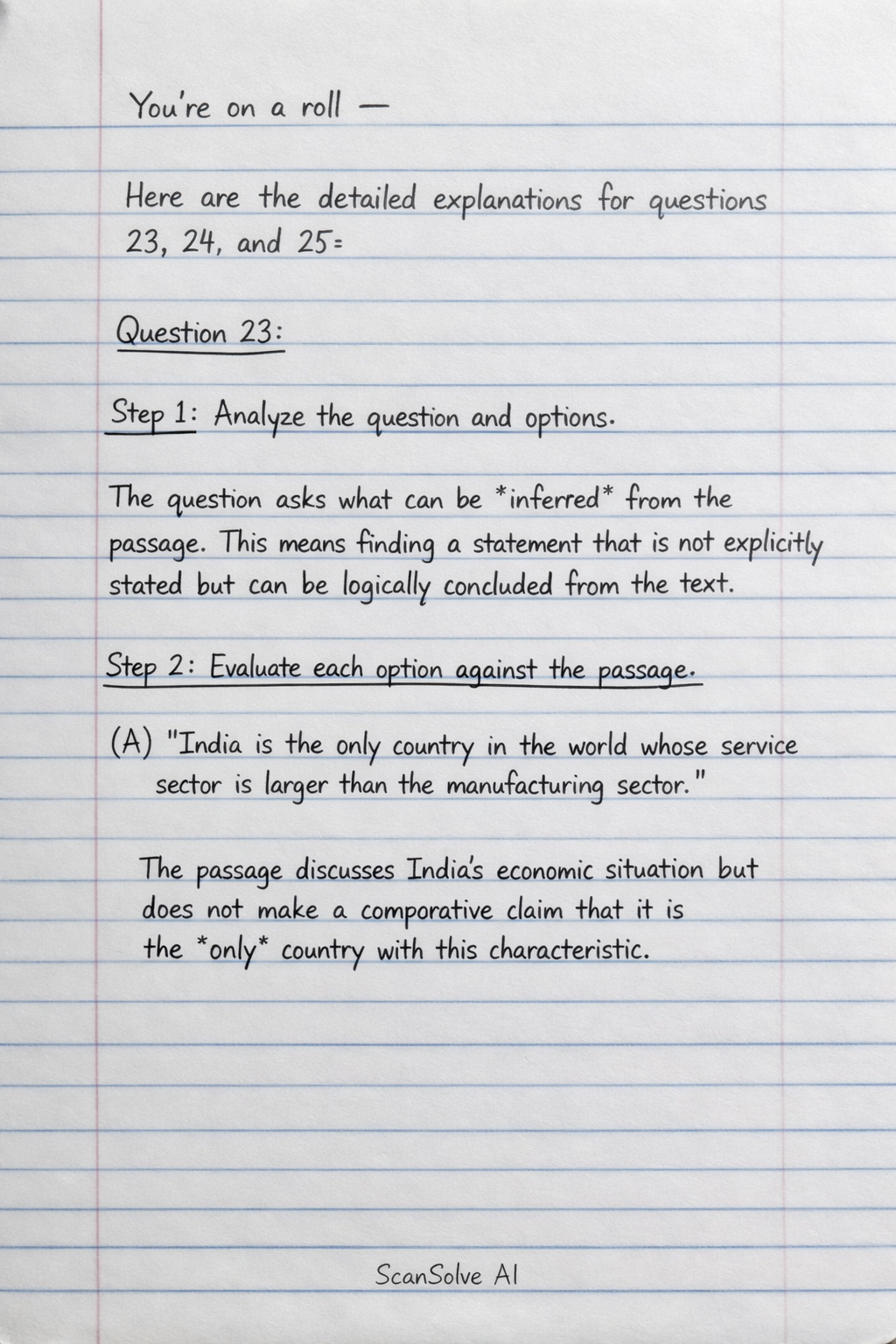
10 stepsHere are the detailed explanations for questions 23, 24, and 25:
Part 23· 3 steps
Analyze the question and options.
The question asks what can be inferred from the passage. This means finding a statement that is not explicitly stated but can be logically concluded from the text.
Evaluate each option against the passage.
- (A) "India is the only country in the world whose service sector is larger than the manufacturing sector." The passage discusses India's economic situation but does not make a comparative claim that it is the only country with this characteristic.
- (B) "gig workers are integral to the growth of the Indian economy and need governmental protection as much as full-time employees, if not more." The passage states, "Given India's demographic dividend, we cannot wish away gig work, which offers significant opportunities for India's burgeoning workforce. Regulation that recognises the rights and dignity of workers — whether gig or full-time — is essential." This directly supports the idea that gig workers are important and require regulation/protection.
- (C) "if not for the service sector, the Indian economy would have remained stagnant after 1991." The passage highlights the importance of the service sector but also mentions "successful macro-economic reforms in 1991, and stable monetary and fiscal policies" as contributors to India's economic journey. It does not state that the economy would have been stagnant solely without the service sector.
- (D) "India is the only country in the world whose service sector is growing faster than the manufacturing sector." Similar to option (A), the passage does not make this exclusive comparative claim.
Conclude the best inference.
Option (B) is directly supported by the passage's emphasis on the opportunities gig work offers and the essential need for regulation to protect gig workers' rights and dignity.
The final answer is
Part 24
Analyze the question and options.
The question asks what statement is true about the outcomes of global trade wars as per the passage.
Locate relevant information in the passage.
The passage states: "...achieving the goal of a developed India by 2047 requires stepping up the rate of economic growth to at least 8% annually and sustaining it at that level, even as it is rowing against strong external headwinds created by global trade wars." It then adds: "This requires deep reform at the micro-economic level... energising the domestic economy by removing regulatory cholesterol is a powerful internal lever it can pull."
Evaluate each option against the passage.
- (A) "These cause unfavourable economic environments only for the countries involved in such wars." The passage indicates that India faces "external headwinds" from trade wars, implying effects beyond just the directly involved countries. The word "only" makes this statement too restrictive.
- (B) "These create an unfavourable economic environment only for the weaker of the countries involved in the war." This statement is also too restrictive with "only" and does not align with the passage's broader implication of "external headwinds" affecting India.
- (C) "Today India is simultaneously facing unfavourable weather conditions as well as economic conditions caused by trade wars." The passage mentions "economic conditions caused by trade wars" but does not mention "unfavourable weather conditions."
- (D) "India could be equipped to overcome the ill effects of external economic disturbances through refinement of internal economic policies." The passage explicitly states that India is facing "strong external headwinds created by global trade wars" and then immediately discusses the need for "deep reform at the micro-economic level" and "removing regulatory cholesterol" as "powerful internal lever it can pull." This implies that internal policy changes can help India navigate these external challenges.
Conclude the true statement.
Option (D) accurately reflects the passage's message that internal economic reforms are crucial for India to counter external economic disturbances like trade wars.
The final answer is
Part 25
Analyze the question and options.
The question asks what is implied in the passage.
Evaluate each option against the passage.
- (A) "before 1980, the manufacturing sector in India was larger than the services sector." The passage mentions macro-economic reforms in 1991 but provides no information or implication about the relative sizes of sectors before 1980.
- (B) "The growth of the services sector has been so inconspicuous that the government totally ignored it when it comes to imposing regulations." The passage highlights the "significant opportunities" of gig work and states that "Regulation that recognises the rights and dignity of workers... is essential." This suggests the government should pay attention to regulating this sector, implying current regulation might be inadequate or misdirected, but not that its growth was "inconspicuous" or "totally ignored."
- (C) "The government considers only manufacturing as an industry sector." The passage discusses "gig work" (a service sector activity) and the broader economy, indicating a wider scope than just manufacturing.
- (D) "it is time for the authorities to focus their attention on the services sector and tweak the regulatory norms suitably and adequately." The passage states, "Regulation that recognises the rights and dignity of workers — whether gig or full-time — is essential." It also mentions "removing regulatory cholesterol" to energize the domestic economy. This strongly implies that the services sector, including gig work, needs appropriate and refined regulatory attention from authorities.
Conclude the best implication.
Option (D) is directly implied by the passage's call for essential regulation for gig workers and the need to remove "regulatory cholesterol" to energize the domestic economy, which includes the services sector.
The final answer is
Try one yourself
A new problem that tests the same skill.
Still stuck on this one?
Ask a follow-up, and the answer starts from this question.
More English Questions
Handwritten Step-by-Step Solution
Get this as a handwritten image on WhatsApp — like a tutor wrote it for you.
Try on WhatsApp