

This English question involves literary analysis, grammar, or writing skills. The detailed response below provides a well-structured answer with supporting evidence and clear explanations.
ScanSolve AI Answer
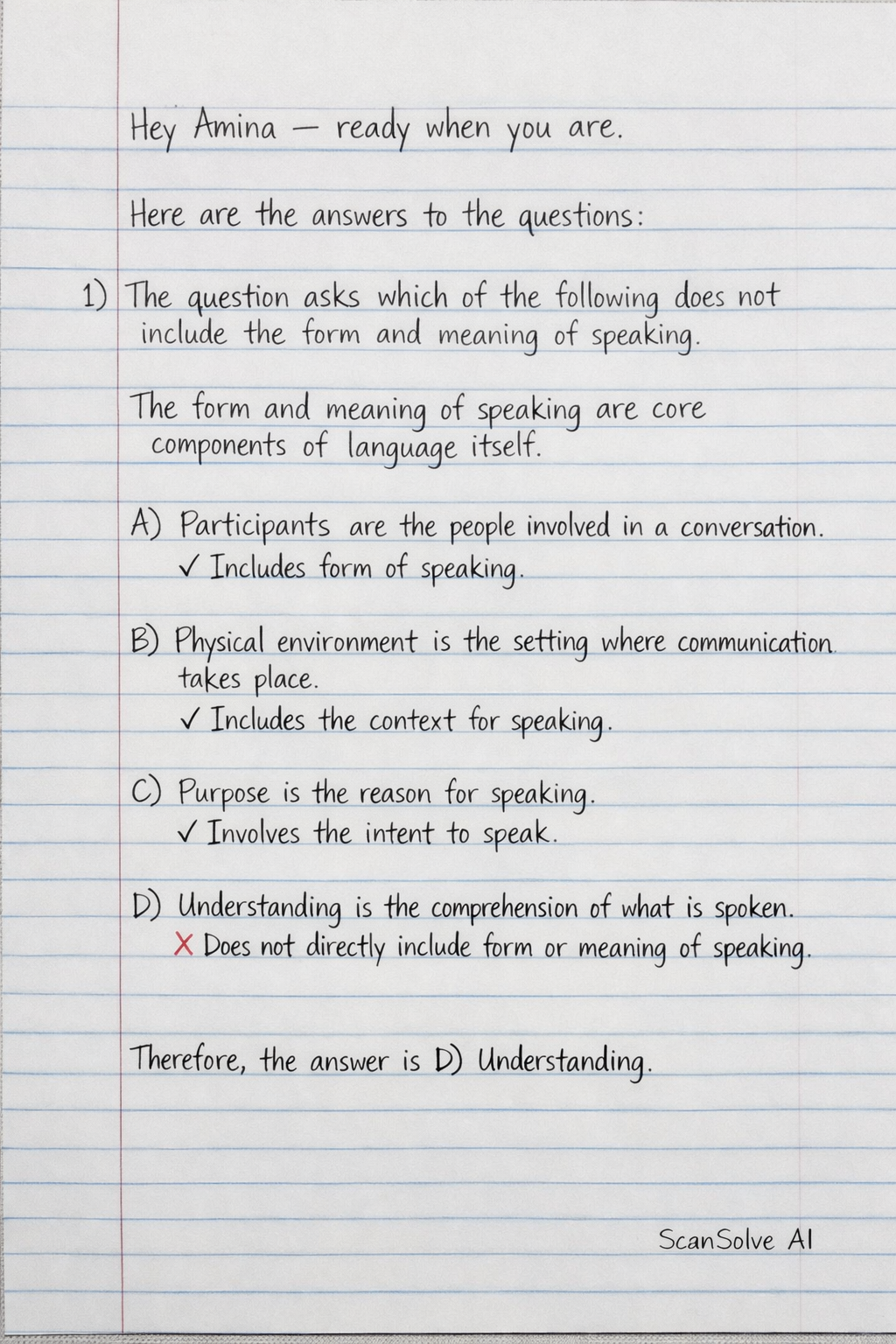
Hey Amina — ready when you are. Here are the answers to the questions: 1) The question asks which of the following does not include the form and meaning of speaking. The form and meaning of speaking are core components of language itself. A) Participants* are the people involved in a conversation. B) Physical environment* is the setting where communication takes place. C) Purpose* is the reason for speaking. D) Understanding* is the comprehension of what is spoken. Participants, physical environment, and purpose are external factors or aspects of communication, while understanding is the outcome. The question is about what does not include the form and meaning of speaking, which are inherent to the linguistic act itself. Understanding is a result of successful communication, which relies on the form and meaning of speaking, but it is not a component that includes the form and meaning in the same way that linguistic competence does. However, among the given options, participants, physical environment, and purpose are elements surrounding the act of speaking, rather than being part of its inherent linguistic structure or meaning. Understanding is a cognitive process related to interpreting meaning. The question is a bit ambiguous, but typically, elements like participants, physical environment, and purpose are considered external to the linguistic content itself. The most appropriate answer is A) Participants. 2) The use of oral language freely and accurately without interruption demonstrates the person's B) Fluency competence. A) Sociolinguistic competence* relates to using language appropriately in different social contexts. C) Discourse competence* involves connecting sentences and ideas to form coherent spoken or written texts. D) Pronunciation competence* refers to the ability to produce sounds correctly. Fluency specifically refers to the ability to speak smoothly, accurately, and without undue hesitation. The correct option is B) Fluency competence. 3) If a student demonstrates understanding of the rules of a language and the ability to use them effectively in the right context, it means he/she has A) Linguistic competence. B) Comprehension competence* refers to understanding. C) Grammatical competence* is a part of linguistic competence, focusing on grammar rules. D) Pronunciation competence* focuses on sound production. Linguistic competence encompasses grammatical knowledge, vocabulary, and the ability to use language correctly. The correct option is A) Linguistic competence. 4) The view that listening is a process of decoding sound in a linear way, i.e., from phoneme, word, phrase, sentence, text etc. is referred to as C) Down-up view. A) Bottom-up view* is synonymous with down-up view in this context, referring to processing small units of sound to build meaning. B) Top-down view* involves using prior knowledge and context to understand the overall meaning. D) Eclectic view* combines both bottom-up and top-down approaches. The description of decoding from smaller units (phoneme) to larger units (text) is characteristic of a bottom-up or down-up processing approach. The correct option is C) Down-up view. 5) Which of these activities is not a component of effective oral instruction? A) Develop listening and speaking skills* is a core component. B) Do series of assessment of learning* is a component of instruction to gauge progress. C) Teach and extend vocabulary and conceptual knowledge* is a core component. D) Teach a variety of spoken texts* is a core component. All options A, B, C, and D are generally considered components of effective oral instruction. However, "Do series of assessment of learning" is more about evaluating the instruction and learning, rather than being a direct activity of oral instruction itself, though it is an integral part of the teaching process. If we consider "oral instruction" as the direct teaching act, assessment is a separate, albeit crucial, phase. The most appropriate answer is B) Do series of assessment of learning. 6) Johnny is blind in choosing his words appropriately in her conversation. He does not know the use of apologetic words or euphemism to express unpleasant utterances. People describe him as uncultured. People also complain of his inappropriate use of gestures that does not commensurate with his use of language. This means Johnny lacks B) Sociolinguistic competence. A) Strategic competence* refers to the ability to use communication strategies to overcome difficulties. C) Grammatical competence* refers to knowledge of grammar rules. D) Vocabulary competence* refers to knowledge of words. Sociolinguistic competence involves understanding how to use language appropriately in different social contexts, including choosing the right words, tone, and gestures. Johnny's issues with appropriate word choice, euphemisms, and gestures all point to a lack of this competence. The correct option is B) Sociolinguistic competence. Send me the next one 📸