
We read your photo as:
Which of the following suffixes can be added to the word "trick" to form a new word?
ScanSolve AI Answer
here are the answers to the questions:
-
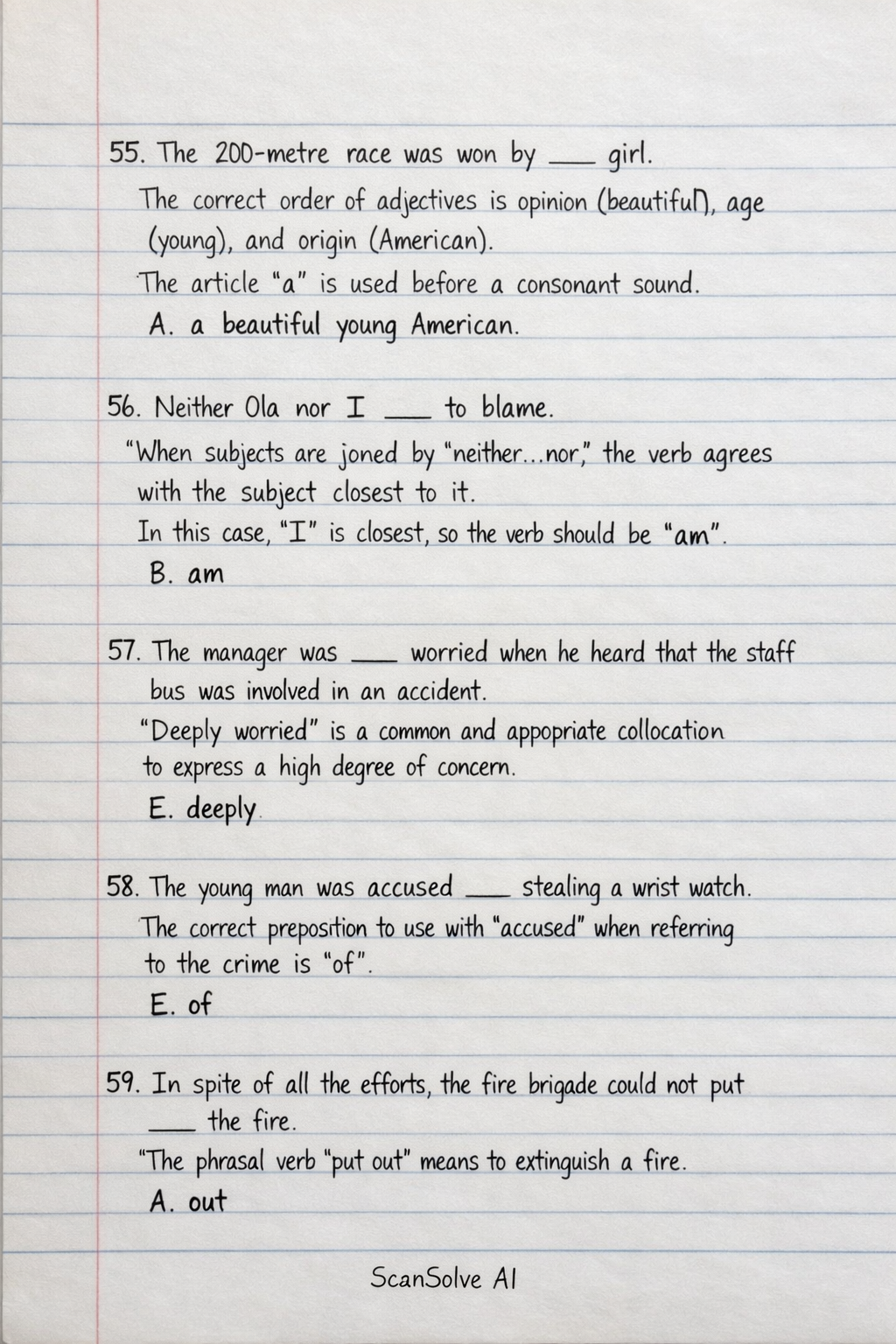
The 200-metre race was won by ____ girl. The correct order of adjectives is opinion (beautiful), age (young), and origin (American). The article "a" is used before a consonant sound.
- A. a beautiful young American
-
Neither Ola nor I ____ to blame. When subjects are joined by "neither...nor", the verb agrees with the subject closest to it. In this case, "I" is closest, so the verb should be "am".
- B. am
-
The manager was ____ worried when he heard that the staff bus was involved in an accident. "Deeply worried" is a common and appropriate collocation to express a high degree of concern.
- E. deeply
-
The young man was accused ____ stealing a wrist watch. The correct preposition to use with "accused" when referring to the crime is "of".
- E. of
-
In spite of all the efforts, the fire brigade could not put ____ the fire. The phrasal verb "put out" means to extinguish a fire.
- A. out
-
Which of the following suffixes can be added to the word "trick" to form a new word? The suffix "-ster" forms the noun "trickster", which refers to a person who plays tricks.
- A. -ster
-
A serious ____ was levelled against his father. The correct spelling for a claim or assertion made without proof is "allegation".
- B. allegation
-
What ____ have happened to them if they had harmed her? This is a third conditional sentence, which describes a hypothetical situation in the past. The structure for the main clause is "would have + past participle".
- B. would
-
The lady ____ we saw at the mall is our guidance counsellor. "Whom" is the objective case of the relative pronoun, used when the pronoun is the object of a verb or preposition. Here, "whom" is the object of "saw" (we saw her).
- D. whom
-
Those ____ believe in justice should be encouraged. "Who" is the subjective case of the relative pronoun, used when the pronoun is the subject of a verb. Here, "who" is the subject of "believe".
- B. who
-
The hunter ____ down to rest when he was tired. The verb "to lie" (meaning to recline) has the past tense form "lay". "Laid" is the past tense of "to lay" (meaning to place something).
- B. lay
Still stuck on this one?
Ask a follow-up, and the answer starts from this question.
More English Questions
Handwritten Step-by-Step Solution
Get this as a handwritten image on WhatsApp — like a tutor wrote it for you.
Try on WhatsApp