

This English question involves literary analysis, grammar, or writing skills. The detailed response below provides a well-structured answer with supporting evidence and clear explanations.
ScanSolve AI Answer
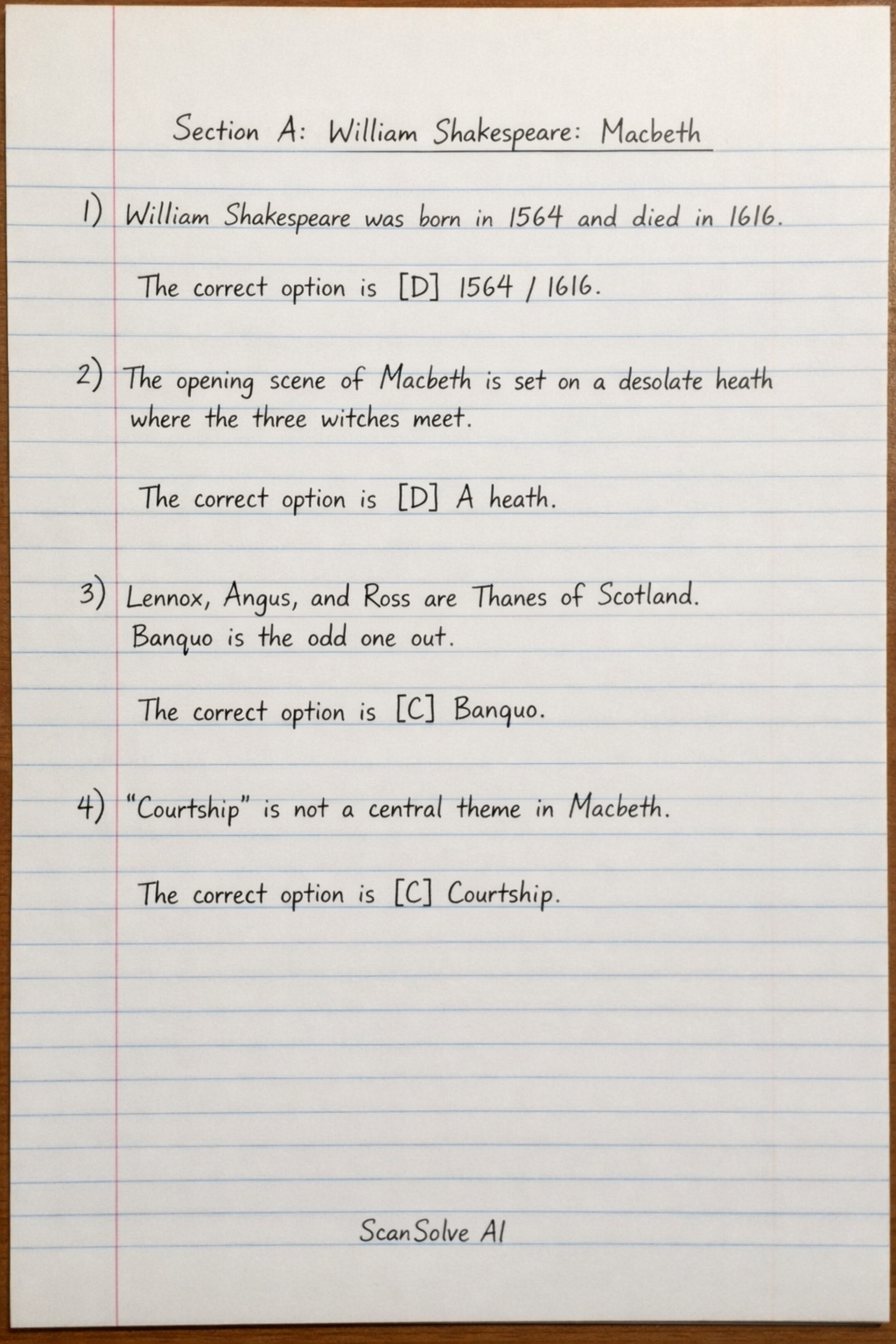
here are the answers to the questions from the image: Section A: William Shakespeare: Macbeth Question 1: William Shakespeare was born in 1564 and died in 1616. The correct option is [D] 1564/1616. Question 2: The opening scene of Macbeth* is set on a desolate heath where the three witches meet. The correct option is [D] A heath. Question 3: Lennox, Angus, and Ross are Thanes (noblemen) of Scotland. Banquo is also a Scottish general and nobleman, but he is often considered distinct due to his prophetic lineage and his role as a foil to Macbeth, making him the "odd one" in some interpretations of the group of Thanes. The correct option is [C] Banquo. Question 4: "Courtship" is not a central theme in Macbeth*. The play primarily explores themes of uncontrolled ambition, good versus evil, and appearance versus reality. The correct option is [C] Courtship. Question 5: William Shakespeare was known for writing, acting, and directing plays, which qualifies him as an all-round artist of the theatre. The correct option is [C] All-round artist. Question 6: The expression "Hover through the fog and filthy air" creates a dark, ominous atmosphere, which can be interpreted as a metaphor for the moral confusion and evil that will pervade the play. The correct option is [D] Metaphor. Question 7: When Malcolm presents the wounded captain, he displays loyalty, courage, and appreciation for the captain's bravery. Jealousy is not a trait he exhibits in this scene. The correct option is [C] Jealous. Question 8: "Gallowglasses" were heavily armed, mounted soldiers (horse soldiers), and "kerns" were lightly armed foot soldiers. The correct option is [A] Horse soldiers and foot soldiers. Question 9: When the Witches first meet Macbeth and Banquo, the themes of the supernatural, prophecy, and superstition are immediately introduced. Guilt and remorse are consequences of Macbeth's later actions, not present at their initial meeting. The correct option is [C] Guilt and remorse. Question 10: Macduff is the Thane of Fife, so his home is in Fife. The correct option is [D] Fife. Question 11: The line "A little water clears us of this deed" is spoken by Lady Macbeth to Macbeth after Duncan's murder, as she tries to dismiss his guilt. The correct option is [B] Lady Macbeth to Macbeth. Question 12: Macbeth's primary tragic flaw and the ultimate cause of his downfall is his uncontrolled ambition. The correct option is [B] Uncontrolled ambition. Question 13: During the final battle outside Dunsinane palace, Macbeth kills Young Siward. The correct option is [A] Young Siward. Section B: African Prose - L.T. Asong: The Crown of Thorns Question 14: L.T. Asong's novel The Crown of Thorns* was published in 1993. The correct option is [B] 1993. Question 15: The imaginary village called Nkokonoko Small Monje in The Crown of Thorns* is located in the Lower Middle Belt region, which is a geographical descriptor used in the novel to distinguish it from the coastal areas. The correct option is [A] Lower Middle Belt. Question 16: In terms of specific settings in The Crown of Thorns*, the shrine of Akuekeuor, the Coast, and the home of Father Preston are all significant locations. The cave on the hill or mountain is not explicitly mentioned as a primary setting in the same way as the others. The correct option is [D] The cave on the hill or mountain. Question 17: "Ku-ngang" in the context of The Crown of Thorns* refers to a traditional secret society or cult, often associated with traditional beliefs and practices. The correct option is [A] A traditional secret society/cult. 4 down, 1 left today. What's next?