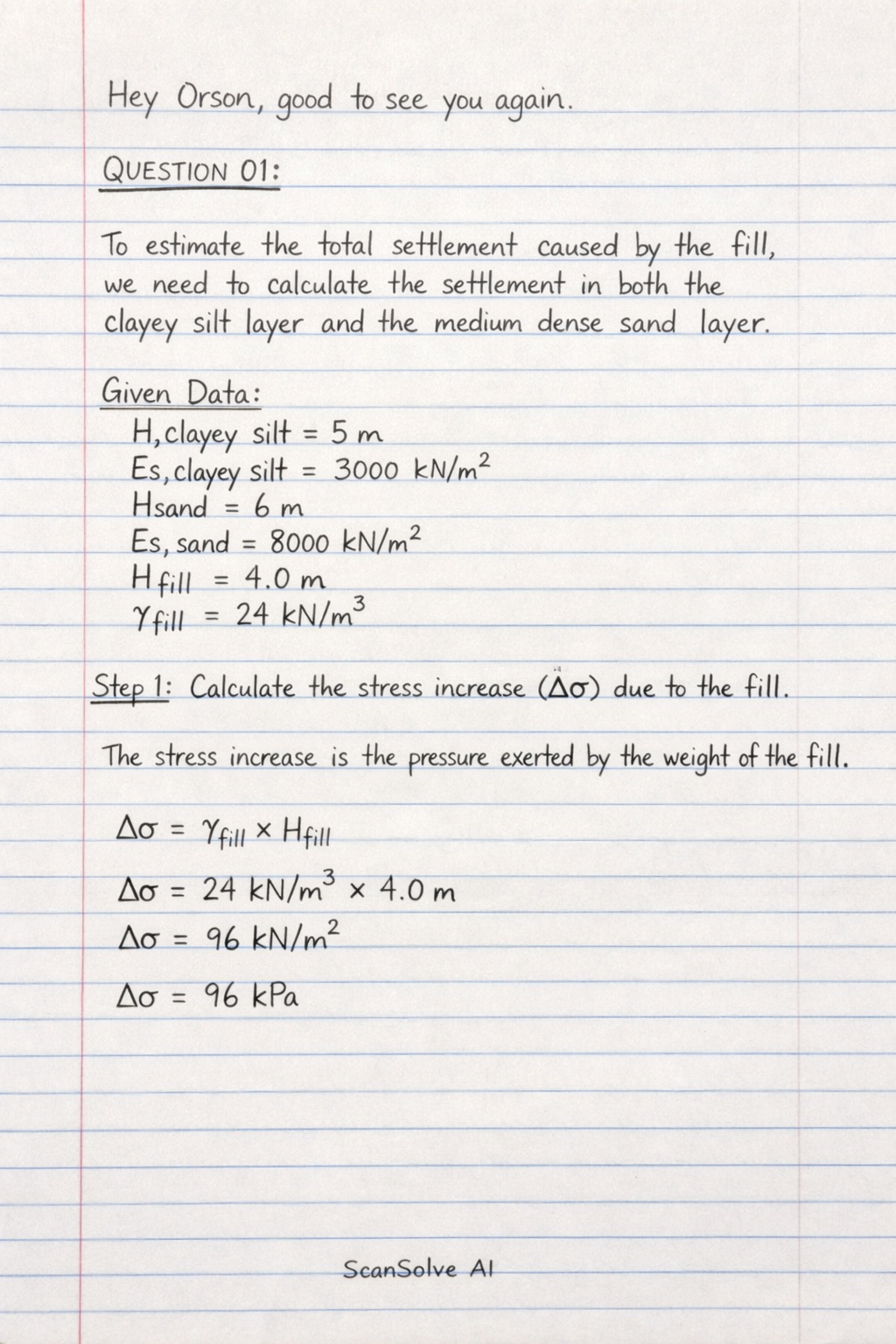
To estimate the total settlement caused by the fill, we need to calculate the settlement in both the clayey silt layer and the medium dense sand layer.
Given Data:
Thickness of clayey silt (Hclayeysilt) = 5m
Stiffness of clayey silt (Es,clayeysilt) = 3MN/m2=3000kN/m2
Thickness of medium dense sand (Hsand) = 6m
Stiffness of medium dense sand (Es,sand) = 8MN/m2=8000kN/m2
Thickness of soil fill (Hfill) = 4.0m
Unit weight of fill (γfill) = 24kN/m3
Step 1: Calculate the stress increase (Δσ) due to the fill.
The stress increase is the pressure exerted by the weight of the fill.
Δσ=γfill×HfillΔσ=24kN/m3×4.0mΔσ=96kN/m2=96kPa
Step 2: Calculate the settlement in the clayey silt layer (ΔSclayeysilt).
We use the elastic settlement formula: ΔS=EsΔσ⋅H.
ΔSclayeysilt=Es,clayeysiltΔσ×HclayeysiltΔSclayeysilt=3000kN/m296kN/m2×5mΔSclayeysilt=3000480mΔSclayeysilt=0.16m=160mm
Step 3: Calculate the settlement in the medium dense sand layer (ΔSsand).ΔSsand=Es,sandΔσ×HsandΔSsand=8000kN/m296kN/m2×6mΔSsand=8000576mΔSsand=0.072m=72mm
Step 4: Calculate the total settlement (ΔStotal).
The total settlement is the sum of the settlements in each layer.
ΔStotal=ΔSclayeysilt+ΔSsandΔStotal=0.16m+0.072mΔStotal=0.232mΔStotal=232mm
The total settlement caused by the fill is: 232mm
QUESTION 02:
Given Data:
Wall height (H) = 5m
Surcharge (q) = 48kPa
Angle of internal friction (ϕ′) = 30∘
Cohesion (c′) = 0
Unit weight of soil (γ) = 20kN/m3
Water table is well below the base of the wall.
Step 1: Calculate the coefficient of active earth pressure (Ka).
For cohesionless soil (c′=0) and a smooth vertical wall, we use Rankine's formula:
Ka=tan2(45∘−2ϕ′)Ka=tan2(45∘−230∘)Ka=tan2(45∘−15∘)Ka=tan2(30∘)Ka=(31)2Ka=31≈0.333
Step 2: Calculate the active thrust due to surcharge and soil weight.
The active thrust can be divided into two parts: from the surcharge and from the soil weight.
Thrust from surcharge (Pq):
Surcharge pressure (pq) = Ka×qpq=31×48kPa=16kPa
Thrust from surcharge (Pq) = pq×HPq=16kPa×5m=80kN/m
This force acts at the mid-height of the wall, i.e., H/2 from the base.
Distance from base (yq) = 25m=2.5m
Thrust from soil weight (Pγ):
Soil pressure at the base (pγ) = Ka×γ×Hpγ=31×20kN/m3×5m=3100kPa≈33.33kPa
Thrust from soil (Pγ) = 21×pγ×H (since the pressure distribution is triangular)
Pγ=21×3100kPa×5m=3250kN/m≈83.33kN/m
This force acts at one-third of the wall height from the base, i.e., H/3 from the base.
Distance from base (yγ) = 35m≈1.667m
Step 3: Calculate the resultant thrust (PA).
The resultant thrust is the sum of the forces from the surcharge and the soil weight.
PA=Pq+PγPA=80kN/m+3250kN/mPA=3240kN/m+3250kN/mPA=3490kN/mPA≈163.33kN/m
Step 4: Determine the position of the resultant thrust from the base of the wall.
The position of the resultant thrust (y) is found by taking moments about the base of the wall.
y=PA(Pq×yq)+(Pγ×yγ)y=3490kN/m(80kN/m×2.5m)+(3250kN/m×35m)y=3490kN/m200kN+91250kNy=349091800+1250my=349093050my=93050×4903my=3×4903050my=147305my≈2.075m
The resultant thrust is: 163.33kN/m
The position of the resultant thrust from the base of the wall is: 2.075m
What's next?
Was this helpful?
Need help with your own homework?
Get instant step-by-step solutions to any question. Free to start.
QUESTION 01: To estimate the total settlement caused by the fill, we need to calculate the settlement in both the clayey silt layer and the medium dense sand layer.
This English question involves literary analysis, grammar, or writing skills. The detailed response below provides a well-structured answer with supporting evidence and clear explanations.
ScanSolve AI Answer
QUESTION 01: To estimate the total settlement caused by the fill, we need to calculate the settlement in both the clayey silt layer and the medium dense sand layer. Given Data: Thickness of clayey silt (H_clayey \, silt) = 5 \, m Stiffness of clayey silt (E_s,clayey \, silt) = 3 \, MN/m^2 = 3000 \, kN/m^2 Thickness of medium dense sand (H_sand) = 6 \, m Stiffness of medium dense sand (E_s,sand) = 8 \, MN/m^2 = 8000 \, kN/m^2 Thickness of soil fill (H_fill) = 4.0 \, m Unit weight of fill (_fill) = 24 \, kN/m^3 Step 1: Calculate the stress increase ( ) due to the fill. The stress increase is the pressure exerted by the weight of the fill. = _fill × H_fill = 24 \, kN/m^3 × 4.0 \, m = 96 \, kN/m^2 = 96 \, kPa Step 2: Calculate the settlement in the clayey silt layer ( S_clayey \, silt). We use the elastic settlement formula: S = ( · H)/(E_s). S_clayey \, silt = × H_clayey \, siltE_s,clayey \, silt S_clayey \, silt = 96 \, kN/m^2 × 5 \, m3000 \, kN/m^2 S_clayey \, silt = (480)/(3000) \, m S_clayey \, silt = 0.16 \, m = 160 \, mm Step 3: Calculate the settlement in the medium dense sand layer ( S_sand). S_sand = × H_sandE_s,sand S_sand = 96 \, kN/m^2 × 6 \, m8000 \, kN/m^2 S_sand = (576)/(8000) \, m S_sand = 0.072 \, m = 72 \, mm Step 4: Calculate the total settlement ( S_total). The total settlement is the sum of the settlements in each layer. S_total = S_clayey \, silt + S_sand S_total = 0.16 \, m + 0.072 \, m S_total = 0.232 \, m S_total = 232 \, mm The total settlement caused by the fill is: 232 mm --- QUESTION 02: Given Data: Wall height (H) = 5 \, m Surcharge (q) = 48 \, kPa Angle of internal friction (') = 30^ Cohesion (c') = 0 Unit weight of soil () = 20 \, kN/m^3 Water table is well below the base of the wall. Step 1: Calculate the coefficient of active earth pressure (K_a). For cohesionless soil (c'=0) and a smooth vertical wall, we use Rankine's formula: K_a = ^2 ( 45^ - (')/(2) ) K_a = ^2 ( 45^ - (30^)/(2) ) K_a = ^2 (45^ - 15^) K_a = ^2 (30^) K_a = ( (1)/(sqrt(3)) )^2 K_a = (1)/(3) ≈ 0.333 Step 2: Calculate the active thrust due to surcharge and soil weight. The active thrust can be divided into two parts: from the surcharge and from the soil weight. Thrust from surcharge (P_q): Surcharge pressure (p_q) = K_a × q p_q = (1)/(3) × 48 \, kPa = 16 \, kPa Thrust from surcharge (P_q) = p_q × H P_q = 16 \, kPa × 5 \, m = 80 \, kN/m This force acts at the mid-height of the wall, i.e., H/2 from the base. Distance from base (y_q) = 5 \, m2 = 2.5 \, m Thrust from soil weight (P_): Soil pressure at the base (p_) = K_a × × H p_ = (1)/(3) × 20 \, kN/m^3 × 5 \, m = (100)/(3) \, kPa ≈ 33.33 \, kPa Thrust from soil (P_) = (1)/(2) × p_ × H (since the pressure distribution is triangular) P_ = (1)/(2) × (100)/(3) \, kPa × 5 \, m = (250)/(3) \, kN/m ≈ 83.33 \, kN/m This force acts at one-third of the wall height from the base, i.e., H/3 from the base. Distance from base (y_) = 5 \, m3 ≈ 1.667 \, m Step 3: Calculate the resultant thrust (P_A). The resultant thrust is the sum of the forces from the surcharge and the soil weight. P_A = P_q + P_ P_A = 80 \, kN/m + (250)/(3) \, kN/m P_A = (240)/(3) \, kN/m + (250)/(3) \, kN/m P_A = (490)/(3) \, kN/m P_A ≈ 163.33 \, kN/m Step 4: Determine the position of the resultant thrust from the base of the wall. The position of the resultant thrust (y) is found by taking moments about the base of the wall. y = ((P_q × y_q) + (P_ × y_))/(P_A) y = ( 80 \, kN/m × 2.5 \, m ) + ( (250)/(3) \, kN/m × (5)/(3) \, m )(490)/(3) \, kN/m y = 200 \, kN + (1250)/(9) \, kN(490)/(3) \, kN/m y = (1800 + 1250)/(9)(490)/(3) \, m y = (3050)/(9)(490)/(3) \, m y = (3050)/(9) × (3)/(490) \, m y = (3050)/(3 × 490) \, m y = (305)/(147) \, m y ≈ 2.075 \, m The resultant thrust is: 163.33 kN/m The position of the resultant thrust from the base of the wall is: 2.075 m What's next?