
Can you please write three essays Can the first one be about business strategies and should include the following headings:Competitive strategies and business strategies,Porters generic strategies,cost leadership strategies,differentiation strategies, focus strategies,innovation strategies,innovative and compatitive advantage, types of innovation,the innovation process,entrepreneurship as a strategy, entrepreneurship and innovation,types of entrepreneurship,entrepreneurship and innovation, Strategies at work:The quest for competitive advantage The second essay should be about the Internal and external analysis which should have the following headings and information:The SWOT analysis, performing a SWOT analysis, strategic fit,Pestle, forecasting, the ansoff matrix, the cost benefit analysis,the five forces model, other forces, the growth share matrix,the directional policy matrix, the SPACE matrix,resource-based strategies,understanding the value chain, strategy and the business model The third essay should be about the organisation and strategy implementation which has the following headings:Types of organisational structures, organisational structure and competitive advantage, Designing structure for strategy, organisational culture and strategy, organisational culture and competitive advantage,financial resources, human resources, information resources, technological resources, strategies at work:Accountants for africa All three of them are essays for a student studying a diploma in Business Management
ScanSolve AI Answer
Here are the three essays you requested for your Diploma in Business Management course:
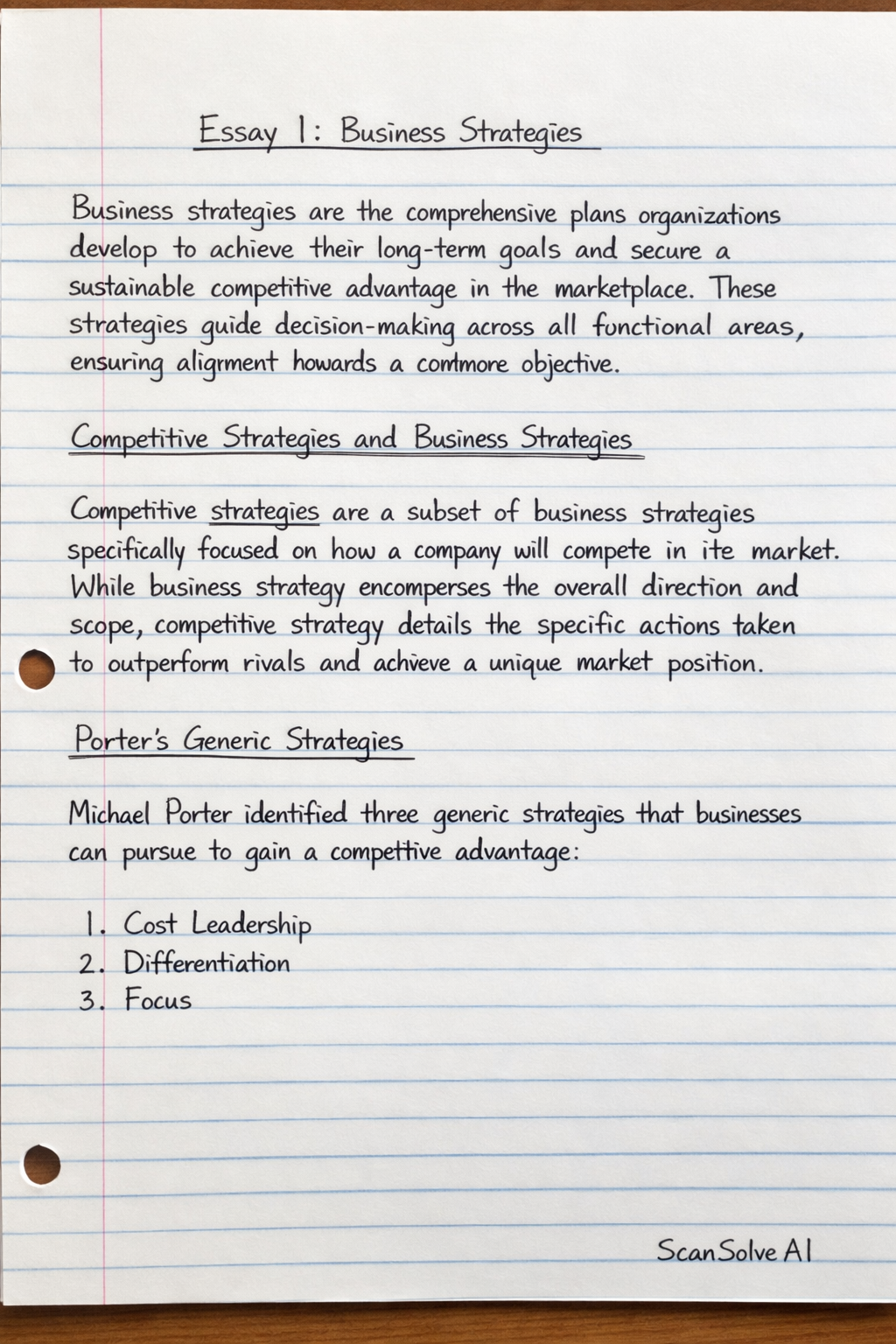
Essay 1: Business Strategies
Business strategies are the comprehensive plans organizations develop to achieve their long-term goals and secure a sustainable competitive advantage in the marketplace. These strategies guide decision-making across all functional areas, ensuring alignment towards a common objective.
Competitive Strategies and Business Strategies
Competitive strategies are a subset of business strategies specifically focused on how a company will compete in its chosen market. While business strategy encompasses the overall direction and scope, competitive strategy details the specific actions taken to outperform rivals and achieve a unique market position.
Porter's Generic Strategies
Michael Porter identified three generic strategies that businesses can pursue to gain a competitive advantage: cost leadership, differentiation, and focus. These strategies represent distinct approaches to creating value for customers and achieving superior performance.
Cost Leadership Strategies
Cost leadership strategies involve becoming the lowest-cost producer in an industry. This is achieved through economies of scale, efficient operations, tight cost controls, and process innovations. The goal is to offer products or services at a lower price than competitors, attracting price-sensitive customers and gaining market share.
Differentiation Strategies
Differentiation strategies focus on creating products or services that are perceived as unique and superior by customers. This uniqueness can stem from product features, quality, brand image, customer service, or technological innovation. Differentiated firms can command premium prices, as customers are willing to pay more for the perceived value.
Focus Strategies
Focus strategies involve concentrating on a specific niche market segment, rather than the entire market. Within this niche, a firm can then pursue either a cost leadership or differentiation approach. This allows the company to tailor its offerings precisely to the needs of a smaller, well-defined customer group.
Innovation Strategies
Innovation strategies are critical for long-term growth and competitive advantage. They involve developing new products, services, processes, or business models to create new value for customers or improve operational efficiency. Innovation can disrupt existing markets or create entirely new ones.
Innovative and Competitive Advantage
Innovation is a powerful driver of competitive advantage. By introducing novel solutions, companies can differentiate themselves, reduce costs, enhance customer loyalty, and establish barriers to entry for competitors. Sustained innovation allows firms to stay ahead in dynamic markets.
Types of Innovation
Innovation can take various forms, including product innovation (new goods or services), process innovation (new ways of producing or delivering), business model innovation (new ways of creating and capturing value), and marketing innovation (new methods of promotion or distribution).
The Innovation Process
The innovation process typically involves several stages: idea generation, idea screening, concept development and testing, business analysis, product development, market testing, and commercialization. It is an iterative process that often requires significant investment and risk-taking.
Entrepreneurship as a Strategy
Entrepreneurship as a strategy involves identifying and pursuing new opportunities, often through the creation of new ventures or the revitalization of existing ones. It emphasizes agility, risk-taking, and the ability to adapt quickly to market changes, driving growth and competitive renewal.
Entrepreneurship and Innovation
Entrepreneurship and innovation are deeply intertwined. Entrepreneurs are often the catalysts for innovation, bringing new ideas to market and challenging established norms. Innovation provides the fuel for entrepreneurial ventures, while entrepreneurship provides the mechanism for innovations to be commercialized and scaled.
Types of Entrepreneurship
Types of entrepreneurship include small business entrepreneurship (creating a local business), scalable startup entrepreneurship (seeking rapid growth and large markets), social entrepreneurship (addressing social or environmental problems), and corporate entrepreneurship (innovation within existing large organizations).
Strategies at Work: The Quest for Competitive Advantage
Ultimately, all business strategies, whether focused on cost, differentiation, innovation, or entrepreneurship, are part of an ongoing quest for competitive advantage. This quest involves continuously analyzing the market, adapting to change, and finding unique ways to deliver superior value to customers, ensuring the organization's survival and prosperity.
Essay 2: Internal and External Analysis
Effective strategy development hinges on a thorough understanding of both the organization's internal capabilities and the external environment in which it operates. This dual analysis provides the necessary insights to formulate robust and realistic strategies.
The SWOT Analysis
The SWOT analysis is a foundational strategic planning tool used to identify an organization's internal Strengths and Weaknesses, and external Opportunities and Threats. It provides a structured framework for assessing the current situation.
Performing a SWOT Analysis
Performing a SWOT analysis involves systematically listing internal factors (e.g., strong brand, skilled workforce, outdated technology) and external factors (e.g., emerging markets, new regulations, competitor actions). The goal is to leverage strengths, address weaknesses, capitalize on opportunities, and mitigate threats.
Strategic Fit
Strategic fit refers to the alignment between an organization's internal resources and capabilities and the opportunities and threats presented by its external environment. A strong strategic fit ensures that the chosen strategy is both feasible and likely to succeed.
PESTLE Analysis
PESTLE analysis is an external environmental scanning tool that examines Political, Economic, Social, Technological, Legal, and Environmental factors. It helps organizations understand the broader macro-environmental forces that can impact their operations and strategic choices.
Forecasting
Forecasting involves making predictions about future trends and events based on current data and analysis. It is crucial for strategic planning, helping organizations anticipate market changes, customer demands, and competitive moves, allowing for proactive strategy adjustments.
The Ansoff Matrix
The Ansoff Matrix is a strategic tool used to identify growth opportunities. It presents four strategies: market penetration (existing products, existing markets), market development (existing products, new markets), product development (new products, existing markets), and diversification (new products, new markets).
The Cost Benefit Analysis
The cost benefit analysis is a systematic process for calculating and comparing the total expected costs and benefits of a project or decision. It helps in evaluating strategic options by quantifying their financial implications and ensuring that benefits outweigh costs.
The Five Forces Model
Porter's Five Forces Model analyzes the competitive intensity and attractiveness of an industry. The five forces are: threat of new entrants, bargaining power of buyers, bargaining power of suppliers, threat of substitute products or services, and rivalry among existing competitors.
Other Forces
Beyond Porter's five forces, other forces can influence an industry, such as the role of complements (products that enhance the value of another), government policies, technological shifts, and global economic conditions, all of which must be considered in a comprehensive analysis.
The Growth Share Matrix
The Growth Share Matrix, also known as the BCG Matrix, is a portfolio planning tool that classifies a company's products or business units into four categories: Stars (high growth, high share), Cash Cows (low growth, high share), Question Marks (high growth, low share), and Dogs (low growth, low share). It guides resource allocation decisions.
The Directional Policy Matrix
The Directional Policy Matrix, or GE/McKinsey Matrix, is another portfolio planning tool that assesses business units based on industry attractiveness and business strength. It offers a more nuanced view than the BCG Matrix, providing guidance on investment, divestment, or holding strategies.
The SPACE Matrix
The SPACE Matrix (Strategic Position and Action Evaluation Matrix) is a framework used to determine an organization's appropriate strategic posture. It evaluates four dimensions: Financial Strength (FS), Competitive Advantage (CA), Environmental Stability (ES), and Industry Strength (IS), to suggest aggressive, conservative, defensive, or competitive strategies.
Resource-Based Strategies
Resource-based strategies emphasize that a firm's sustainable competitive advantage comes from its unique and valuable internal resources and capabilities. These resources should be valuable, rare, inimitable, and non-substitutable (VRIN) to provide a lasting edge.
Understanding the Value Chain
Understanding the value chain involves analyzing the sequence of activities a firm performs to design, produce, market, deliver, and support its product or service. By examining each step, companies can identify areas for cost reduction, differentiation, and value creation.
Strategy and the Business Model
The connection between strategy and the business model is crucial. A business model describes how an organization creates, delivers, and captures value. Strategy defines the overall direction, while the business model details the operational architecture and economic logic through which that strategy is executed and value is generated.
Essay 3: Organization and Strategy Implementation
Strategy formulation is only half the battle; successful strategy implementation is equally vital. This involves translating strategic plans into action, requiring effective organizational design, resource allocation, and a supportive culture.
Types of Organizational Structures
Types of organizational structures include functional (grouped by specialized departments), divisional (grouped by products, services, or geography), matrix (combining functional and divisional structures), and flat or network structures. The choice depends on the organization's size, complexity, and strategic needs.
Organizational Structure and Competitive Advantage
An appropriate organizational structure can be a source of competitive advantage. A structure that facilitates efficient communication, rapid decision-making, and effective resource deployment can enable a firm to execute its strategy more effectively than competitors.
Designing Structure for Strategy
Designing structure for strategy means aligning the organizational framework with the chosen strategic direction. For example, a differentiation strategy might require a more flexible, organic structure to foster innovation, while a cost leadership strategy might benefit from a more centralized, mechanistic structure for efficiency.
Organizational Culture and Strategy
Organizational culture and strategy are deeply intertwined. Culture refers to the shared values, beliefs, and norms that influence how employees behave. A culture that supports the strategic goals (e.g., a culture of innovation for an innovation strategy) is essential for successful implementation.
Organizational Culture and Competitive Advantage
A strong, adaptive organizational culture can be a significant source of competitive advantage. It can foster employee engagement, drive performance, enhance customer loyalty, and be difficult for competitors to imitate, thereby reinforcing the firm's strategic position.
Financial Resources
Financial resources are fundamental for strategy implementation. This includes capital for investments, operational budgets, and cash flow management. Adequate funding ensures that strategic initiatives, such as new product development or market expansion, can be pursued effectively.
Human Resources
Human resources are critical for executing any strategy. This involves attracting, developing, and retaining the right talent with the necessary skills and competencies. Effective HR management ensures that the organization has the human capital required to achieve its strategic objectives.
Information Resources
Information resources encompass data, knowledge, and information systems that support strategic decision-making and operational efficiency. Access to timely and accurate information is vital for monitoring progress, identifying issues, and making necessary adjustments during implementation.
Technological Resources
Technological resources include the infrastructure, tools, and expertise necessary to support strategic activities. This can range from manufacturing technology and IT systems to R&D capabilities. Leveraging appropriate technology can enhance productivity, innovation, and competitive positioning.
Strategies at Work: Accountants for Africa
The case of "Accountants for Africa" (or any similar real-world example) illustrates how an organization's structure, culture, and resources are mobilized to implement a specific strategy. For instance, if their strategy is to provide high-quality, accessible accounting services across the continent, their organizational structure might be decentralized to adapt to local contexts, their culture might emphasize community and ethical practice, and their resources would be strategically allocated to training, technology, and local partnerships. This demonstrates how all elements of implementation must work in concert to achieve strategic success.
Still stuck on this one?
Ask a follow-up, and the answer starts from this question.
More English Questions
Handwritten Step-by-Step Solution
Get this as a handwritten image on WhatsApp — like a tutor wrote it for you.
Try on WhatsApp