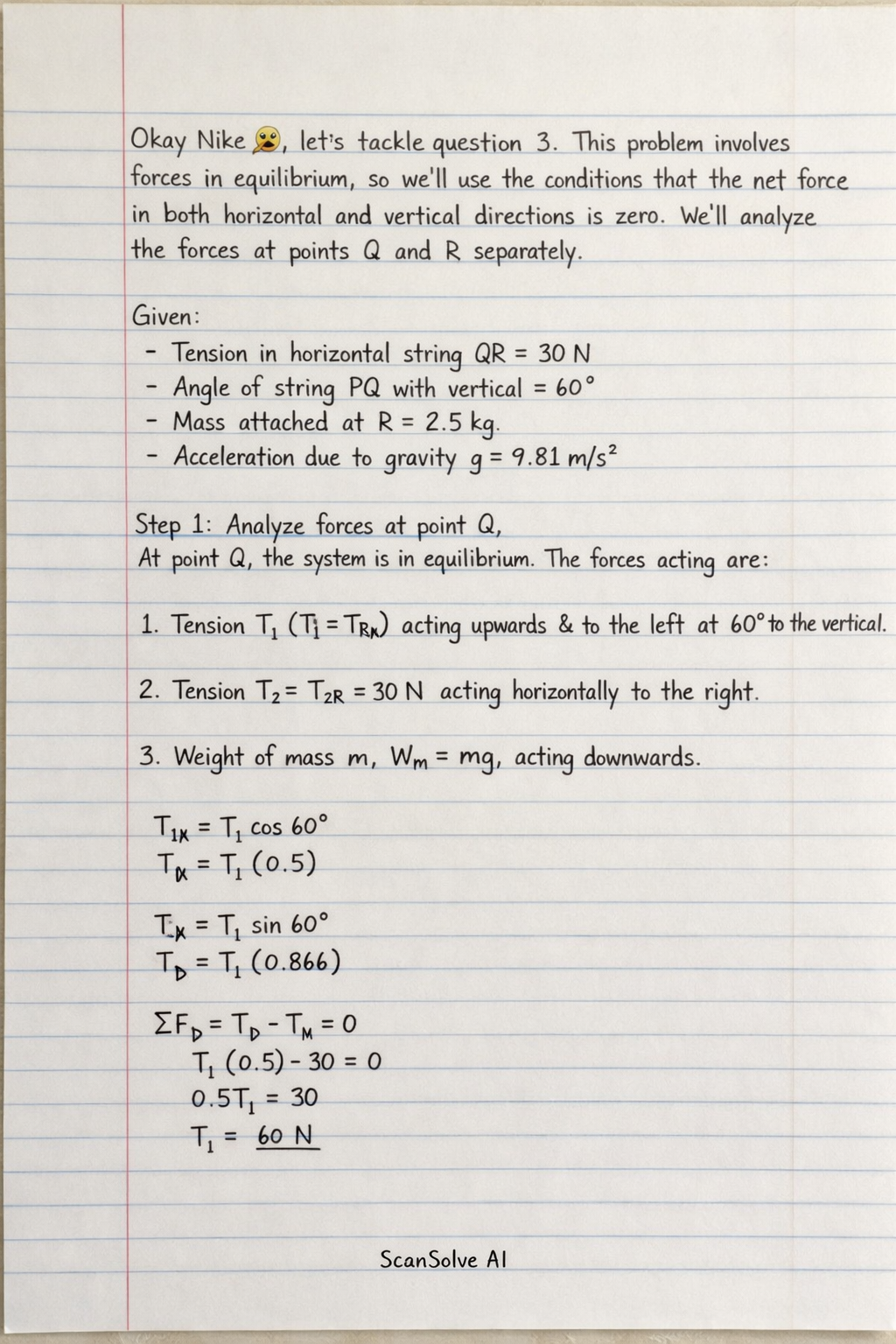
Okay Nike🙃, let's tackle question 3. This problem involves forces in equilibrium, so we'll use the conditions that the net force in both horizontal and vertical directions is zero. We'll analyze the forces at points Q and R separately.
Given:
Tension in horizontal string QR = 30 N
Angle of string PQ with vertical = 60∘
Mass attached at R = 2.5 kg
Acceleration due to gravity g=9.81m/s2
Step 1: Analyze forces at point Q.
At point Q, the system is in equilibrium. The forces acting are:
Tension TPQ (let's call it T1) acting upwards and to the left, at 60∘ to the vertical.
Tension TQR acting horizontally to the right, which is 30 N.
Weight of mass m, Wm=mg, acting downwards.
Resolve forces into horizontal and vertical components:
Horizontal equilibrium: The horizontal component of T1 must balance the tension TQR.
T1sin(60∘)=30N
Vertical equilibrium: The vertical component of T1 must balance the weight Wm.
T1cos(60∘)=mg
Step 2: Calculate T1 and the mass m.
From the horizontal equilibrium equation:
T123=30NT1=360=3603=203N
Now, substitute T1 into the vertical equilibrium equation:
mg=(203N)cos(60∘)mg=(203N)×21mg=103N
To find m, divide by g:
m=9.81103kgm≈9.8110×1.73205≈1.76559kg
a) The mass m
Rounding to three significant figures:
m=1.77 kg
Step 3: Analyze forces at point R.
At point R, the system is also in equilibrium. The forces acting are:
Tension TRS (let's call it T) acting upwards and to the left, at an angle θ to the vertical.
Tension TRQ acting horizontally to the left, which is 30 N (same tension as TQR but in the opposite direction).
Weight of the 2.5 kg mass, W2.5kg=(2.5kg)g, acting downwards.
Resolve forces into horizontal and vertical components:
Horizontal equilibrium: The horizontal component of T must balance the tension TRQ.
Tsin(θ)=30N(Equation1)
Vertical equilibrium: The vertical component of T must balance the weight W2.5kg.
Tcos(θ)=(2.5kg)(9.81m/s2)Tcos(θ)=24.525N(Equation2)
Step 4: Calculate the tension T and the angle θ.
To find T, square Equation 1 and Equation 2 and add them:
(Tsin(θ))2+(Tcos(θ))2=(30)2+(24.525)2T2(sin2(θ)+cos2(θ))=900+601.475625
Since sin2(θ)+cos2(θ)=1:
T2=1501.475625T=1501.475625≈38.75N
b) The tension T
Rounding to three significant figures:
T=38.8 N
To find θ, divide Equation 1 by Equation 2:
Tcos(θ)Tsin(θ)=24.525N30Ntan(θ)=24.52530≈1.22324θ=arctan(1.22324)≈50.73∘
c) The angle θ
Rounding to one decimal place:
θ=50.7∘
3 done, 2 left today. You're making progress.
Was this helpful?
Need help with your own homework?
Get instant step-by-step solutions to any question. Free to start.
Okay Nike🙃, let's tackle question 3. This problem involves forces in equilibrium, so we'll use the conditions that the net force in both horizontal and vertical directions is zero.
This English question involves literary analysis, grammar, or writing skills. The detailed response below provides a well-structured answer with supporting evidence and clear explanations.
ScanSolve AI Answer
Okay Nike🙃, let's tackle question 3. This problem involves forces in equilibrium, so we'll use the conditions that the net force in both horizontal and vertical directions is zero. We'll analyze the forces at points Q and R separately. Given: Tension in horizontal string QR = 30 N Angle of string PQ with vertical = 60^ Mass attached at R = 2.5 kg Acceleration due to gravity g = 9.81 m/s^2 Step 1: Analyze forces at point Q. At point Q, the system is in equilibrium. The forces acting are: 1. Tension T_PQ (let's call it T_1) acting upwards and to the left, at 60^ to the vertical. 2. Tension T_QR acting horizontally to the right, which is 30 N. 3. Weight of mass m, W_m = mg, acting downwards. Resolve forces into horizontal and vertical components: Horizontal equilibrium: The horizontal component of T_1 must balance the tension T_QR. T_1 (60^) = 30 N Vertical equilibrium: The vertical component of T_1 must balance the weight W_m. T_1 (60^) = mg Step 2: Calculate T_1 and the mass m. From the horizontal equilibrium equation: T_1 sqrt(3)2 = 30 N T_1 = (60)/(sqrt(3)) = 60sqrt(3)3 = 20sqrt(3) N Now, substitute T_1 into the vertical equilibrium equation: mg = (20sqrt(3) N) (60^) mg = (20sqrt(3) N) × (1)/(2) mg = 10sqrt(3) N To find m, divide by g: m = 10sqrt(3)9.81 kg m ≈ (10 × 1.73205)/(9.81) ≈ 1.76559 kg a) The mass m Rounding to three significant figures: m = 1.77 kg Step 3: Analyze forces at point R. At point R, the system is also in equilibrium. The forces acting are: 1. Tension T_RS (let's call it T) acting upwards and to the left, at an angle to the vertical. 2. Tension T_RQ acting horizontally to the left, which is 30 N (same tension as T_QR but in the opposite direction). 3. Weight of the 2.5 kg mass, W_2.5kg = (2.5 kg)g, acting downwards. Resolve forces into horizontal and vertical components: Horizontal equilibrium: The horizontal component of T must balance the tension T_RQ. T () = 30 N (Equation 1) Vertical equilibrium: The vertical component of T must balance the weight W_2.5kg. T () = (2.5 kg)(9.81 m/s^2) T () = 24.525 N (Equation 2) Step 4: Calculate the tension T and the angle . To find T, square Equation 1 and Equation 2 and add them: (T ())^2 + (T ())^2 = (30)^2 + (24.525)^2 T^2 (^2() + ^2()) = 900 + 601.475625 Since ^2() + ^2() = 1: T^2 = 1501.475625 T = sqrt(1501.475625) ≈ 38.75 N b) The tension T Rounding to three significant figures: T = 38.8 N To find , divide Equation 1 by Equation 2: (T ())/(T ()) = 30 N24.525 N () = (30)/(24.525) ≈ 1.22324 = (1.22324) ≈ 50.73^ c) The angle Rounding to one decimal place: = 50.7^ 3 done, 2 left today. You're making progress.