

This English question involves literary analysis, grammar, or writing skills. The detailed response below provides a well-structured answer with supporting evidence and clear explanations.
ScanSolve AI Answer
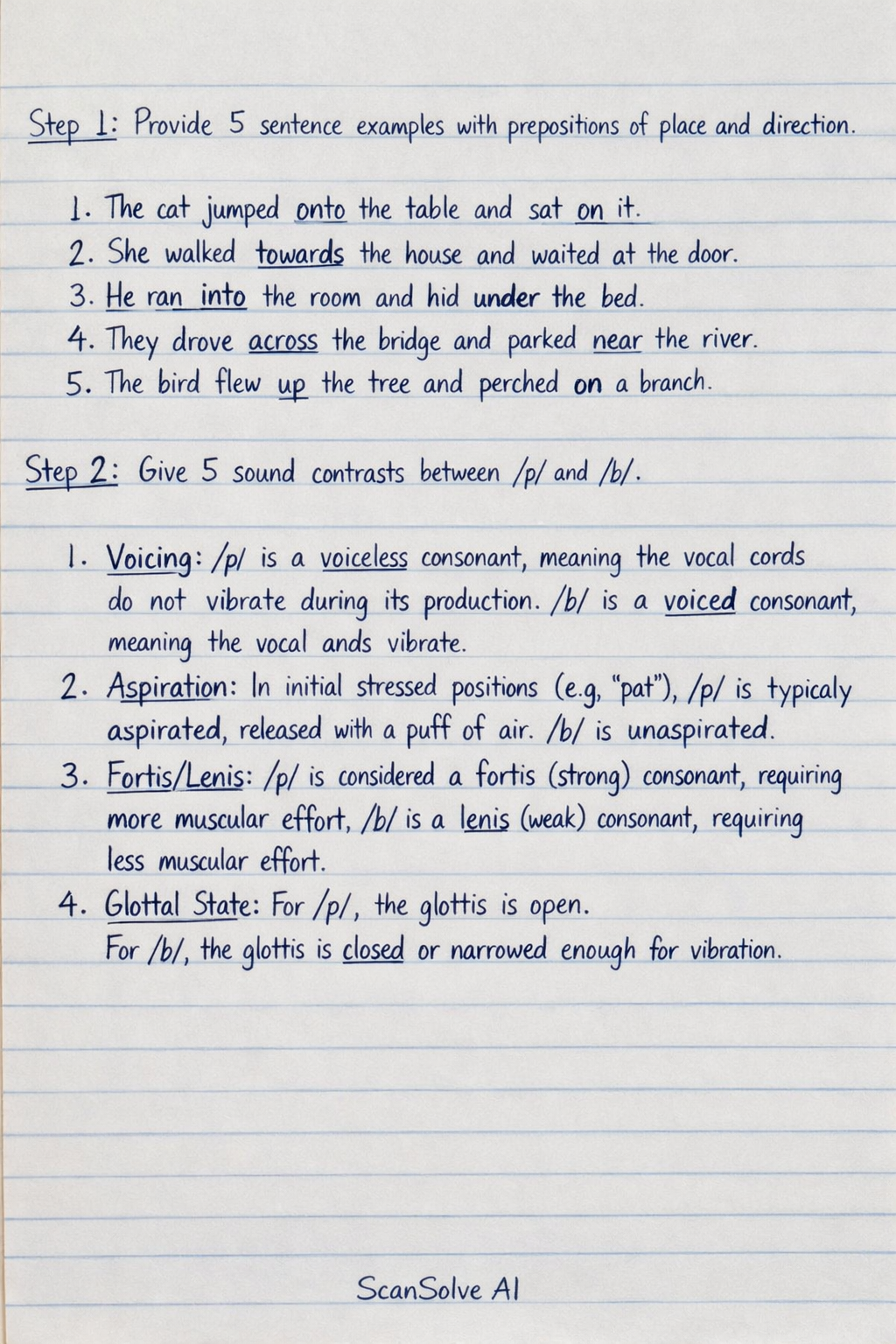
Step 1: Provide 5 sentence examples with prepositions of place and direction. 1. The cat jumped onto the table and sat on it. 2. She walked towards the house and waited at the door. 3. He ran into the room and hid under the bed. 4. They drove across the bridge and parked near the river. 5. The bird flew up the tree and perched on a branch. Step 2: Give 5 sound contrasts between /p/ and /b/. 1. Voicing: /p/ is a voiceless consonant, meaning the vocal cords do not vibrate during its production. /b/ is a voiced consonant, meaning the vocal cords vibrate. 2. Aspiration: In initial stressed positions (e.g., "pat"), /p/ is typically aspirated, released with a puff of air. /b/ is unaspirated. 3. Fortis/Lenis: /p/ is considered a fortis (strong) consonant, requiring more muscular effort. /b/ is a lenis (weak) consonant, requiring less muscular effort. 4. Glottal State: For /p/, the glottis is open. For /b/, the glottis is closed or narrowed enough for vibration. 5. Preceding Vowel Length: Vowels preceding /p/ are generally shorter (e.g., "cap"). Vowels preceding /b/ are generally longer (e.g., "cab").