
We read your photo as:
Explain the purpose and process of a literature review and describe a seminar in Nursing education.
ScanSolve AI Answer
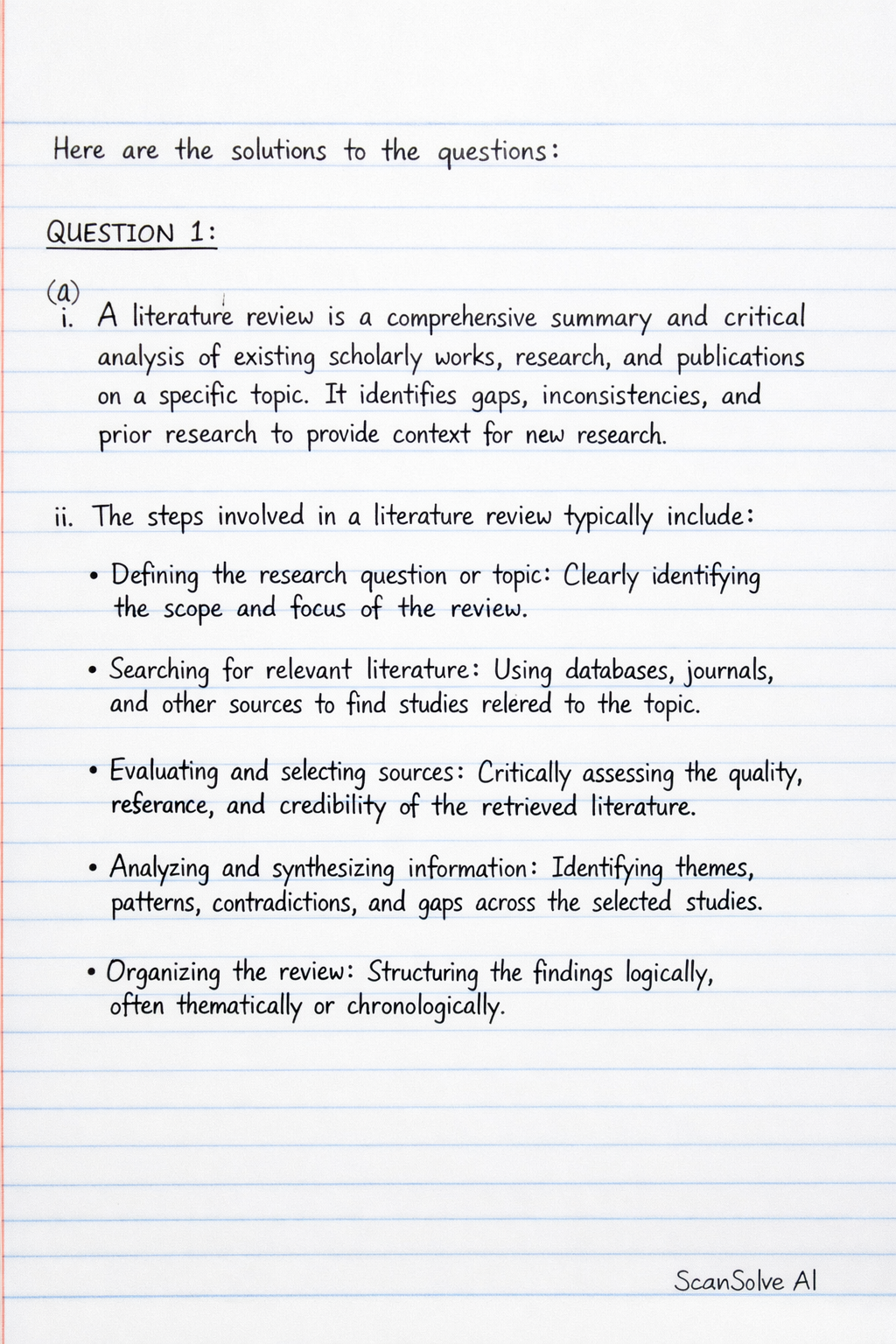
Here are the solutions to the questions:
QUESTION 1:
a)
i. A literature review is a comprehensive summary and critical analysis of existing scholarly works, research, and publications on a specific topic. It identifies gaps, inconsistencies, and prior research to provide context for new research.
ii. The steps involved in a literature review typically include:
- Defining the research question or topic: Clearly identifying the scope and focus of the review.
- Searching for relevant literature: Using databases, journals, and other sources to find studies related to the topic.
- Evaluating and selecting sources: Critically assessing the quality, relevance, and credibility of the retrieved literature.
- Analyzing and synthesizing information: Identifying themes, patterns, contradictions, and gaps across the selected studies.
- Organizing the review: Structuring the findings logically, often thematically or chronologically.
- Writing the literature review: Presenting the synthesized information, discussing findings, and identifying implications for future research.
b) A seminar in Nursing education is an interactive instructional method where a small group of students discusses a specific topic or case study under the guidance of a facilitator. It aims to foster critical thinking, deeper understanding, and collaborative learning among participants.
c)
i. Conceptual review: This type of review focuses on examining and synthesizing existing theories, models, and concepts related to a particular phenomenon or research problem. It helps to clarify definitions, identify theoretical frameworks, and understand the underlying ideas that inform a field of study.
ii. Empirical review: An empirical review systematically examines studies that have collected and analyzed data to answer specific research questions. It focuses on the findings, methodologies, and results of actual research studies, often to identify trends, effectiveness of interventions, or relationships between variables.
iii. Theoretical review: Similar to a conceptual review, a theoretical review specifically explores the theoretical frameworks and perspectives that have been applied to a topic. It analyzes how different theories explain phenomena, their strengths, weaknesses, and how they have evolved over time, providing a foundation for new theoretical development.
iv. Proposal: In the context of research, a proposal is a detailed plan outlining a proposed study or project. It typically includes the research question, objectives, literature review, methodology, ethical considerations, timeline, and expected outcomes, serving as a blueprint for the research to be conducted.
QUESTION 2:
a)
i. A nursing resume is a professional document that outlines a nurse's education, clinical experience, skills, licenses, certifications, and professional achievements. Its purpose is to showcase qualifications and secure employment in the nursing field.
ii. Components of a professional nursing resume typically include:
- Contact Information: Name, phone number, email, and professional social media (e.g., LinkedIn).
- Professional Summary or Objective: A brief statement highlighting key qualifications, experience, and career goals.
- Education: Details of nursing degrees, institutions, graduation dates, and relevant coursework or honors.
- Licenses and Certifications: State nursing license number, expiration date, and any specialized certifications (e.g., BLS, ACLS).
- Clinical Experience: A chronological list of nursing positions, including facility name, location, dates of employment, and key responsibilities or accomplishments.
- Skills: A section detailing clinical skills (e.g., IV insertion, wound care), technical skills (e.g., EMR systems), and soft skills (e.g., communication, teamwork).
- Professional Affiliations: Membership in nursing organizations (e.g., ANA, specialty associations).
- Awards and Honors: Recognition for academic or professional achievements.
b)
i. Critical thinking is the objective analysis and evaluation of information in order to form a judgment. In nursing, it involves purposeful, self-regulatory judgment that applies to what a nurse believes or does, enabling sound clinical decision-making and problem-solving.
ii. A position paper is a written argument that presents an arguable opinion about an issue, supported by evidence and reasoning. In nursing, it often advocates for a specific stance on a healthcare policy, clinical practice, ethical dilemma, or professional issue, aiming to persuade an audience and influence decision-making.
QUESTION 3:
a) Plagiarism is the act of using someone else's words, ideas, or work without proper attribution and presenting them as one's own original creation.
b) Different types of plagiarism include:
- Direct Plagiarism: Copying text word-for-word from a source without quotation marks or citation. Example: Submitting an entire paragraph from a textbook as your own without any changes or citation.
- Self-Plagiarism: Reusing significant portions of one's own previously published or submitted work without proper citation or permission. Example: Submitting a paper you wrote for a previous course to a new course without acknowledging its prior use.
- Mosaic Plagiarism (Patchwork Plagiarism): Borrowing phrases and clauses from a source and weaving them into your own writing without proper citation, or changing a few words while maintaining the original sentence structure. Example: Taking sentences from multiple sources, changing a few words in each, and combining them into a new paragraph without citing the original sources.
- Accidental Plagiarism: Unintentionally failing to cite sources, misquoting, or paraphrasing incorrectly due to carelessness or lack of understanding of citation rules. Example: Forgetting to include an in-text citation for information you correctly paraphrased from a source.
- Paraphrasing Plagiarism: Restating someone else's ideas in your own words without proper attribution, making it appear as if the ideas are original to you. Example: Rewriting a paragraph from an article in your own words but not citing the original author.
c) Strategies for preventing plagiarism include:
- Proper Citation: Always cite all sources of information, ideas, and direct quotes using a consistent citation style (e.g., APA, MLA).
- Paraphrasing and Summarizing Correctly: Understand the difference between paraphrasing (restating in your own words) and summarizing (condensing main ideas), and always cite the original source.
- Using Quotation Marks: Enclose all direct quotes in quotation marks and provide the source citation, including page numbers.
- Understanding Academic Integrity: Familiarize yourself with your institution's policies on plagiarism and academic honesty.
- Planning and Note-Taking: Organize research materials and notes carefully, clearly distinguishing between your own ideas and those from sources.
- Using Plagiarism Checkers: Utilize tools like Turnitin or Grammarly to identify potential instances of plagiarism before submission.
d) The academic, professional, and legal implications of plagiarism are significant:
- Academic Implications: Students may face failing grades for assignments, suspension from the institution, or even expulsion. It undermines the integrity of academic work and the learning process.
- Professional Implications: Plagiarism can severely damage a professional's reputation, leading to loss of credibility, job termination, or even revocation of professional licenses (e.g., for nurses, doctors, researchers). It can hinder career advancement and trust within a professional community.
- Legal Implications: In cases where plagiarism involves copyrighted material, it can lead to copyright infringement lawsuits. This may result in substantial fines, legal fees, and, in severe instances, criminal charges or imprisonment, particularly if the plagiarism is for commercial gain.
Still stuck on this one?
Ask a follow-up, and the answer starts from this question.
More English Questions
Handwritten Step-by-Step Solution
Get this as a handwritten image on WhatsApp — like a tutor wrote it for you.
Try on WhatsApp