
We read your photo as:
Q1. Write a letter to the minister of education in 400 words explain to him or her the problem you facing in your senior secondary school. Q2. In 400 words write a story and explain the way you enjoy traveling by sea or in a wooden boat.
ScanSolve AI Answer
Step-by-step solution
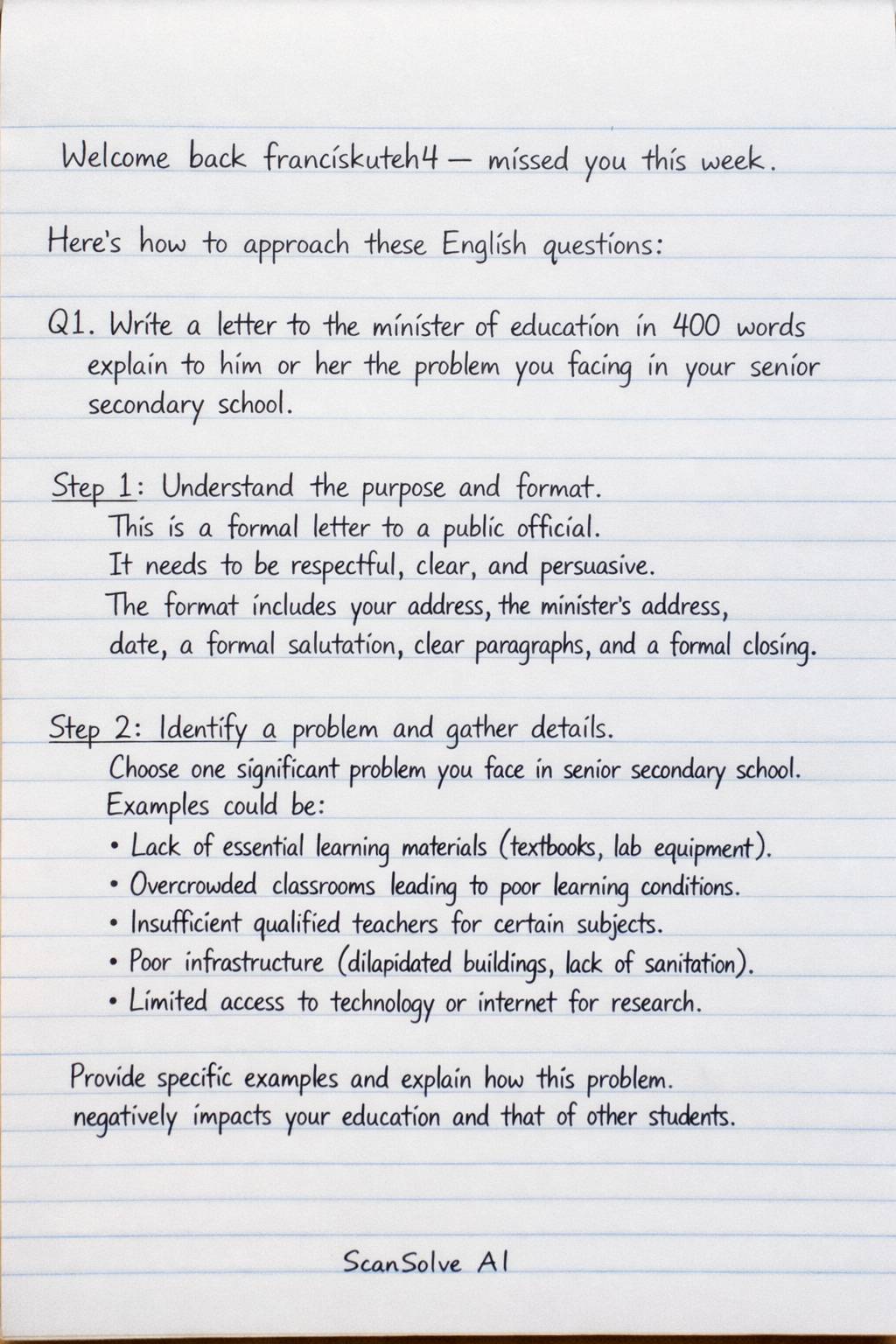
6 stepsHere's how to approach these English questions:
Q1. Write a letter to the minister of education in 400 words explain to him or her the problem you facing in your senior secondary school
Understand the purpose and format.
This is a formal letter to a public official. It needs to be respectful, clear, and persuasive. The format includes your address, the minister's address, date, a formal salutation, clear paragraphs, and a formal closing.
Identify a problem and gather details.
Choose one significant problem you face in senior secondary school. Examples could be:
- Lack of essential learning materials (textbooks, lab equipment).
- Overcrowded classrooms leading to poor learning conditions.
- Insufficient qualified teachers for certain subjects.
- Poor infrastructure (dilapidated buildings, lack of sanitation).
- Limited access to technology or internet for research. Provide specific examples and explain how this problem negatively impacts your education and that of other students.
Structure your letter.
- Your Address and Date: Top right.
- Minister's Address: Below your address, left-aligned.
- Salutation: "Dear Honourable Minister,"
- Introduction (1 paragraph): State your purpose clearly – you are writing to highlight a specific issue in your school.
- Body Paragraphs (2-3 paragraphs): Detail the problem. Explain its causes, effects, and provide specific examples. Emphasize how it affects students' academic performance and overall well-being.
- Proposed Solutions (1 paragraph): Briefly suggest possible solutions or actions the ministry could take.
- Conclusion (1 paragraph): Reiterate the urgency of the matter and express hope for a positive response.
- Closing: "Yours faithfully," followed by your full name and student ID/class.
Develop these points into approximately 400 words, ensuring a formal tone throughout.
Q2. In 400 words write a story and explain the way you enjoy traveling by sea or in a wooden boat ⛵
Understand the purpose and elements of a story.
This is a narrative essay where you tell a personal story about traveling by sea or in a wooden boat. It should have a clear plot, characters (even if just you), setting, and convey your feelings and experiences.
Brainstorm experiences and sensory details.
Think about a specific journey or a composite of experiences. Focus on sensory details:
- Sights: The vast ocean, distant shores, marine life, the boat's wooden texture, sunrise/sunset over water.
- Sounds: Waves lapping, creaking wood, seagulls, wind in the sails, silence of the open sea.
- Smells: Salty air, fresh wood, ocean breeze.
- Feelings: The rocking motion, the sun on your skin, the thrill of adventure, peace, solitude, connection with nature.
- Emotions: Joy, wonder, tranquility, excitement, freedom.
Structure your story.
- Introduction (1 paragraph): Set the scene. Introduce the journey, the boat, and your initial feelings or anticipation.
- Rising Action (2-3 paragraphs): Describe the journey itself. What happened? What did you see, hear, and feel? Detail specific moments or events that made the experience enjoyable. Build up the sense of adventure or tranquility.
- Climax/Turning Point (1 paragraph): A significant moment during the journey – perhaps a beautiful discovery, a challenging but rewarding moment, or a profound realization.
- Falling Action (1 paragraph): What happened after the climax? How did the journey continue towards its end?
- Resolution (1 paragraph): Conclude the story by reflecting on the overall experience. Explain why you enjoy traveling this way and the lasting impact it has on you.
Weave your personal enjoyment and reflections throughout the narrative to meet the "explain the way you enjoy" part of the prompt. Aim for approximately 400 words.
Still stuck on this one?
Ask a follow-up, and the answer starts from this question.
More English Questions
Handwritten Step-by-Step Solution
Get this as a handwritten image on WhatsApp — like a tutor wrote it for you.
Try on WhatsApp