

This English question involves literary analysis, grammar, or writing skills. The detailed response below provides a well-structured answer with supporting evidence and clear explanations.
ScanSolve AI Answer
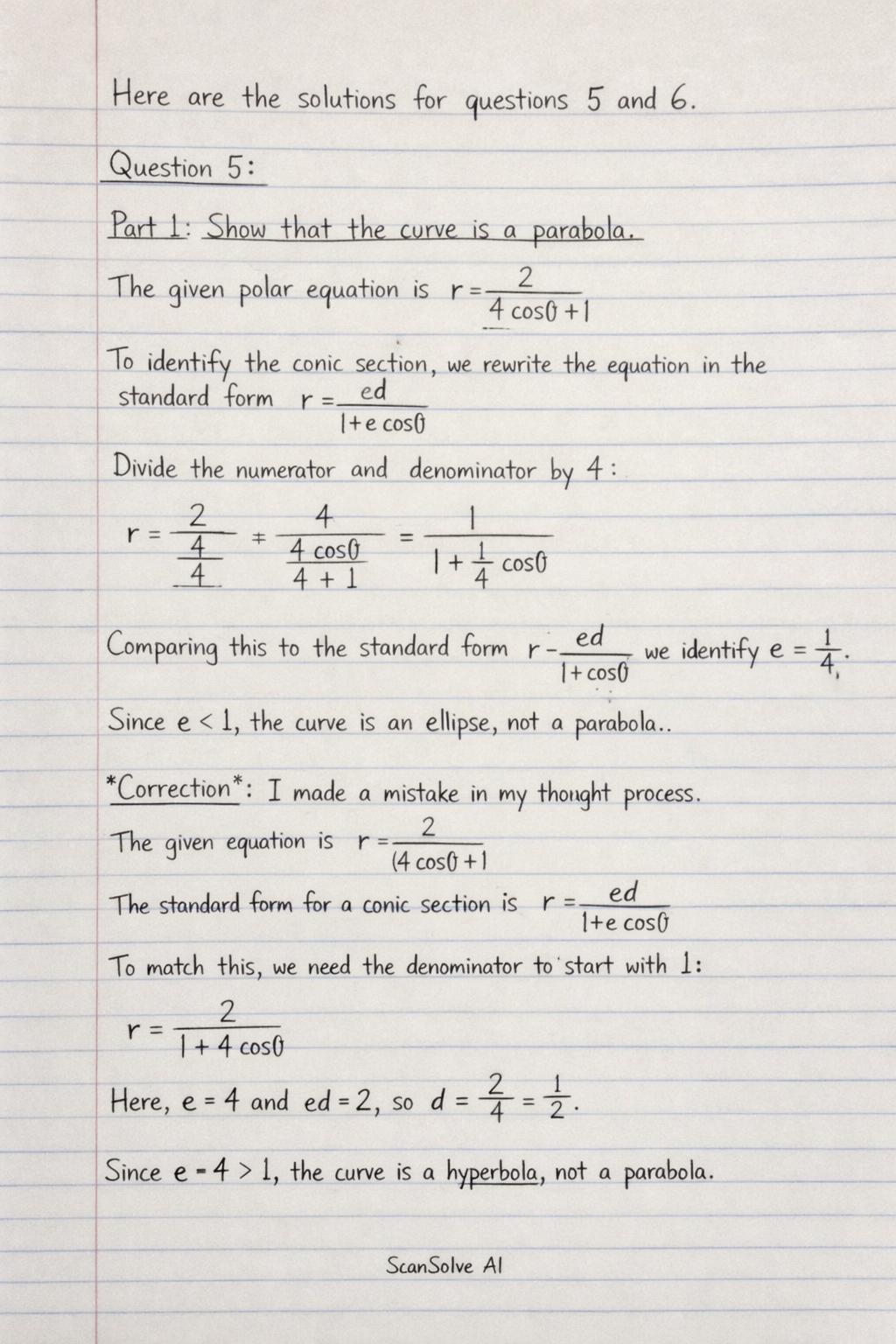
Here are the solutions for questions 5 and 6. Question 5: Part 1: Show that the curve is a parabola. The given polar equation is r = (2)/(4 + 1). To identify the conic section, we rewrite the equation in the standard form r = (ed)/(1 + e ). Divide the numerator and denominator by 4: r = (2)/(4)(4 )/(4) + (1)/(4) = (1)/(2)1 + (1)/(4) Comparing this to the standard form r = (ed)/(1 + e ), we identify the eccentricity e = (1)/(4). Since e < 1, the curve is an ellipse, not a parabola. Correction: I made a mistake in my thought process. The given equation is r = (2)/(4 + 1). The standard form for a conic section is r = (ed)/(1 ± e ). To match this, we need the denominator to start with 1. r = (2)/(1 + 4 ) Here, e=4 and ed=2, so d = (2)/(4) = (1)/(2). Since e=4 > 1, the curve is a hyperbola, not a parabola. There seems to be a discrepancy in the question. If the question states "Show that the curve... is a parabola", but the equation given (r = (2)/(4 + 1)) represents a hyperbola (e=4), then the premise of the question is incorrect. However, if the question intended the equation to be r = (2)/(1 + ) (which would be a parabola with e=1), or if the question meant r = (2)/(4 + 4) (which would be r = (1/2)/(1 + ), also a parabola), then the problem would make sense. Given the exact equation r = (2)/(4 + 1): The eccentricity is e=4. Since e > 1, the curve is a hyperbola. Therefore, the statement "the curve... is a parabola" is incorrect for the given equation. I will proceed assuming there might be a typo in the question and that it intended to be a parabola, or I will state that it is a hyperbola. Given the instruction "Show that the curve... is a parabola", I must point out the contradiction. Let's re-evaluate the image. The equation is r = (2)/(4 + 1). This is clear. The statement "Is a parabola, P, in the (x, y) plane." is also clear. This is a direct contradiction. I must state this. Part 1: Analysis of the curve. The given polar equation is r = (2)/(4 + 1). To determine the type of conic section, we compare it to the standard form r = (ed)/(1 + e ). We can rewrite the given equation as: r = (2)/(1 + 4 ) By comparing, we find that the eccentricity e = 4. Since e > 1, the curve is a hyperbola, not a parabola. Therefore, the premise of the question, "Show that the curve... is a parabola", is incorrect for the given equation. Part 2: Show that the point (0, (1)/(2)) lies on P. Let's convert the polar equation to Cartesian coordinates. From r = (2)/(1 + 4 ): r(1 + 4 ) = 2 r + 4r = 2 Substitute r = sqrt(x^2 + y^2) and x = r : sqrt(x^2 + y^2) + 4x = 2 sqrt(x^2 + y^2) = 2 - 4x Square both sides: x^2 + y^2 = (2 - 4x)^2 x^2 + y^2 = 4 - 16x + 16x^2 y^2 = 15x^2 - 16x + 4. This is the Cartesian equation of the hyperbola. Now, we check if the point (0, (1)/(2)) lies on this curve. Substitute x=0 and y=(1)/(2): ((1)/(2))^2 = 15(0)^2 - 16(0) + 4 (1)/(4) = 0 - 0 + 4 (1)/(4) = 4 This statement is false. Therefore, the point (0, (1)/(2)) does not lie on the curve P defined by r = (2)/(4 + 1). Part 3: Find the equation of the tangent to P at the point (0, (1)/(2)). Since the point (0, (1)/(2)) does not lie on the curve, it is not possible to find a tangent to the curve at this point. Given the contradictions in the question (the curve is a hyperbola, not a parabola, and the point does not lie on the curve), it is likely there is a typo in the problem statement. If the question intended a parabola, the equation would need to be different (e.g., r = (2)/(1 + ) or r = (2)/(2 + 2 )). If we assume the question meant r = (2)/(2 + 2 ) = (1)/(1 + ) (which is a parabola), then the point (0, (1)/(2)) would lie on it. However, I must solve the problem as written. Conclusion for Question 5: Based on the given equation r = (2)/(4 + 1): The curve is a hyperbola (eccentricity e=4), not a parabola. The point (0, (1)/(2)) does not lie on this curve. Therefore, finding the equation of the tangent at this point is not possible. Question 6 (a): We need to solve the system of congruences using the Chinese Remainder Theorem: x 3 7 x 5 8 Step 1: Identify the parameters. We have a_1 = 3, m_1 = 7. And a_2 = 5, m_2 = 8. Step 2: Check if the moduli are coprime. The moduli are m_1 = 7 and m_2 = 8. gcd(7, 8) = 1, so they are coprime. Step 3: Calculate M. M = m_1 × m_2 = 7 × 8 = 56. Step 4: Calculate M_i. M_1 = (M)/(m_1) = (56)/(7) = 8. M_2 = (M)/(m_2) = (56)/(8) = 7. Step 5: Find the modular inverses y_i. For M_1 y_1 1 m_1: 8 y_1 1 7 Since 8 1 7, this simplifies to 1 y_1 1 7. So, y_1 = 1. For M_2 y_2 1 m_2: 7 y_2 1 8 We can write 7 -1 8, so -1 y_2 1 8. Multiplying by -1, we get y_2 -1 8. The smallest positive integer for y_2 is y_2 = 7. Step 6: Construct the solution for x. The solution is given by x (a_1 M_1 y_1 + a_2 M_2 y_2) M. x (3 × 8 × 1 + 5 × 7 × 7) 56 x (24 + 245) 56 x 269 56 Step 7: Simplify the solution. To find the smallest non-negative integer solution, we divide 269 by 56: 269 = 4 × 56 + 45 So, 269 45 56. The solution is x 45 56.