
![Questions 50-54 are based on the passage below. The passage has been abbreviated for this exercise. Did John agree to sell the shirt to Ade? (A) [B] [C] [D] Did James refuse to sell the shirt to Ade? Did John refuse to sell the shirt to Ade? Did John refuse to sell the shoes to Ade?](/_next/image?url=https%3A%2F%2Fohijasnjvprzodcmxltt.supabase.co%2Fstorage%2Fv1%2Fobject%2Fpublic%2Fwhatsapp-images%2F1781106311692-7aba668896095da8.png&w=3840&q=75)
This English question involves literary analysis, grammar, or writing skills. The detailed response below provides a well-structured answer with supporting evidence and clear explanations.
ScanSolve AI Answer
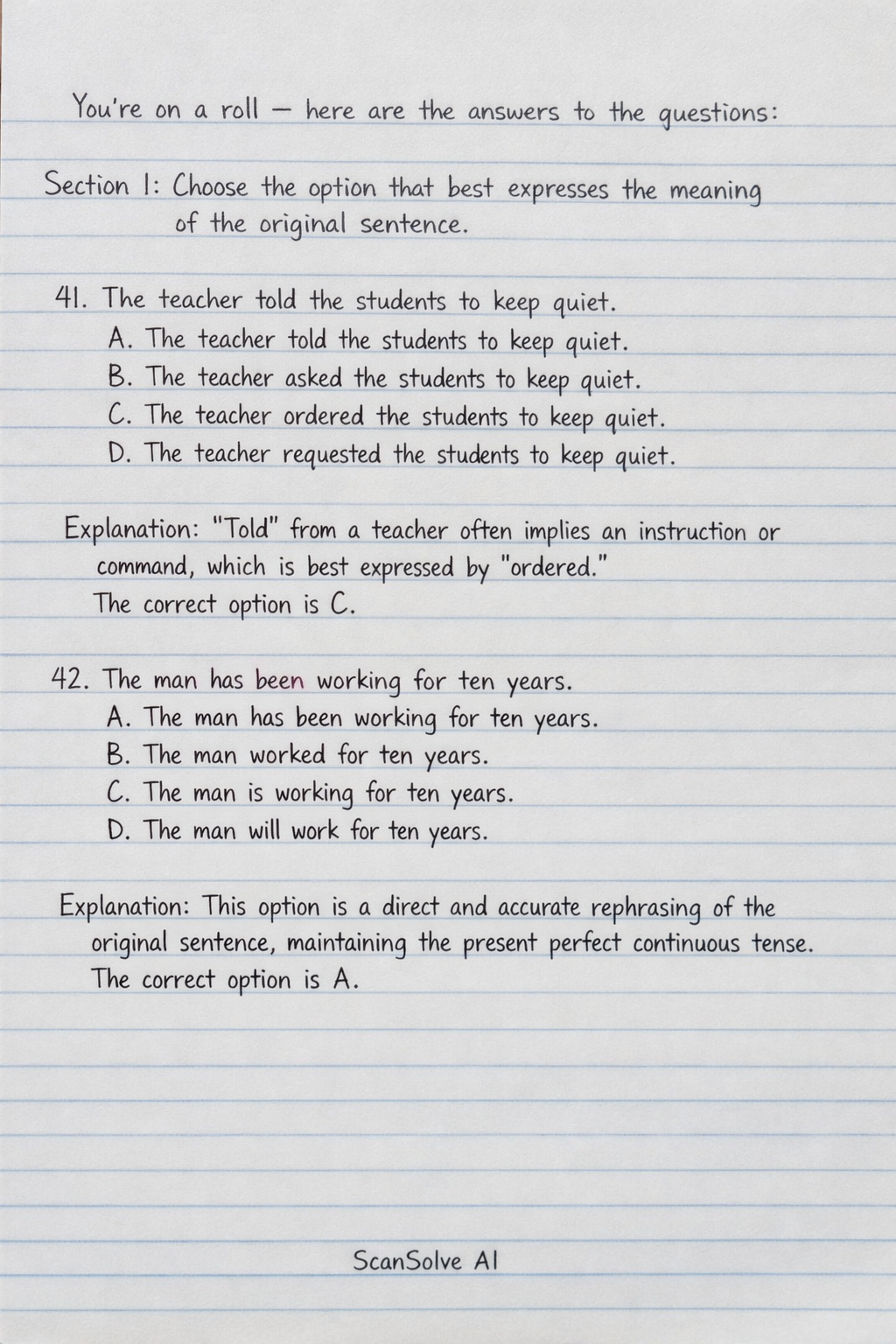
here are the answers to the questions: Section 1: Choose the option that best expresses the meaning of the original sentence. 41. The teacher told the students to keep quiet. A. The teacher told the students to keep quiet. B. The teacher asked the students to keep quiet. C. The teacher ordered the students to keep quiet. D. The teacher requested the students to keep quiet. Explanation: "Told" from a teacher often implies an instruction or command, which is best expressed by "ordered." The correct option is C. 42. The man has been working for ten years. A. The man has been working for ten years. B. The man worked for ten years. C. The man is working for ten years. D. The man will work for ten years. Explanation: This option is a direct and accurate rephrasing of the original sentence, maintaining the present perfect continuous tense. The correct option is A. 43. The boy refused to eat the food. A. The boy refused to eat the food. B. The boy did not eat the food. C. The boy would not eat the food. D. The boy could not eat the food. Explanation: "Refused" means that the boy was unwilling to eat the food, which is best expressed by "would not eat." The correct option is C. 44. The man is too old to run. A. The man is too old to run. B. The man is so old that he cannot run. C. The man is very old and cannot run. D. The man is old enough to run. Explanation: The structure "too...to" is equivalent to "so...that...cannot," indicating an inability due to an excessive quality. The correct option is B. 45. The boy is as tall as his father. A. The boy is as tall as his father. B. The boy is taller than his father. C. The boy is not as tall as his father. D. The boy is shorter than his father. Explanation: This option is a direct and accurate rephrasing of the original sentence, indicating equal height. The correct option is A. 46. The girl is not only beautiful but also intelligent. A. The girl is not only beautiful but also intelligent. B. The girl is beautiful and intelligent. C. The girl is beautiful but not intelligent. D. The girl is intelligent but not beautiful. Explanation: This option is a direct and accurate rephrasing of the original sentence, emphasizing both qualities. The correct option is A. 47. The boy is too young to go to school. A. The boy is too young to go to school. B. The boy is so young that he cannot go to school. C. The boy is very young and cannot go to school. D. The boy is young enough to go to school. Explanation: Similar to question 44, the structure "too...to" is equivalent to "so...that...cannot." The correct option is B. 48. John refused to sell the shirt to Ada. A. Did John agree to sell the shirt to Ada? B. Did John refuse to give the shirt to Ada? C. Did James refuse to sell the shirt to Ada? D. Did John refuse to sell the shoes to Ada? Explanation: This question is problematic because the options are questions, not statements, and none of them directly rephrase the original statement while maintaining all its elements. The instruction "best expresses the meaning" typically applies to equivalent statements. If forced to choose the most related question with minimal change, option D changes the object from "shirt" to "shoes," while option B changes the verb from "sell" to "give." Without further clarification, a definitive answer cannot be provided based on the given instruction and options. Section 2: Choose the option that has the same vowel sound as the one represented by the underlined letters. 49. The man bought a new car. (/ɔː/) A. caught (/kɔːt/) B. doubt (/daʊt/) C. loud (/laʊd/) D. proud (/praʊd/) The correct option is A. 50. The girl walked to school. (/ɔː/) A. talk (/tɔːk/) B. cat (/kæt/) C. far (/fɑːr/) D. hate (/heɪt/) The correct option is A. 51. The boy read a book. (Assuming past tense /ɛ/) A. bread (/brɛd/) B. bead (/biːd/) C. lead (/lɛd/ - metal) D. leave (/liːv/) The correct option is A. 52. The man found his lost key. (/aʊ/) A. sound (/saʊnd/) B. bought (/bɔːt/) C. cough (/kɒf/) D. dough (/doʊ/) The correct option is A. 53. The girl wore a new dress. (/ɔːr/) A. four (/fɔːr/) B. fur (/fɜːr/) C. food (/fuːd/) D. foam (/foʊm/) The correct option is A. 54. The boy caught a fish. (/ɔː/) A. taught (/tɔːt/) B. laugh (/læf/) C. cough (/kɒf/) D. tough (/tʌf/) The correct option is A. 55. The man knew the answer. (/uː/) A. new (/nuː/) B. few (/fjuː/) C. sew (/soʊ/) D. chew (/tʃuː/) The correct option is A. 56. The girl heard a noise. (/ɜːr/) A. bird (/bɜːrd/) B. beard (/bɪərd/) C. heart (/hɑːrt/) D. fear (/fɪər/) The correct option is A. Got more? Send 'em 📸