
Please solve the questions in English
ScanSolve AI Answer
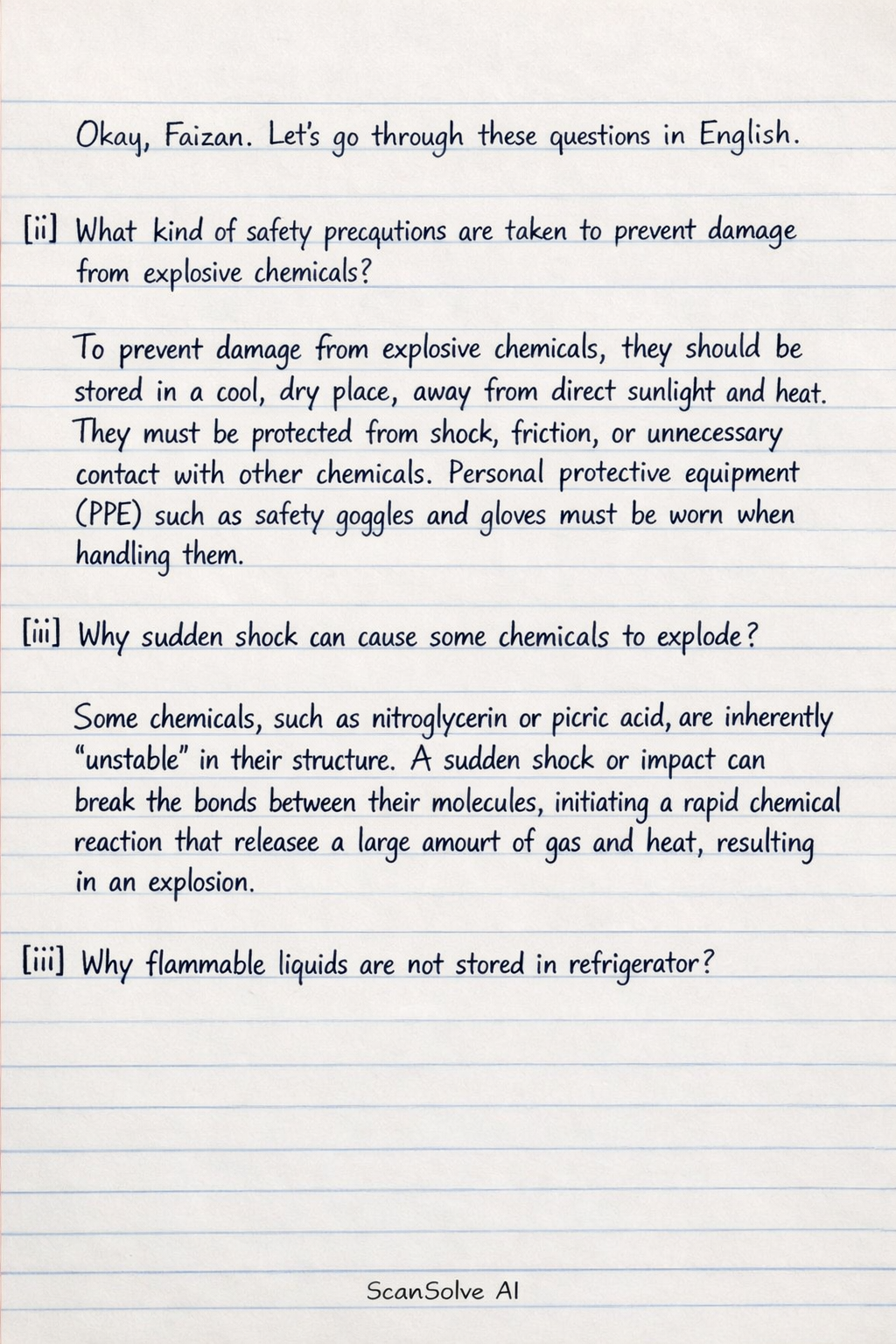
Okay, Faizan. Let's go through these questions in English.
[i] What kind of safety precautions are taken to prevent damage from explosive chemicals?
To prevent damage from explosive chemicals, they should be stored in a cool, dry place, away from direct sunlight and heat. They must be protected from shock, friction, or unnecessary contact with other chemicals. Personal protective equipment (PPE) such as safety goggles and gloves must be worn when handling them.
[ii] Why sudden shock can cause some chemicals to explode?
Some chemicals, such as nitroglycerin or picric acid, are inherently unstable in their structure. A sudden shock or impact can break the bonds between their molecules, initiating a rapid chemical reaction that releases a large amount of gas and heat, resulting in an explosion.
[iii] Why flammable liquids are not stored in refrigerator?
Flammable liquids are not stored in refrigerators because many refrigerators contain internal electrical components that can produce sparks. If vapors from the flammable liquid accumulate inside the refrigerator, these sparks can ignite the vapors, causing a fire or explosion.
[iv] Can you wear contact lenses in the lab?
It is generally not recommended to wear contact lenses in the lab. Chemical splashes can get trapped under the lenses and cause severe eye damage. In an emergency, removing the lenses can be difficult, delaying immediate eye flushing.
[v] Under which circumstances explosive chemicals are likely to explode?
Explosive chemicals are likely to explode under the following circumstances:
- Heat: Exposure to high temperatures.
- Shock or Friction: Sudden impact or rubbing.
- Fire: Exposure to flames or sparks.
- Incompatibility with other chemicals: Mixing with incompatible substances.
- Unstable storage: Storing under conditions that degrade their stability over time.
[vi] How will you dispose off acid and alkali waste after the experiment is finished?
Before disposing of acid and alkali waste, they must be carefully neutralized. Acids are slowly neutralized with an alkali, and alkalis with an acid, until the pH reaches 7. Afterwards, the neutralized solution can be flushed down the drain with a large amount of water, or disposed of according to local regulations.
[vii] Name some corrosive chemicals.
Some corrosive chemicals include:
- Sulfuric acid ()
- Hydrochloric acid ()
- Sodium hydroxide ()
- Potassium hydroxide ()
- Nitric acid ()
[viii] Why sudden shock can cause some chemicals to explode?
Some chemicals, such as nitroglycerin or picric acid, are inherently unstable in their structure. A sudden shock or impact can break the bonds between their molecules, initiating a rapid chemical reaction that releases a large amount of gas and heat, resulting in an explosion.
Still stuck on this one?
Ask a follow-up, and the answer starts from this question.
More English Questions
Handwritten Step-by-Step Solution
Get this as a handwritten image on WhatsApp — like a tutor wrote it for you.
Try on WhatsApp