

This English question involves literary analysis, grammar, or writing skills. The detailed response below provides a well-structured answer with supporting evidence and clear explanations.
ScanSolve AI Answer
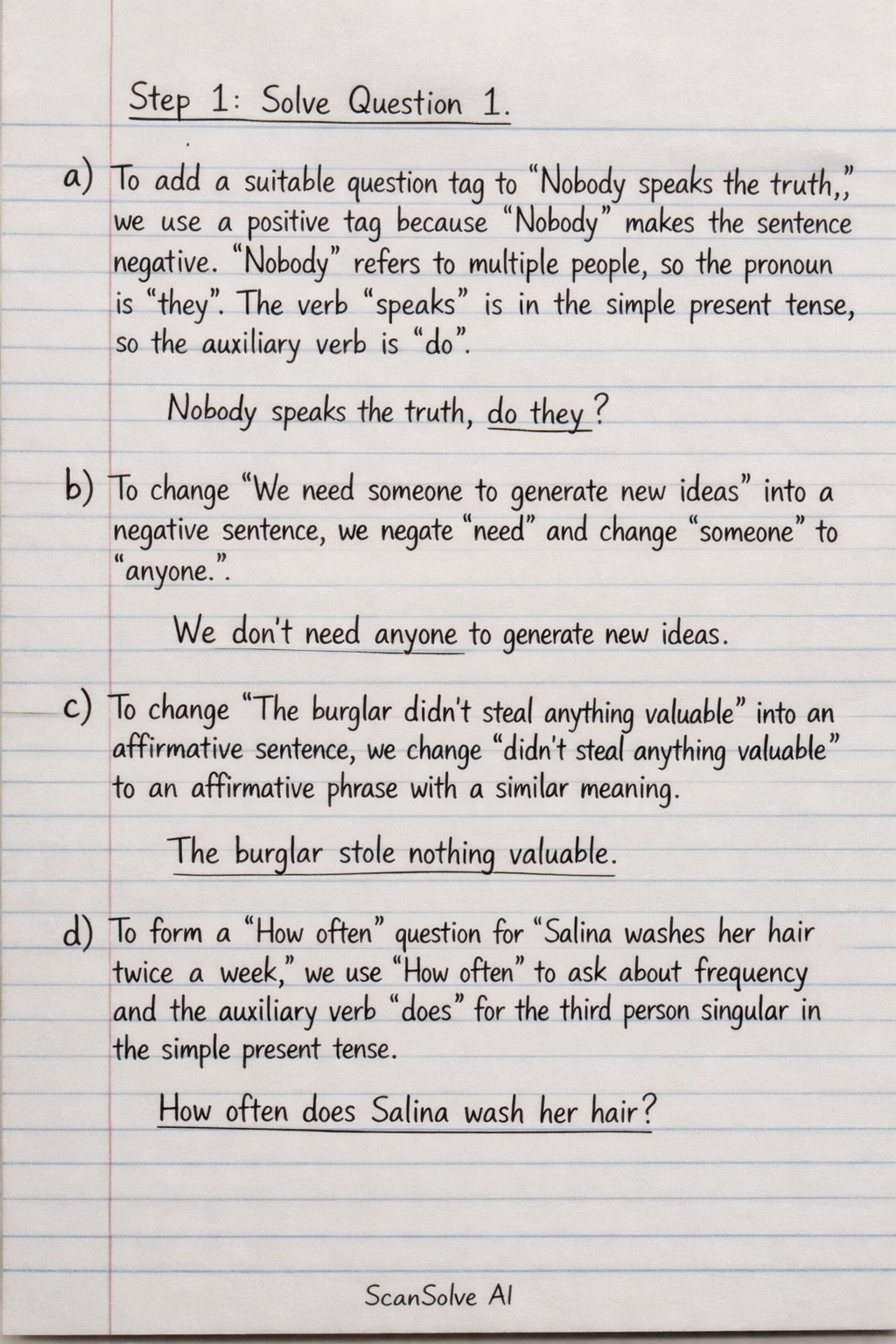
Step 1: Solve Question 1. a)* To add a suitable question tag to "Nobody speaks the truth", we use a positive tag because "Nobody" makes the sentence negative. "Nobody" refers to multiple people, so the pronoun is "they". The verb "speaks" is in the simple present tense, so the auxiliary verb is "do". Nobody speaks the truth, do they*? b)* To change "We need someone to generate new ideas" into a negative sentence, we negate "need" and change "someone" to "anyone". We don't need anyone* to generate new ideas. c)* To change "The burglar didn't steal anything valuable" into an affirmative sentence, we change "didn't steal anything valuable" to an affirmative phrase with a similar meaning. The burglar stole nothing valuable*. d)* To form a 'How often' question for "Salina washes her hair twice a week", we use "How often" to ask about frequency and the auxiliary verb "does" for the third person singular in the simple present tense. How often does Salina wash her hair*? e)* To change "Amit does not buy old books" into the simple future tense, we replace "does not buy" with the future negative form. Amit will not buy* old books. Step 2: Solve Question 2. "Did you hear about Sera? She got a small part in a film recently, didn't she*?" (The statement "She got a small part" is past simple affirmative, so the tag is negative past simple.) "The accident got her right arm broken* and got cut and bruises all over." (The past participle "broken" describes the state of the arm.) "She said with herself, "I am lucky* I didn't break my neck!"" (Sera is referring to herself.) "The director was sorry because he didn't want* this scene in the film." ("didn't" is followed by the base form of the verb.) "Sera wouldn't go to see herself at the cinema if she had known* it earlier." (This is a third conditional sentence, requiring the past perfect in the 'if' clause.) Step 3: Solve Question 3, Part A. The text provides the following chronological information about Daniel Defoe: "Daniel Defoe was born in London in 1660." (b) "...spent many years of his young life studying religion and later travelling as a merchant." (a) "...around 1690, his business failed and he fell into debt." (c) "...Defoe turned to fiction writing." (d) "His first novel written in 1719..." (e) The correct chronological order is: b) Defoe was born in London.* a) He travelled widely.* c) In 1690, his business failed.* d) He turned to fiction writing.* e) His first novel was written in 1719.* Step 4: Solve Question 3, Part B. a) What did Daniel do in early life?* According to the text: "He was not very educated and spent many years of his young life studying religion and later travelling as a merchant." He studied religion and travelled as a merchant.* b) What did he do after hopeless political writing?* According to the text: "But his political writing brought only troubles and increasing debts. So, Defoe turned to fiction writing." He turned to fiction writing.* c) When did he write his first novel?* According to the text: "His first novel written in 1719..." In 1719.* d) Name any two novels written by Crusoe.* The question likely contains a typo and meant "novels written by Defoe", as Robinson Crusoe is a character and a novel title, not an author. The text mentions Defoe wrote "Robinson Crusoe", "Moll Flanders", and "Colonel Jack". Robinson Crusoe and Moll Flanders*.