
We read your photo as:
Rewrite the sentences using the indicated grammatical forms: (1) replacing 'can' with a modal of compulsion (2) forming a rhetorical question.
ScanSolve AI Answer
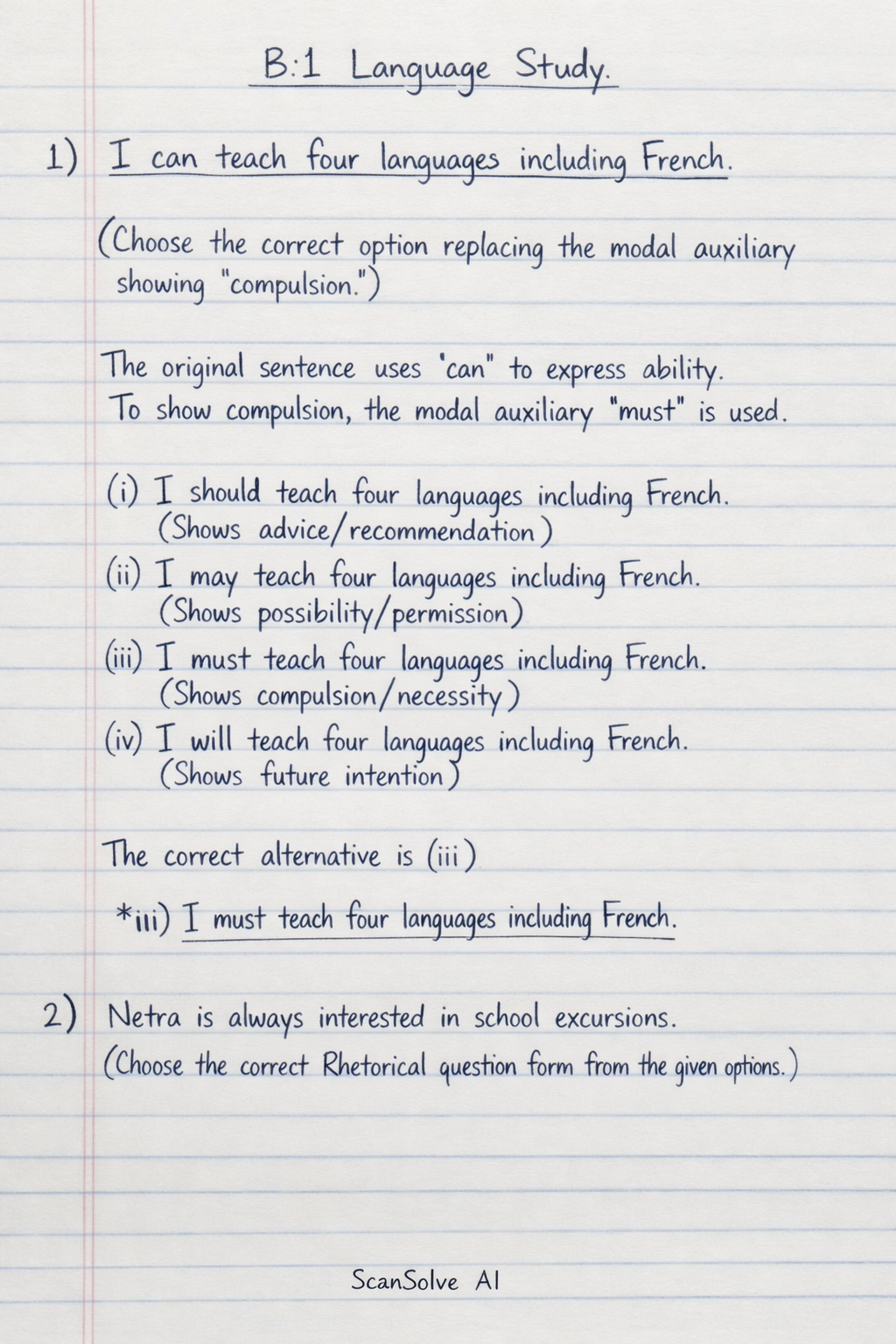
B.1 Language Study.
- I can teach four languages including French. (Choose the correct option replacing the modal auxiliary showing 'compulsion.')
The original sentence uses "can" to express ability. To show compulsion, the modal auxiliary "must" is used.
- (i) I should teach four languages including French. (Shows advice/recommendation)
- (ii) I may teach four languages including French. (Shows possibility/permission)
- (iii) I must teach four languages including French. (Shows compulsion/necessity)
- (iv) I will teach four languages including French. (Shows future intention)
The correct alternative is iii).
iii) I must teach four languages including French.
- Netra is always interested in school excursions. (Choose the correct Rhetorical question form from the given options.)
A rhetorical question is asked for effect and implies the answer. The original sentence is a positive statement in the present tense. A negative rhetorical question in the present tense best conveys this.
- (i) Hasn't Netra always been interested in school excursions? (Present perfect tense)
- (ii) Is Netra always interested in school excursions? (Direct question, not rhetorical)
- (iii) Was Netra always interested in school excursions? (Direct question, past tense)
- (iv) Isn't Netra always interested in school excursions? (Rhetorical question, present tense, implying "Yes, she is.")
The correct alternative is iv).
iv) Isn't Netra always interested in school excursions?
- There are many people who had a desire to speak 'Correct' English. (Choose the correct simple sentence form of the sentence from the given below.)
A simple sentence contains only one independent clause. The original sentence is complex due to the relative clause "who had a desire to speak 'Correct' English." We need to simplify it while retaining the core meaning.
- (i) There are many people who have a desire to speak 'Correct' English. (Still a complex sentence)
- (ii) Many people have a desire to speak 'Correct' English. (This is a simple sentence. It maintains the idea of "many people" and "desire to speak 'Correct' English." While the tense shifts from "had" to "have," it is the most appropriate simple sentence among the choices as options (iii) and (iv) significantly alter the meaning by changing the quantity.)
- (iii) Very few people had a desire to speak 'Correct' English. (Changes "many" to "very few," altering the meaning)
- (iv) Some people will have a desire to speak 'Correct' English. (Changes "many" to "some" and the tense to future, altering the meaning)
The correct alternative is ii).
ii) Many people have a desire to speak 'Correct' English.
Still stuck on this one?
Ask a follow-up, and the answer starts from this question.
More English Questions
Handwritten Step-by-Step Solution
Get this as a handwritten image on WhatsApp — like a tutor wrote it for you.
Try on WhatsApp