
We read your photo as:
S & Y Faith Academy Grade 6 4th Period English Test. Part I: Fill in the blank spaces. Part II: True or False. Part III: Composition (Essay).
ScanSolve AI Answer
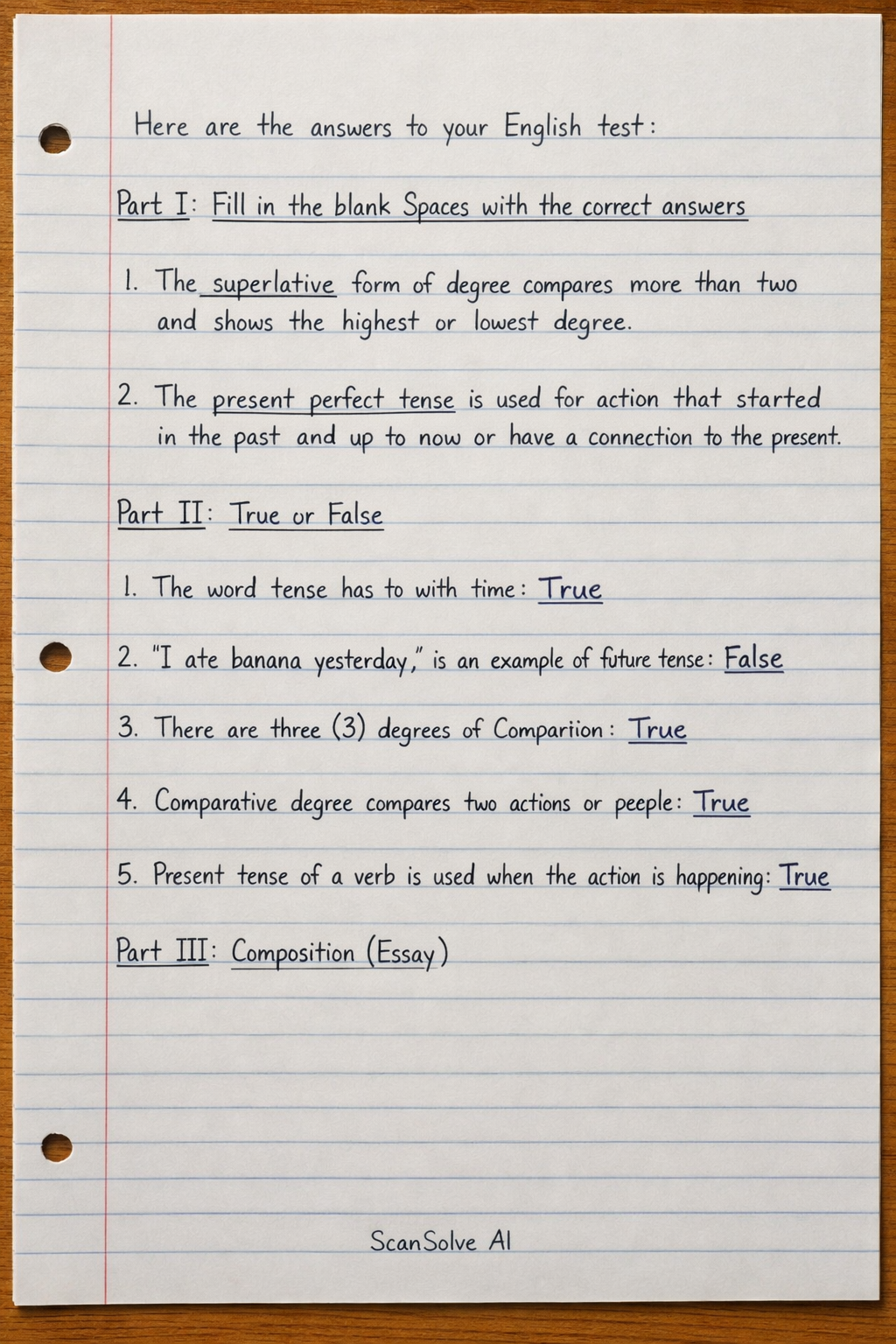
Here are the answers to your English test:
Part I: Fill in the blank Spaces with the correct answers
- The superlative form of degree compares more than two and shows the highest or lowest degree.
- The present perfect tense is used for action that started in the past and up to now or have a connection to the present.
Part II: True or False
- The word tense has to with time: True
- I ate banana yesterday, is an example of future tense: False
- There are three (3) degrees of Comparison: True
- Comparative degree compares two actions or people: True
- Present tense of a verb is used when the action is happening: True
Part III: Composition (Essay)
-
Define comparative and superlative degree with two examples.
- The comparative degree is used to compare two nouns or pronouns, showing which one has more or less of a particular quality.
- Example 1: "My car is faster than yours."
- Example 2: "This book is more interesting than that one."
- The superlative degree is used to compare three or more nouns or pronouns, indicating which one has the most or least of a particular quality among the group.
- Example 1: "She is the tallest student in the class."
- Example 2: "This is the most difficult problem on the test."
- The comparative degree is used to compare two nouns or pronouns, showing which one has more or less of a particular quality.
-
Explain what the tense of a verb does to the reader? The tense of a verb tells the reader when an action or state occurred. It helps the reader understand the timeline of events, indicating whether something happened in the past, is happening now, or will happen in the future. This provides crucial context for the narrative or information being conveyed.
-
Discuss the following a. present, past and future tense with two examples.
- Present Tense: Describes actions happening now, habitual actions, or general truths.
- Example 1: "She reads a book every night."
- Example 2: "The sun shines brightly today."
- Past Tense: Describes actions that happened and were completed at a specific time in the past.
- Example 1: "They visited Paris last year."
- Example 2: "I finished my homework an hour ago."
- Future Tense: Describes actions that will happen at some point in the future.
- Example 1: "We will go to the beach tomorrow."
- Example 2: "He is going to start a new job next week."
- Present Tense: Describes actions happening now, habitual actions, or general truths.
-
Write the positive, comparative and superlative form for the followings: Well, little, and Much.
- Well (adverb) / Good (adjective):
- Positive: good / well
- Comparative: better
- Superlative: best
- Little:
- Positive: little
- Comparative: less
- Superlative: least
- Much:
- Positive: much
- Comparative: more
- Superlative: most
- Well (adverb) / Good (adjective):
Still stuck on this one?
Ask a follow-up, and the answer starts from this question.
More English Questions
Handwritten Step-by-Step Solution
Get this as a handwritten image on WhatsApp — like a tutor wrote it for you.
Try on WhatsApp