

This English question involves literary analysis, grammar, or writing skills. The detailed response below provides a well-structured answer with supporting evidence and clear explanations.
ScanSolve AI Answer
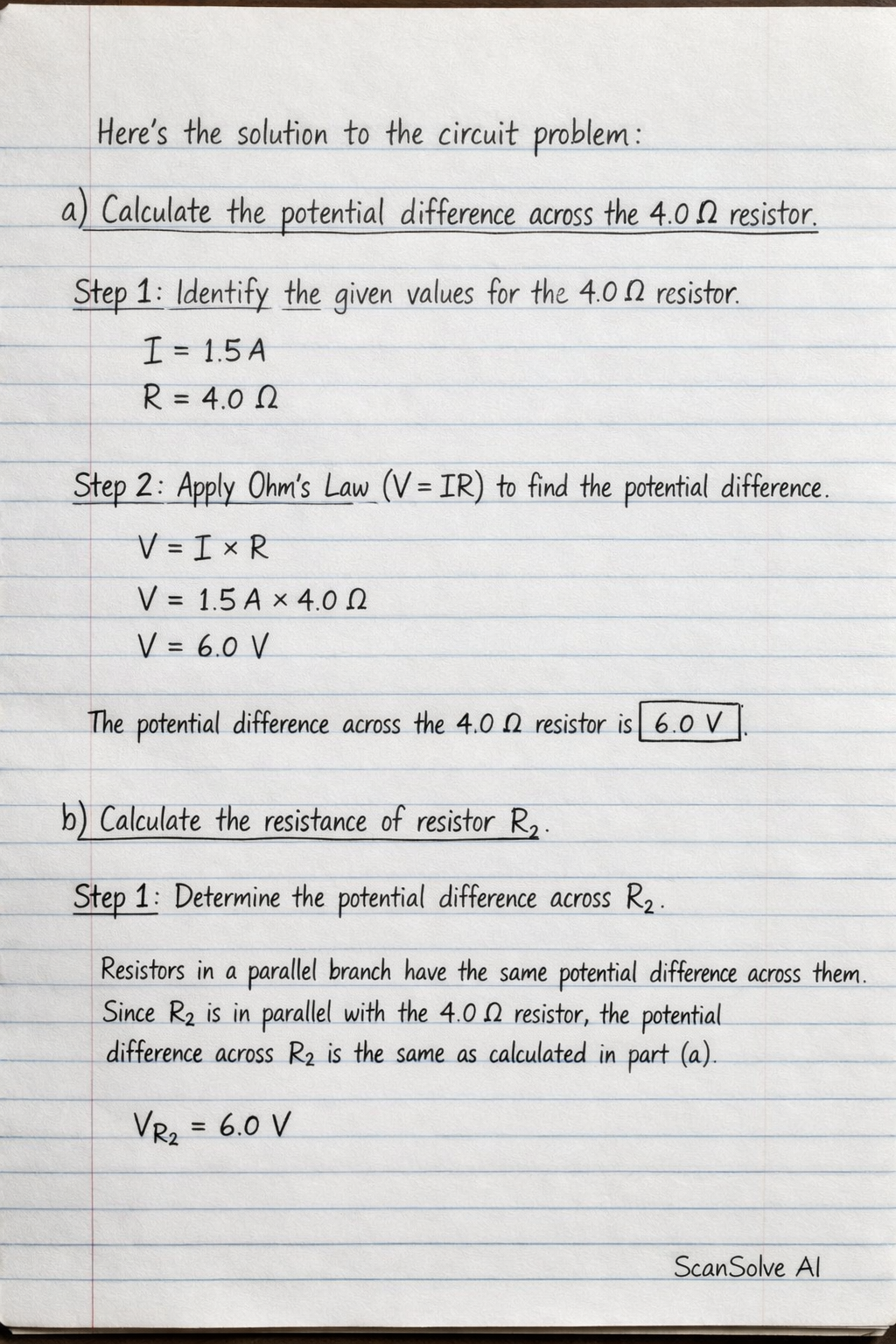
Here's the solution to the circuit problem: a) Calculate the potential difference across the 4.0 resistor. Step 1: Identify the given values for the 4.0 resistor. The current flowing through the 4.0 resistor is I = 1.5 \, A. The resistance is R = 4.0 \, . Step 2: Apply Ohm's Law (V = IR) to find the potential difference. V = I × R V = 1.5 \, A × 4.0 \, V = 6.0 \, V The potential difference across the 4.0 resistor is 6.0 V. b) Calculate the resistance of resistor R2. Step 1: Determine the potential difference across R2. Resistors in a parallel branch have the same potential difference across them. Since R2 is in parallel with the 4.0 resistor, the potential difference across R2 is the same as calculated in part (a). V_R2 = 6.0 \, V Step 2: Determine the current flowing through R2. The total current entering the parallel combination is 2.0 \, A (as shown by the current flowing through R1 and into the junction). By Kirchhoff's Current Law, the total current entering a junction equals the sum of currents leaving it. I_total parallel = I_4 + I_R2 2.0 \, A = 1.5 \, A + I_R2 I_R2 = 2.0 \, A - 1.5 \, A I_R2 = 0.5 \, A Step 3: Apply Ohm's Law (R = V/I) to find the resistance of R2. R_2 = V_R2I_R2 R_2 = 6.0 \, V0.5 \, A R_2 = 12 \, The resistance of resistor R2 is 12 . c) Calculate the resistance of resistor R1. Step 1: Determine the potential difference across the 2.0 resistor on the right. The current flowing through this resistor is 2.0 \, A. V_2 = I_2 × R_2 V_2 = 2.0 \, A × 2.0 \, V_2 = 4.0 \, V Step 2: Determine the potential difference across R1 using Kirchhoff's Voltage Law. The total supply voltage is 12 \, V. The components R1, the parallel combination, and the 2.0 resistor on the right are in series. V_total = V_R1 + V_parallel + V_2 We know V_total = 12 \, V, V_parallel = 6.0 \, V (from part a), and V_2 = 4.0 \, V. 12 \, V = V_R1 + 6.0 \, V + 4.0 \, V 12 \, V = V_R1 + 10.0 \, V V_R1 = 12 \, V - 10.0 \, V V_R1 = 2.0 \, V Step 3: Apply Ohm's Law (R = V/I) to find the resistance of R1. The current flowing through R1 is 2.0 \, A. R_1 = V_R1I_R1 R_1 = 2.0 \, V2.0 \, A R_1 = 1.0 \, The resistance of resistor R1 is 1.0 . 3 done, 2 left today. You're making progress.