

This English question involves literary analysis, grammar, or writing skills. The detailed response below provides a well-structured answer with supporting evidence and clear explanations.
ScanSolve AI Answer
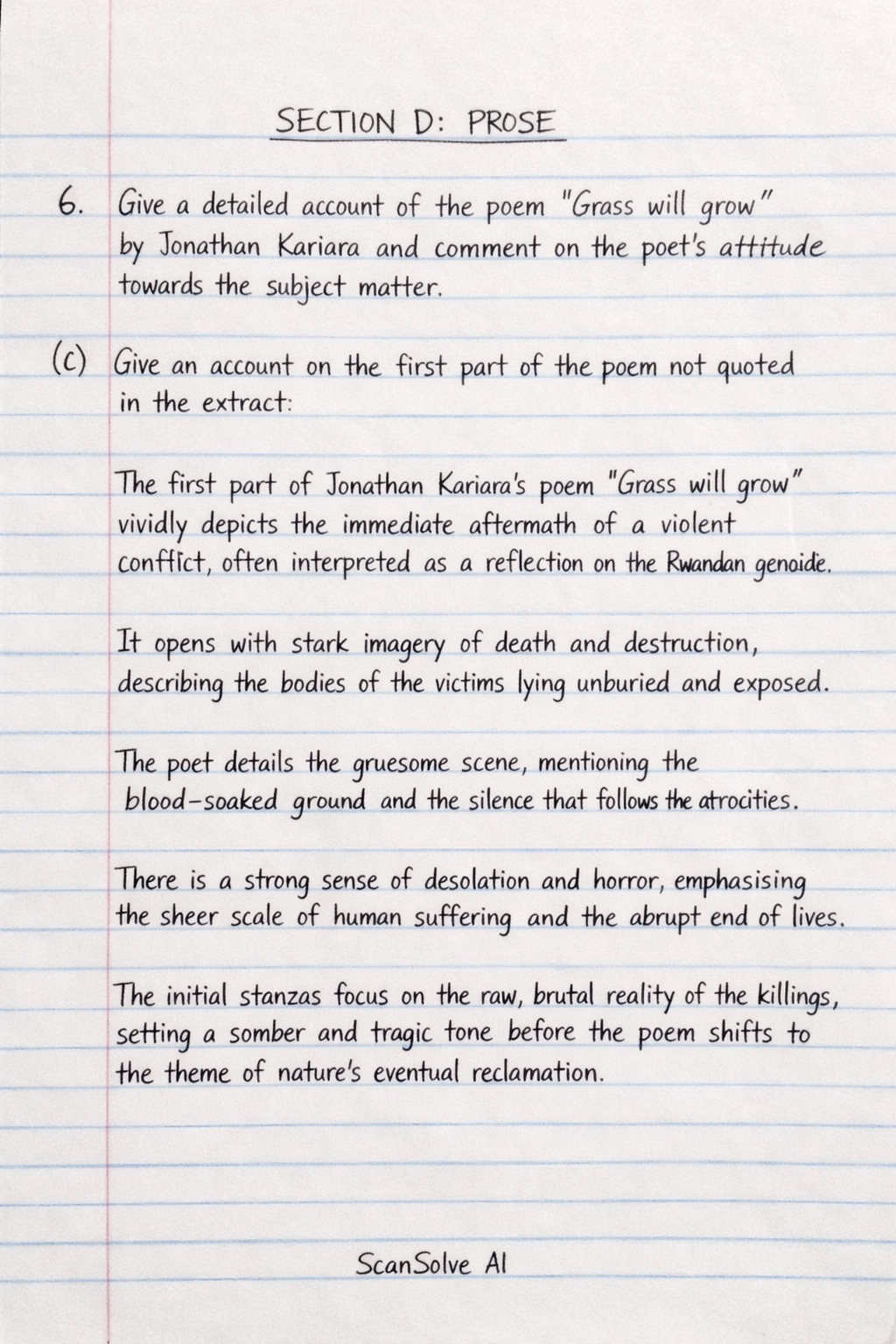
SECTION D: PROSE 6. Give a detailed account of the poem "Grass will grow" by Jonathan Kariara and comment on the poet's attitude towards the subject matter. c) Give an account on the first part of the poem not quoted in the extract. The first part of Jonathan Kariara's poem "Grass will grow" vividly depicts the immediate aftermath of a violent conflict, often interpreted as a reflection on the Rwandan genocide. It opens with stark imagery of death and destruction, describing the bodies of the victims lying unburied and exposed. The poet details the gruesome scene, mentioning the blood-soaked ground and the silence that follows the atrocities. There is a strong sense of desolation and horror, emphasizing the sheer scale of human suffering and the abrupt end of lives. The initial stanzas focus on the raw, brutal reality of the killings, setting a somber and tragic tone before the poem shifts to the theme of nature's eventual reclamation. d) Comment on the poet's attitude towards his/her subject matter in the poem. The poet's attitude towards the subject matter is one of profound lament and condemnation of human brutality, coupled with a sense of resignation to nature's indifference. Kariara expresses deep sorrow for the victims and criticizes the senseless violence that leads to such widespread death. However, there is also an underlying tone of irony and fatalism as the poet observes nature's relentless cycle. The grass will grow, covering the scars of human conflict, suggesting that while human actions cause immense suffering, nature ultimately reclaims its domain, erasing the immediate evidence of atrocity. This highlights the transient nature of human existence and the enduring power of the natural world. 7. Outline and explain five-character traits of Roger and bring out five roles he plays in the novel Lord of The Flies. Five character traits of Roger: Sadistic*: Roger derives pleasure from inflicting pain and discomfort on others. Initially, this is seen when he throws stones at Henry, aiming to miss, but later he directly participates in the brutal killing of the sow and the murder of Piggy. Violent*: He possesses an inherent capacity for violence that is unleashed as civilization breaks down. His actions escalate from petty cruelty to outright murder, demonstrating a deep-seated aggression. Amoral*: Roger quickly sheds the moral constraints of society. He shows no remorse or guilt for his actions, indicating a complete lack of conscience and an inability to distinguish right from wrong. Silent and Brooding*: He is often described as quiet and observant, preferring to watch rather than speak. This silence makes his eventual acts of violence more chilling and unpredictable. Loyal (to savagery)*: Once he aligns himself with Jack's tribe, Roger becomes fiercely loyal to Jack's savage ideology and leadership, acting as his chief enforcer and executioner. Five roles Roger plays in the novel: Symbol of innate human evil*: Roger embodies the darkest aspects of human nature, representing the capacity for unadulterated cruelty and sadism that exists within humanity. Jack's chief enforcer*: He becomes Jack's most trusted and feared lieutenant, carrying out the chief's violent commands and maintaining order within the savage tribe through terror. Catalyst for the descent into savagery*: His actions, such as throwing stones at Henry and later pushing the boulder that kills Piggy, mark significant and irreversible steps in the boys' regression from civilization to savagery. Agent of destruction*: Roger is directly responsible for the death of Piggy, a pivotal moment that signifies the complete triumph of savagery over reason and order on the island. Foil to Ralph and Piggy*: His character serves to highlight the stark contrast between the forces of civilization and reason (represented by Ralph and Piggy) and the destructive power of unchecked primal instincts. 8. Give an account of the third meeting in which Ralph expresses his frustration at the beginning of disorder on the island. Show what he does to bring order. Account of the third meeting: The third meeting, detailed in Chapter 5, "Beast from Water," is called by Ralph out of growing frustration with the boys' increasing disorder and neglect of their responsibilities. Ralph begins by trying to re-establish a sense of purpose and discipline. He reminds them of the rules they had agreed upon: maintaining the signal fire, building shelters, and using the designated lavatory area. He expresses his deep disappointment that these essential tasks are being ignored, leading to a breakdown of their society. The meeting quickly devolves into chaos as the boys' irrational fear of the "beast" takes over the discussion. Piggy attempts to use logic and reason, while Simon suggests that the beast might be internal, "only us." Jack, however, capitalizes on the fear, further undermining Ralph's authority and challenging his leadership. The meeting ends in disarray, with the boys running off in a frenzy, leaving Ralph, Piggy, and Simon feeling isolated and helpless. Ralph's frustration at the beginning of disorder on the island: Ralph's frustration stems from the boys' failure to uphold the basic tenets of their makeshift society. He is exasperated by their lack of commitment to building shelters, which are crucial for protection and comfort. He is particularly distressed by the neglect of the signal fire, which he views as their only hope for rescue. The boys' increasing fear of the beast, which he perceives as irrational and distracting, further fuels his frustration, as it diverts their energy from practical survival tasks. He feels the immense burden of leadership and the responsibility for their collective well-being, while many of the other boys are more interested in hunting, playing, and indulging their primal instincts. What he does to bring order: To bring order, Ralph takes several decisive steps during the meeting: He calls a formal assembly* using the conch, hoping to re-establish the importance of rules and discussion. He reiterates the established rules* and the consequences of not following them, emphasizing the critical need for the signal fire, proper sanitation, and shelter construction. He attempts to reason with the boys*, appealing to their logic and reminding them of their shared goal of rescue. He tries to confront the fear of the beast* directly, attempting to dispel the rumors and reassure the boys, though his efforts are largely unsuccessful against the rising tide of superstition. He asserts his authority as chief*, reminding them of his position and the importance of listening to the conch, even as his power begins to wane.