
We read your photo as:
Short answer English mein
ScanSolve AI Answer
Step-by-step solution
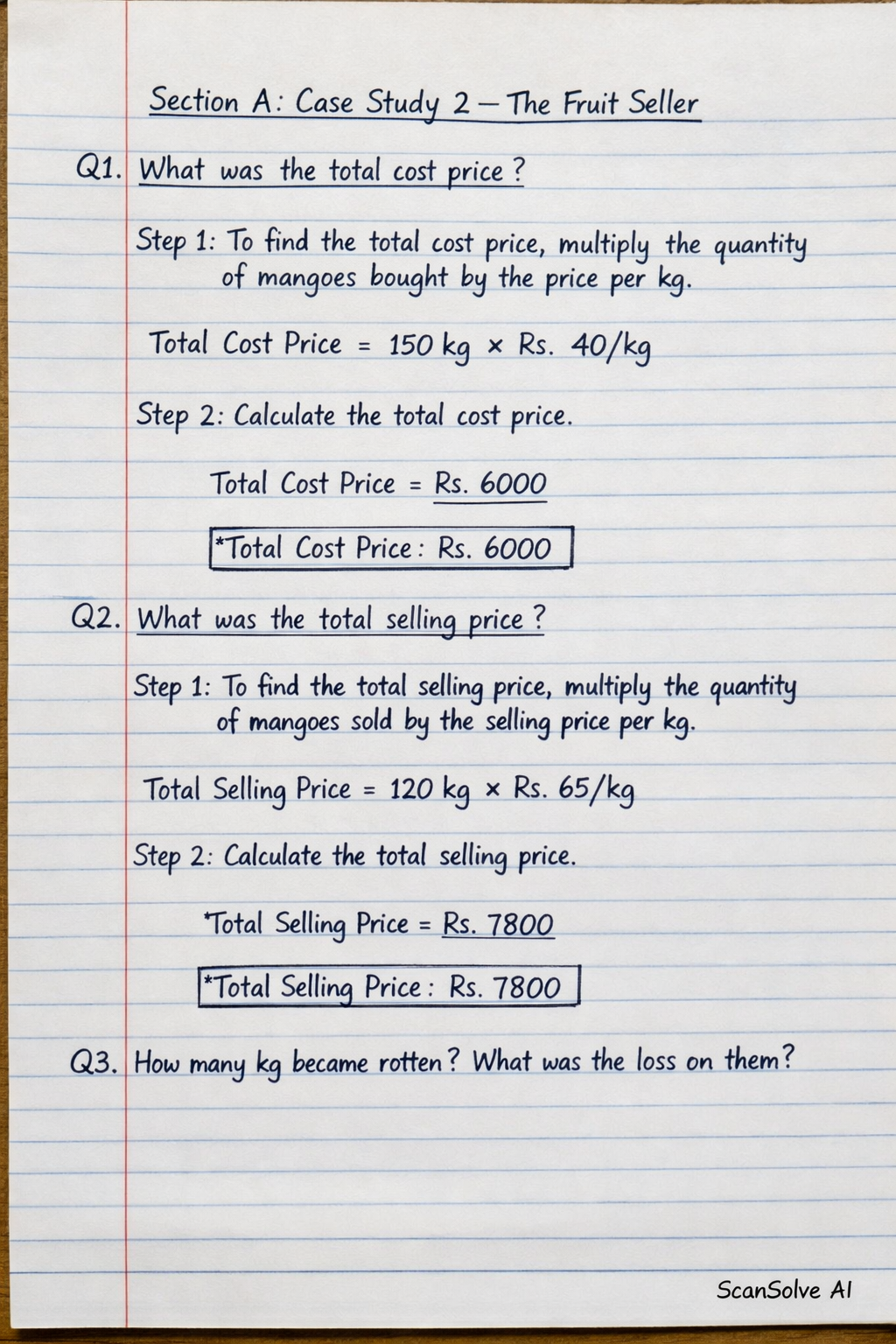
22 stepsSection A: Case Study 2 – The Fruit Seller
Q1. What was the total cost price?
To find the total cost price, multiply the quantity of mangoes bought by the price per kg.
Calculate the total cost price.
Total Cost Price:
Q2. What was the total selling price?
To find the total selling price, multiply the quantity of mangoes sold by the selling price per kg.
Calculate the total selling price.
Total Selling Price:
Q3. How many kg became rotten? What was the loss on them?
To find the quantity of rotten mangoes, subtract the quantity sold from the total quantity bought.
To calculate the loss on the rotten mangoes, multiply the quantity of rotten mangoes by the cost price per kg.
Rotten quantity:
Loss on them:Q4. Did the seller make a net profit or loss? How much?
To find the net profit or loss, subtract the total cost price from the total selling price.
Calculate the difference.
Since the result is positive, the seller made a profit.
Seller made a:
How much:Section B: Case Study 3 – Water Tank
Q1. How much water was used in total?
To find the total water used, multiply the number of families by the amount of water each family used.
Calculate the total water used.
Total water used:
Q2. How much water is left in the tank?
To find the water left in the tank, subtract the total water used from the total water filled.
Calculate the remaining water.
Water left in the tank:
Q3. If a 5th family needs 200 litres, is there enough water? Explain.
Compare the water left in the tank (1150 litres) with the requirement of the 5th family (200 litres).
Conclude based on the comparison.
Since the water left in the tank (1150 litres) is more than the 5th family's requirement (200 litres), there is enough water.
Is there enough water:
Explanation: There are of water left in the tank, which is more than the needed.Section C: Case Study 4 – Savings
Q1. How much does Meena spend monthly?
To find Meena's total monthly spending, add up all her expenses.
Calculate the total monthly spending.
Meena's monthly spending:
Q2. How much does she save monthly?
To find Meena's monthly savings, subtract her total monthly spending from her monthly income.
Calculate the monthly savings.
Meena's monthly savings:
Q3. How much will she save in 6 months?
To find her savings in 6 months, multiply her monthly savings by 6.
Calculate the total savings.
Savings in 6 months:
Q4. If she wants to buy a phone for Rs 12,000, after how many months can she afford it?
To find the number of months required to buy the phone, divide the cost of the phone by her monthly savings.
Calculate the number of months and round up, as she needs to save for full months.
Since the number of months must be a whole number, she will need 4 months to afford the phone.
Months to afford it:
Still stuck on this one?
Ask a follow-up, and the answer starts from this question.
More English Questions
Handwritten Step-by-Step Solution
Get this as a handwritten image on WhatsApp — like a tutor wrote it for you.
Try on WhatsApp