
We read your photo as:
What statement is specifically implied in the passage.
ScanSolve AI Answer
Step-by-step solution
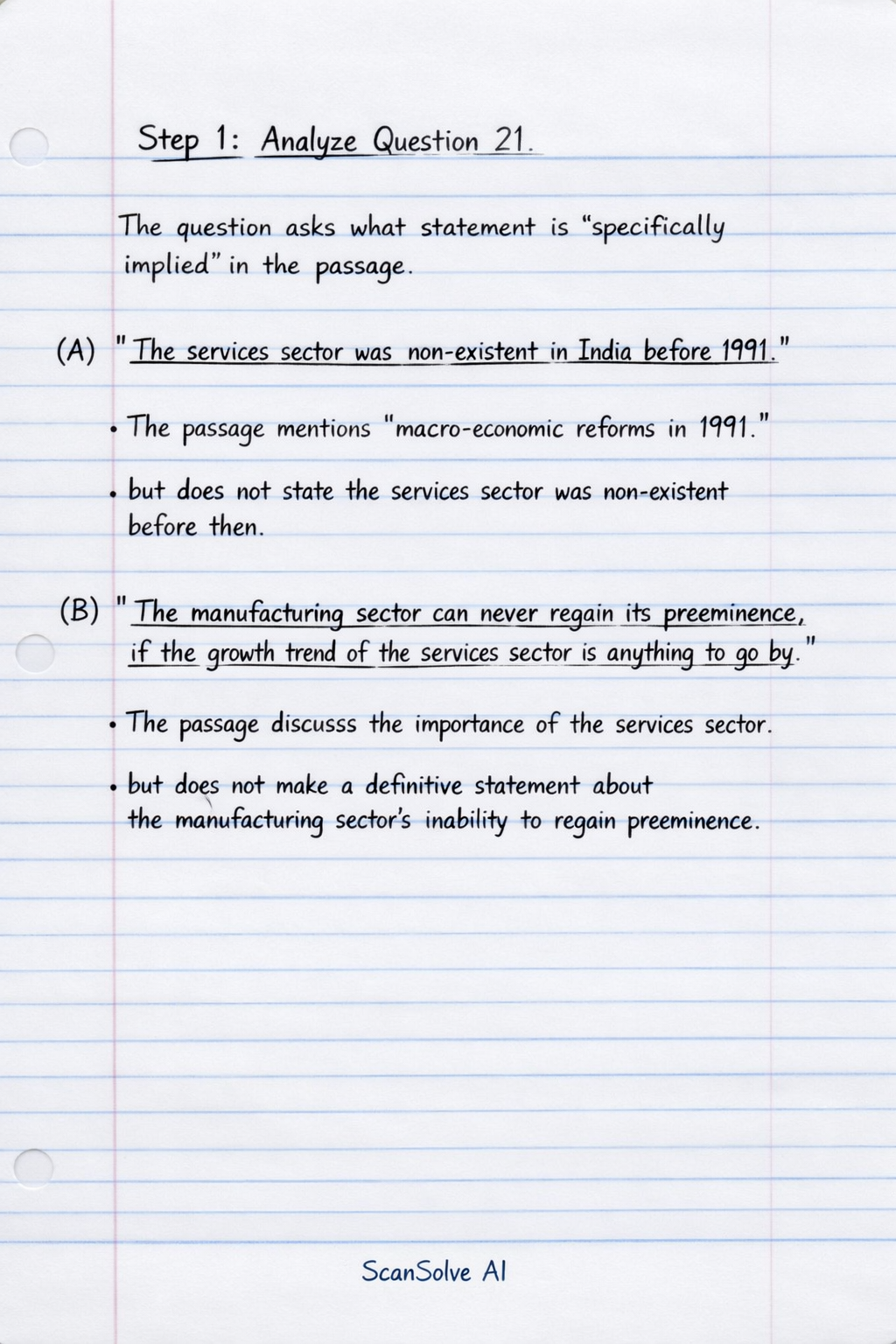
5 stepsAnalyze Question 21.
The question asks what statement is specifically implied in the passage.
- (A) "The services sector was non-existent in India before 1991." The passage mentions "macro-economic reforms in 1991" but does not state the services sector was non-existent before then.
- (B) "The manufacturing sector can never regain its preeminence, if the growth trend of the services sector is anything to go by." The passage discusses the importance of the services sector but does not make a definitive statement about the manufacturing sector's inability to regain preeminence.
- (C) "Micro-economic reforms kick in growth of the economy while macro-economic reforms ensure stability." The passage states, "It carried out successful macro-economic reforms in 1991, and stable monetary and fiscal policies continue to serve it well to this day. However, achieving the goal of a developed India by 2047 requires stepping up the rate of economic growth... This requires deep reform at the micro-economic level." This implies both are important, but not that one only kicks in growth and the other only ensures stability.
- (D) "Regulatory mechanisms could end up stifling economic growth if these are not reviewed and refined periodically." The passage states, "The prevailing bureaucratic attitude of regulators towards business remains one of distrust. This bureaucratic attitude needs to be transformed into one of trust. Essentially, India is once again at a 1991-like moment... energising the domestic economy by removing regulatory cholesterol is a powerful internal lever it can pull." This strongly implies that current regulations (regulatory cholesterol) are stifling growth and need to be reviewed/reformed.
Therefore, option (D) is the most directly implied statement.
The final answer is
Analyze Question 22.
The question asks for a substitute for the word "cahoots" in the context of the passage. The word "cahoots" is not present in the provided text. Assuming it refers to a word that might have been in a previous part of the passage or is a typo for a word that is in the passage. Given the options, "cahoots" typically means conspiring or secretly working together.
Let's re-examine the passage for any word that might fit the context of the options. The passage discusses "bureaucratic attitude of regulators towards business remains one of distrust" and "removing regulatory cholesterol." This suggests issues with how regulators and businesses interact.
If "cahoots" were present, it would imply a secret, often illicit, partnership.
- (A) "Without the knowledge of" - This is the opposite of being in cahoots.
- (B) "Secretly from within the office of" - This aligns with the idea of secret dealings, often implying an insider's involvement.
- (C) "Collusion" - This is a synonym for cahoots, meaning secret cooperation or conspiracy.
- (D) "Unequal partnerships" - While partnerships can be unequal, "cahoots" specifically implies secrecy and often illicit intent, not just inequality.
Given the options, "Collusion" is the closest synonym for "cahoots." However, since the word "cahoots" is not in the visible text, there might be an error in the question or the provided text. If we assume the question intends to ask for a synonym of "cahoots" in a general sense, then "Collusion" is the best fit. If the question refers to a specific word in the passage that is not "cahoots," then this question cannot be answered accurately without that word.
Assuming "cahoots" is the intended word and we are looking for its synonym:
- Collusion means secret or illegal cooperation or conspiracy, especially in order to cheat or deceive others. This is the most direct synonym for "cahoots."
The final answer is
Analyze Question 23.
The question asks what can be inferred from the passage.
- (A) "India is the only country in the world whose service sector is larger than the manufacturing sector." The passage states, "India is once again at a 1991-like moment... energising the domestic economy by removing regulatory cholesterol is a powerful internal lever it can pull." It emphasizes India's situation but does not claim it's the only country with a larger service sector.
- (B) "gig workers are integral to the growth of the Indian economy and need governmental protection as much as full-time employees, if not more." The passage begins, "Given India's demographic dividend, we cannot wish away gig work, which offers significant opportunities for India's burgeoning workforce. Regulation that recognises the rights and dignity of workers — whether gig or full-time — is essential." This directly supports the idea that gig workers are integral and need protection.
- (C) "if not for the service sector, the Indian economy would have remained stagnant after 1991." The passage highlights the importance of the service sector but doesn't explicitly state that the economy would have been stagnant without it. It mentions "successful macro-economic reforms in 1991" and "stable monetary and fiscal policies" as contributing factors.
- (D) "India is the only country in the world whose service sector is growing faster than the manufacturing sector." Similar to (A), the passage focuses on India's growth but does not make a comparative claim about it being the only country.
Therefore, option (B) is the most directly inferable statement from the passage.
The final answer is
Analyze Question 24.
The question asks what statement is true about the outcomes of global trade wars as per the passage.
The passage states: "achieving the goal of a developed India by 2047 requires stepping up the rate of economic growth to at least 8% annually and sustaining it at that level, even as it is rowing against strong external headwinds created by global trade wars."
This means global trade wars create "strong external headwinds" for India's economic growth.- (A) "These cause unfavourable economic environments only for the countries involved in such wars." The passage implies India, which may not be directly "involved" in starting the wars, is affected. The word "only" makes this too restrictive.
- (B) "These create an unfavourable economic environment only for the weaker of the countries involved in the war." Again, "only" makes this too restrictive, and it doesn't align with India facing "external headwinds."
- (C) "Today India is simultaneously facing unfavourable weather conditions as well as economic conditions caused by trade wars." The passage mentions "strong external headwinds created by global trade wars" but does not mention "unfavourable weather conditions."
- (D) "India could be equipped to overcome the ill effects of external economic disturbances through refinement of internal economic policies." The passage states, "This requires deep reform at the micro-economic level... energising the domestic economy by removing regulatory cholesterol is a powerful internal lever it can pull." This implies that internal policy changes can help India navigate external challenges like trade wars.
Therefore, option (D) is the most accurate statement about how India can deal with the outcomes of global trade wars, as implied by the passage's focus on internal reforms to counter external headwinds.
The final answer is
Analyze Question 25.
The question asks what is implied in the passage.
- (A) "before 1980, the manufacturing sector in India was larger than the services sector." The passage mentions 1991 reforms but does not provide data or implications about the relative sizes of sectors before 1980.
- (B) "The growth of the services sector has been so inconspicuous that the government totally ignored it when it comes to imposing regulations." The passage highlights the importance of "gig work" and "regulation that recognises the rights and dignity of workers — whether gig or full-time — is essential." This suggests the government should pay attention to regulating the services sector, implying it might not have adequately done so, but not that its growth was "inconspicuous" or "totally ignored."
- (C) "The government considers only manufacturing as an industry sector." The passage discusses both "gig work" (services) and "macro-economic reforms" (broader economy), not exclusively manufacturing.
- (D) "it is time for the authorities to focus their attention on the services sector and tweak the regulatory norms suitably and adequately." The passage states, "Given India's demographic dividend, we cannot wish away gig work, which offers significant opportunities for India's burgeoning workforce. Regulation that recognises the rights and dignity of workers — whether gig or full-time — is essential." It also mentions "removing regulatory cholesterol." This strongly implies that regulatory attention is needed for the services/gig sector.
Therefore, option (D) is the most directly implied statement.
The final answer is
Still stuck on this one?
Ask a follow-up, and the answer starts from this question.
More English Questions
Handwritten Step-by-Step Solution
Get this as a handwritten image on WhatsApp — like a tutor wrote it for you.
Try on WhatsApp